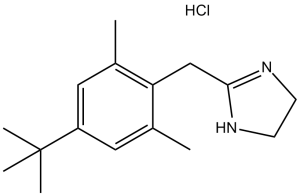
Xylometazoline HCl (xylomethazoline; Otrivine; Amidrin; Balkis; Chlorohist-LA; Decongest; espa-rhin; Gelonasal), the hydrochloride salt of Xylometazoline, is an α-adrenoceptor agonist commonly used as nasal decongestant.shows maximum potency at the α2B-adrenoceptor subtype with EC50 of 99 μM. Xylometazoline, a α-adrenoceptor agonist that is frequently used as a nasal decongestant, has an EC50 of 99 μM and is most potent at the α2B-adrenoceptor subtype. With an IC50 of 0.08, 0.56, 0.45, 0.98, 1.8, and 0.22 μM, respectively, xylometazoline binds at adrenoceptor subtypes α1A, α1B, α1D, α2A, α2B, and α2C.
Physicochemical Properties
| Molecular Formula | C16H25CLN2 |
| Molecular Weight | 280.84 |
| Exact Mass | 280.17 |
| Elemental Analysis | C, 68.43; H, 8.97; Cl, 12.62; N, 9.98 |
| CAS # | 1218-35-5 |
| Related CAS # | Xylometazoline; 526-36-3 |
| PubChem CID | 5709 |
| Appearance | White to off-white crystalline powder |
| Boiling Point | 394.2ºC at 760 mmHg |
| Melting Point | 131-133ºC |
| Flash Point | 192.2ºC |
| Vapour Pressure | 4.56E-06mmHg at 25°C |
| LogP | 3.711 |
| Hydrogen Bond Donor Count | 1 |
| Hydrogen Bond Acceptor Count | 1 |
| Rotatable Bond Count | 3 |
| Heavy Atom Count | 18 |
| Complexity | 302 |
| Defined Atom Stereocenter Count | 0 |
| SMILES | Cl[H].N1([H])C([H])([H])C([H])([H])N=C1C([H])([H])C1C(C([H])([H])[H])=C([H])C(=C([H])C=1C([H])([H])[H])C(C([H])([H])[H])(C([H])([H])[H])C([H])([H])[H] |
| InChi Key | YGWFCQYETHJKNX-UHFFFAOYSA-N |
| InChi Code | InChI=1S/C16H24N2.ClH/c1-11-8-13(16(3,4)5)9-12(2)14(11)10-15-17-6-7-18-15;/h8-9H,6-7,10H2,1-5H3,(H,17,18);1H |
| Chemical Name | 2-[(4-tert-butyl-2,6-dimethylphenyl)methyl]-4,5-dihydro-1H-imidazole;hydrochloride |
| Synonyms | xylomethazoline; Xylometazoline HCl; Brand name: Decongest; Otrivine; Balkis; Amidrin; Chlorohist-LA; espa-rhin; Gelonasal |
| HS Tariff Code | 2934.99.9001 |
| Storage |
Powder-20°C 3 years 4°C 2 years In solvent -80°C 6 months -20°C 1 month Note: Please store this product in a sealed and protected environment, avoid exposure to moisture. |
| Shipping Condition | Room temperature (This product is stable at ambient temperature for a few days during ordinary shipping and time spent in Customs) |
Biological Activity
| Targets | Alpha-1A adrenergic receptor ( Ki = 0.05 μM ); Alpha-1B adrenergic receptor ( Ki = 0.30 μM ); Alpha-1D adrenergic receptor ( Ki = 0.15 μM ); Alpha-2A adrenergic receptor ( Ki = 0.88 μM ); Alpha-2B adrenergic receptor ( Ki = 1.7 μM ); Alpha-2C adrenergic receptor ( Ki = 0.19 μM nM ) | ||
| ln Vitro |
|
||
| ln Vivo |
|
||
| Animal Protocol |
|
||
| ADME/Pharmacokinetics |
Absorption, Distribution and Excretion No information is available on xylometazoline pharmacokinetics. No information is available on xylometazoline pharmacokinetics. No information is available on xylometazoline pharmacokinetics. No information is available on xylometazoline pharmacokinetics. Metabolism / Metabolites No information is available on xylometazoline pharmacokinetics. Biological Half-Life No information is available on xylometazoline pharmacokinetics. |
||
| Toxicity/Toxicokinetics |
Protein Binding No information is available on xylometazoline pharmacokinetics. |
||
| References |
[1]. Fundam Clin Pharmacol . 2010 Dec;24(6):729-39. |
||
| Additional Infomation |
Xylometazoline is an alkylbenzene. Xylometazoline is an imidazoline derivative with sympathomimetic and nasal decongestant activity. Xylometazoline works by binding to alpha (α)-adrenergic receptors to cause vasoconstriction of nasal blood vessels. Xylometazoline is available in over-the-counter (OTC) nasal sprays or drops to temporarily relieve nasal congestion due to cold, hay fever or other respiratory allergies. In some countries, it is available as combination products with [ipratropium], [domiphen], or [dexpanthenol]. See also: Xylometazoline Hydrochloride (has salt form). Drug Indication Xylometazoline is indicated for the temporary relief of nasal congestion due to cold, hay fever or other respiratory allergies. Mechanism of Action Nasal congestion is caused by various etiologies, such as rhinosinusitis and allergic or non-allergic rhinitis, leading to congestion of the venous sinusoids lining the nasal mucosa. Activation of α-adrenergic receptors leads to vasoconstriction of the blood vessels of the nasal mucosa and resumption of nasal airflow. As the most abundantly expressed in the human nasal mucosa, α1A- and α2B-adrenoceptors may play the most important role in vasoconstriction of the human nasal mucosa. Xylometazoline is a more selective agonist at α2B-adrenoceptors, with affinity at α1A-, α2A-, α2C-, α1B-, and α1D-adrenoceptors. Xylometazoline decreases nasal resistance during inspiration and expiration and increases the volume of nasal airflow. Compared to [oxymetazoline], another imidazoline nasal decongestant, xylometazoline had a slightly faster onset of action although they had a similar duration of action. In one study, subjects with nasal congestion reported relief of earache and sore throat in addition to nasal decongestion: it is speculated that oxymetazoline mediates this effect by causing vasoconstriction of the nasal mucosa that contains the venous sinuses and nasal decongestion allows breathing through the nose, providing relief from sore throat caused by mouth breathing that dries and irritates the throat. Pharmacodynamics Xylometazoline is a sympathomimetic agent that causes vasoconstriction of the nasal mucosa. In one study comprising subjects with nasal congestion associated with the common cold, the median time of onset of subjective relief of nasal congestion was about 1.7 minutes and the time of subjective peak relief of nasal congestion was 30 minutes. Previous studies reported rebound swelling, rebound nasal congestion, rhinitis medicamentosa, and shorter duration of decongestant effect from the long-term use of xylometazoline in healthy volunteers, suggesting that the drug is most effective if used temporarily. An early _in vitro_ study demonstrated xylometazoline to exert anti-oxidant actions, where it inhibited microsomal lipid peroxidation and mediated hydroxyl radical scavenging activity. This suggests that xylometazoline has a beneficial effect against oxidants, which play a role in tissue damage in inflammation. |
Solubility Data
| Solubility (In Vitro) |
|
|||
| Solubility (In Vivo) |
Solubility in Formulation 1: ≥ 2.5 mg/mL (8.90 mM) (saturation unknown) in 10% DMSO + 40% PEG300 + 5% Tween80 + 45% Saline (add these co-solvents sequentially from left to right, and one by one), clear solution. For example, if 1 mL of working solution is to be prepared, you can add 100 μL of 25.0 mg/mL clear DMSO stock solution to 400 μL PEG300 and mix evenly; then add 50 μL Tween-80 to the above solution and mix evenly; then add 450 μL normal saline to adjust the volume to 1 mL. Preparation of saline: Dissolve 0.9 g of sodium chloride in 100 mL ddH₂ O to obtain a clear solution. Solubility in Formulation 2: ≥ 2.5 mg/mL (8.90 mM) (saturation unknown) in 10% DMSO + 90% (20% SBE-β-CD in Saline) (add these co-solvents sequentially from left to right, and one by one), clear solution. For example, if 1 mL of working solution is to be prepared, you can add 100 μL of 25.0 mg/mL clear DMSO stock solution to 900 μL of 20% SBE-β-CD physiological saline solution and mix evenly. Preparation of 20% SBE-β-CD in Saline (4°C,1 week): Dissolve 2 g SBE-β-CD in 10 mL saline to obtain a clear solution. Solubility in Formulation 3: ≥ 2.5 mg/mL (8.90 mM) (saturation unknown) in 10% DMSO + 90% Corn Oil (add these co-solvents sequentially from left to right, and one by one), clear solution. For example, if 1 mL of working solution is to be prepared, you can add 100 μL of 25.0 mg/mL clear DMSO stock solution to 900 μL of corn oil and mix evenly. Solubility in Formulation 4: 16.67 mg/mL (59.36 mM) in PBS (add these co-solvents sequentially from left to right, and one by one), clear solution; with ultrasonication. (Please use freshly prepared in vivo formulations for optimal results.) |
| Preparing Stock Solutions | 1 mg | 5 mg | 10 mg | |
| 1 mM | 3.5607 mL | 17.8037 mL | 35.6075 mL | |
| 5 mM | 0.7121 mL | 3.5607 mL | 7.1215 mL | |
| 10 mM | 0.3561 mL | 1.7804 mL | 3.5607 mL |