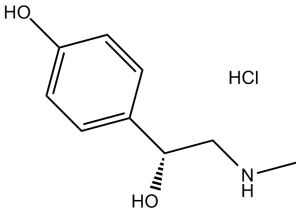
Synephrine HCl (Sympatol; oxedrine), the hydrochloride salt of synephrine which is a naturally occuring protoalkaloid extracted from bitter orange and other citrus species, is commonly used for weight loss. Synephrine has also been widely used as an alternative to ephedrine. Products that contain synephrine or bitter orange may cause negative cardiovascular reactions. Regardless of insulin-stimulated PI3 kinase-Akt activity in L6 skeletal muscle cells, synephrine can promote glucose consumption (Glut4-dependent glucose uptake) by upregulating AMPK activity.
Physicochemical Properties
| Molecular Formula | C9H14CLNO2 | |
| Molecular Weight | 203.67 | |
| Exact Mass | 203.071 | |
| Elemental Analysis | C, 53.08; H, 6.93; Cl, 17.41; N, 6.88; O, 15.71 | |
| CAS # | 5985-28-4 | |
| Related CAS # | Synephrine; 94-07-5; Synephrine hemitartrate; 16589-24-5 | |
| PubChem CID | 42609626 | |
| Appearance | White to off-white solid powder | |
| Boiling Point | 341.1ºC at 760 mmHg | |
| Melting Point | 147-150ºC | |
| Flash Point | 163.4ºC | |
| LogP | 1.837 | |
| Hydrogen Bond Donor Count | 4 | |
| Hydrogen Bond Acceptor Count | 3 | |
| Rotatable Bond Count | 3 | |
| Heavy Atom Count | 13 | |
| Complexity | 122 | |
| Defined Atom Stereocenter Count | 0 | |
| SMILES | Cl[H].O([H])C([H])(C1C([H])=C([H])C(=C([H])C=1[H])O[H])C([H])([H])N([H])C([H])([H])[H] |
|
| InChi Key | COTCEGYSNTWJQV-UHFFFAOYSA-N | |
| InChi Code | InChI=1S/C9H13NO2.ClH/c1-10-6-9(12)7-2-4-8(11)5-3-7;/h2-5,9-12H,6H2,1H3;1H | |
| Chemical Name | 4-[1-hydroxy-2-(methylamino)ethyl]phenol;hydrochloride | |
| Synonyms |
|
|
| HS Tariff Code | 2934.99.9001 | |
| Storage |
Powder-20°C 3 years 4°C 2 years In solvent -80°C 6 months -20°C 1 month Note: Please store this product in a sealed and protected environment, avoid exposure to moisture. |
|
| Shipping Condition | Room temperature (This product is stable at ambient temperature for a few days during ordinary shipping and time spent in Customs) |
Biological Activity
| Targets | β adrenergic receptor | ||
| ln Vitro | Synephrine (0.1-30 μM) exhibits strong vasoconstrictive effects on isolated rat aortas in a dose-dependent manner that is significantly inhibited by pretreatment with ketanserin, prazosin, and BRL15572, but not by pretreatment with SB216641 and propranolol. This suggests that synephrine acts via serotonergic 5-HT(1D) receptors, adrenergic alpha(1)-receptors, and adrenergic alpha(1)-receptors.[2] Synephrine is the only partial agonist of the α1A-AR subtype that is stably expressed in HEK 293 cells, with an EC50 of 4 µM and a maximal response at 100 µM equal to 55.3% of the L-phenylephrine maximum, despite the fact that the Ki values of Synephrine, 1R, 2S-norephedrine, and β-phenethylamine are the same for all three subtypes. Synephrine may function as an antagonist rather than an agonist of the pre-synaptic α(2A)- and α(2C)-AR subtypes found in nerve terminals, according to functional studies on the α2A- and α2C-AR subtypes that are stably expressed in CHO cells. However, synephrine's antagonist activity is less than its partial agonist potency.[3] In a dose-dependent manner, synephrine (~100 μM) treatment raises basal glucose consumption over the control by up to 50% without compromising the viability of L6 skeletal muscle cells. When basal or insulin-stimulated lactic acid production and glucose consumption are combined, synephrine dramatically increases both of these processes. In addition, synephrine-induced glucose consumption and the translocation of Glut4 from the cytoplasm to the plasma membrane are responsive to AMPK inhibition but not PI3 kinase inhibition. Synephrine treatment stimulates the phosphorylation of AMPK but not Akt.[4] | ||
| ln Vivo |
|
||
| Animal Protocol |
|
||
| References |
[1]. Jpn J Pharmacol . 2001 Feb;85(2):183-8. [2]. J Pharmacol Sci . 2009 Sep;111(1):73-81. [3]. Planta Med . 2010 Jul;76(10):981-6. [4]. Biochem Biophys Res Commun . 2012 Feb 24;418(4):720-4. |
Solubility Data
| Solubility (In Vitro) |
|
|||
| Solubility (In Vivo) |
|
| Preparing Stock Solutions | 1 mg | 5 mg | 10 mg | |
| 1 mM | 4.9099 mL | 24.5495 mL | 49.0990 mL | |
| 5 mM | 0.9820 mL | 4.9099 mL | 9.8198 mL | |
| 10 mM | 0.4910 mL | 2.4550 mL | 4.9099 mL |