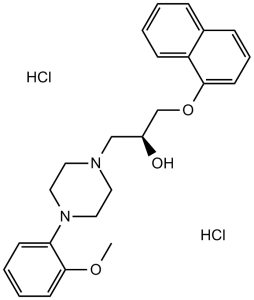
Naftopidil 2HCl (BM-15275; KT-611; BM15275; KT611; Flivas), the dihydrochloride salt of Naftopidil, is a potent and selective α1-adrenergic receptor antagonist with antihypertensive effects. It has a Kis of 3.7 nM, 20 nM, and 1.2 nM for α1a, α1b, and α1d adrenergic receptor inhibition, respectively. Benign prostatic hyperplasia, or BPH, may now be treated with naftopidil. When compared to the alpha1a- and alpha1b-adrenoceptor subtypes, naptopidil has a selectivity for the alpha1d-adrenoceptor that is roughly 3- and 17-fold higher, respectively. In human prostate cancer cell lines that are both androgen-sensitive and -insensitive, naftopidil inhibits the growth of the cells.
Physicochemical Properties
| Molecular Formula | C24H30CL2N2O3 | |
| Molecular Weight | 465.41 | |
| Exact Mass | 392.209 | |
| Elemental Analysis | C, 61.94; H, 6.50; Cl, 15.23; N, 6.02; O, 10.31 | |
| CAS # | 57149-08-3 | |
| Related CAS # | Naftopidil; 57149-07-2; Naftopidil hydrochloride; 1164469-60-6 | |
| PubChem CID | 11957660 | |
| Appearance | Solid powder | |
| Density | 1.2±0.1 g/cm3 | |
| Boiling Point | 602.8±55.0 °C at 760 mmHg | |
| Melting Point | 212-213° | |
| Flash Point | 318.3±31.5 °C | |
| Vapour Pressure | 0.0±1.8 mmHg at 25°C | |
| Index of Refraction | 1.619 | |
| LogP | 4.81 | |
| Hydrogen Bond Donor Count | 3 | |
| Hydrogen Bond Acceptor Count | 5 | |
| Rotatable Bond Count | 7 | |
| Heavy Atom Count | 31 | |
| Complexity | 483 | |
| Defined Atom Stereocenter Count | 0 | |
| SMILES | Cl[H].Cl[H].O([H])C([H])(C([H])([H])OC1=C([H])C([H])=C([H])C2=C([H])C([H])=C([H])C([H])=C12)C([H])([H])N1C([H])([H])C([H])([H])N(C2=C([H])C([H])=C([H])C([H])=C2OC([H])([H])[H])C([H])([H])C1([H])[H] |
|
| InChi Key | HZVCEQMJXMUXJF-UHFFFAOYSA-N | |
| InChi Code | InChI=1S/C24H28N2O3.2ClH/c1-28-24-11-5-4-10-22(24)26-15-13-25(14-16-26)17-20(27)18-29-23-12-6-8-19-7-2-3-9-21(19)23;;/h2-12,20,27H,13-18H2,1H3;2*1H | |
| Chemical Name | 1-[4-(2-methoxyphenyl)piperazin-1-yl]-3-naphthalen-1-yloxypropan-2-ol;dihydrochloride | |
| Synonyms |
|
|
| HS Tariff Code | 2934.99.9001 | |
| Storage |
Powder-20°C 3 years 4°C 2 years In solvent -80°C 6 months -20°C 1 month |
|
| Shipping Condition | Room temperature (This product is stable at ambient temperature for a few days during ordinary shipping and time spent in Customs) |
Biological Activity
| Targets | Alpha-1A adrenergic receptor ( Ki = 3.7 nM ); Alpha-1B adrenergic receptor ( Ki = 20 nM ); Alpha-1D adrenergic receptor ( Ki = 1.2 ) | ||
| ln Vitro |
|
||
| ln Vivo |
|
||
| Cell Assay | Flow cytometry is used to analyze cell cycles. After treating the cells for 24 hours with either 20 μM Naftopidil (LNCaP), 40 μM Naftopidil (PC-3), or vehicle (0.1% DMSO), the cells are trypsinized, once again cleaned with phosphate-buffer saline (PBS), fixed in 70% ethanol, and kept at 4 °C for the purpose of cell cycle analysis. After fixed cells are rinsed with PBS, they are incubated for 30 minutes at 37 °C in PBS containing 20 μg/mL RNaseA and 0.3% NP-40. Afterwards, they are stained for 30 minutes at 4 홈 in the dark with 50 μg/mL propidium iodide (PI). One FACS Caliburflow cytometer is used to analyze the DNA content of one million stained cells. Using Cell Quest software, the fractions of cells in the G0/G1, S, and G2/M phases are computed. | ||
| Animal Protocol |
|
||
| References |
[1]. Eur J Pharmacol . 1991 Nov 19;205(1):105-7. [2]. Int J Cancer . 2008 Jan 15;122(2):444-51. [3]. Br J Clin Pharmacol . 1997 Apr;43(4):415-20. [1]. BJU Int . 2006 Apr;97(4):747-51, discussion 751. [2]. Cancer Prev Res (Phila) . 2011 Jan;4(1):87-96. [3]. Neurosci Lett . 2002 Aug 2;328(1):74-6. [3]. Jpn J Pharmacol . 1999 Apr;79(4):447-54. |
Solubility Data
| Solubility (In Vitro) |
|
|||
| Solubility (In Vivo) |
|
| Preparing Stock Solutions | 1 mg | 5 mg | 10 mg | |
| 1 mM | 2.1486 mL | 10.7432 mL | 21.4864 mL | |
| 5 mM | 0.4297 mL | 2.1486 mL | 4.2973 mL | |
| 10 mM | 0.2149 mL | 1.0743 mL | 2.1486 mL |