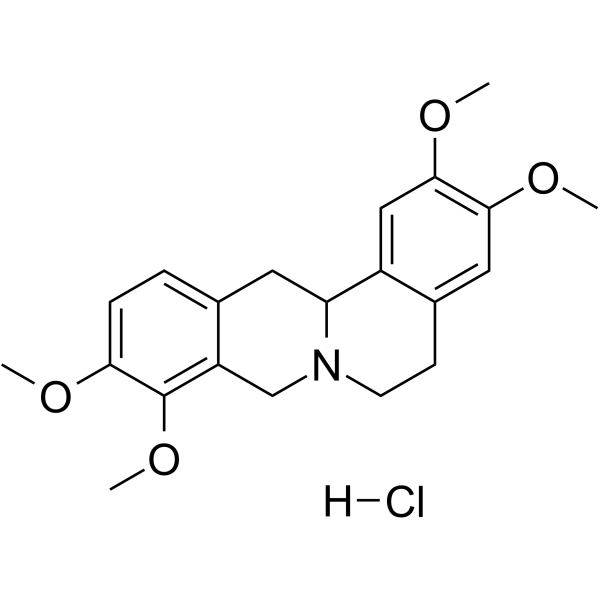
Physicochemical Properties
| Molecular Formula | C21H26CLNO4 |
| Molecular Weight | 391.8884 |
| Exact Mass | 391.155 |
| CAS # | 6024-85-7 |
| Related CAS # | Rotundine; 483-14-7; Tetrahydropalmatine; 2934-97-6 |
| PubChem CID | 6602555 |
| Appearance | White to off-white solid powder |
| Boiling Point | 482.9ºC at 760 mmHg |
| Melting Point | 250-252ºC |
| Flash Point | 138.7ºC |
| LogP | 4.116 |
| Hydrogen Bond Donor Count | 1 |
| Hydrogen Bond Acceptor Count | 5 |
| Rotatable Bond Count | 4 |
| Heavy Atom Count | 27 |
| Complexity | 475 |
| Defined Atom Stereocenter Count | 0 |
| InChi Key | MGSZZQQRTPWMEI-UHFFFAOYSA-N |
| InChi Code | InChI=1S/C21H25NO4.ClH/c1-23-18-6-5-13-9-17-15-11-20(25-3)19(24-2)10-14(15)7-8-22(17)12-16(13)21(18)26-4;/h5-6,10-11,17H,7-9,12H2,1-4H3;1H |
| Chemical Name | 2,3,9,10-tetramethoxy-6,8,13,13a-tetrahydro-5H-isoquinolino[2,1-b]isoquinoline;hydrochloride |
| Synonyms | Tetrahydropalmatine hydrochloride; DL-Tetrahydropalmatine hydrochloride |
| HS Tariff Code | 2934.99.9001 |
| Storage |
Powder-20°C 3 years 4°C 2 years In solvent -80°C 6 months -20°C 1 month Note: Please store this product in a sealed and protected environment (e.g. under nitrogen), avoid exposure to moisture and light. |
| Shipping Condition | Room temperature (This product is stable at ambient temperature for a few days during ordinary shipping and time spent in Customs) |
Biological Activity
| Targets | Dopamine |
| ln Vitro | Tetrahydropalmatine suppresses the production of COX-2 protein and mRNA induced by LPS in a dose-dependent manner. It specifically inhibits the ERK1=2 and p38 MAPK signaling pathways and suppresses activation of the NF-kB signaling pathway, which regulates the expression of IL-8[1]. By downregulating XIAP protein and inhibiting MDM2 linked to a proteasome-dependent pathway, L-THP causes p53 independent apoptosis. It also increases the susceptibility of EU-4 cells to doxorubicin. Apoptosis is the result of caspase activation caused by L-THP[2]. Voltage-sensitive Ca2+ channels and dopamine D1 and D2 receptors are both blocked by l-THP[3]. |
| ln Vivo | l-THP may reduce the effects of oxycodone on the locomotor system and prevent the emergence and manifestation of oxycodone behavioral sensitization[3]. |
| Cell Assay | The MTT assay measures cell viability. THP-1 cells are essentially seeded in 96-well plates at a density of 5×10⁴ cells/mL. There is a control group in every batch of cells that has not received treatment. Each well is then filled with tetrahydropalmatine (0.2, 1, or 2 mM) and LPS (2 mg/mL). The plates are then incubated for 24 hours at 37°C with 5% CO2 in the air. Samples are cultivated for an additional 4 hours after MTT solutions (5 mg/mL) are added to each well. Each well receives 100 mL of dimethylsulfoxide after the supernatant is discarded. The optical density at 590 nm is then measured. |
| Animal Protocol |
Rats: In this study, male Sprague-Dawley rats weighing 250–320 g are employed. The animals live in a room with a controlled temperature of 22±1°C and a 12:12 h light/dark cycle. They have unlimited access to food and water. At 6:00 a.m., the light is turned on, and it turns off at 18:00 a.m. Study is done on at least two major animal groups. (1) Rats given a vehicle treatment got an intraperitoneal injection of 0.9% saline along with 3–4 mg/kg of picrotoxin. (2) Rats treated with tetrahydropalmatine receive an injection of both picrotoxin (3–4 mg/kg, s.c.) and tetrahydropalmatine (10 mg/kg, i.p.). Rats that are not sedated are used to evaluate the effects of intraperitoneal injection (s.c.) of picrotoxin or tetrahydropalmatine on locomotor activity. Conversely, urethane (1.4 g/kg, i.p.) anesthesia is used to evaluate the effects of picrotoxin or tetrahydropalmatine on amygdaloid DA release in rats. Nine groups of eight rats each are created by randomly selecting seventy-two unstimulated rats. The animals are given an injection of saline, tetrahydropalmatine (10 or 15 mg/kg, i.p. ), or picrotoxin (3 or 4 mg/kg, s.c.) after spending 30 minutes getting used to the behavior apparatus. The 30-minute period that follows the injections is then used to record the rats' locomotor activity. |
| References |
[1]. J Med Food . 2010 Oct;13(5):1125-32. [2]. Curr Mol Med . 2017;17(3):236-245. [3]. Acta Pharmacol Sin . 2005 May;26(5):533-8. |
Solubility Data
| Solubility (In Vitro) |
DMSO: 12~25 mg/mL (30.6~63.8 mM) H2O: ~4 mg/mL (~10.2 mM) |
| Solubility (In Vivo) |
Solubility in Formulation 1: 2.5 mg/mL (6.38 mM) in 10% DMSO + 40% PEG300 + 5% Tween80 + 45% Saline (add these co-solvents sequentially from left to right, and one by one), clear solution; with sonication. For example, if 1 mL of working solution is to be prepared, you can add 100 μL of 25.0 mg/mL clear DMSO stock solution to 400 μL PEG300 and mix evenly; then add 50 μL Tween-80 to the above solution and mix evenly; then add 450 μL normal saline to adjust the volume to 1 mL. Preparation of saline: Dissolve 0.9 g of sodium chloride in 100 mL ddH₂ O to obtain a clear solution. Solubility in Formulation 2: ≥ 2.5 mg/mL (6.38 mM) (saturation unknown) in 10% DMSO + 90% (20% SBE-β-CD in Saline) (add these co-solvents sequentially from left to right, and one by one), clear solution. For example, if 1 mL of working solution is to be prepared, you can add 100 μL of 25.0 mg/mL clear DMSO stock solution to 900 μL of 20% SBE-β-CD physiological saline solution and mix evenly. Preparation of 20% SBE-β-CD in Saline (4°C,1 week): Dissolve 2 g SBE-β-CD in 10 mL saline to obtain a clear solution. Solubility in Formulation 3: ≥ 2.5 mg/mL (6.38 mM) (saturation unknown) in 10% DMSO + 90% Corn Oil (add these co-solvents sequentially from left to right, and one by one), clear solution. For example, if 1 mL of working solution is to be prepared, you can add 100 μL of 25.0 mg/mL clear DMSO stock solution to 900 μL of corn oil and mix evenly. (Please use freshly prepared in vivo formulations for optimal results.) |
| Preparing Stock Solutions | 1 mg | 5 mg | 10 mg | |
| 1 mM | 2.5517 mL | 12.7587 mL | 25.5174 mL | |
| 5 mM | 0.5103 mL | 2.5517 mL | 5.1035 mL | |
| 10 mM | 0.2552 mL | 1.2759 mL | 2.5517 mL |