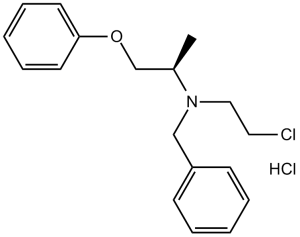
Phenoxybenzamine HCl (formerly NSC-37448; NSC37448; Dibenzyline, NCI-C01661, NCIC01661; NCI-c01661), the hydrochloride salt of Phenoxybenzamine, is a potent, non-specific, irreversible alpha-adrenergic receptor antagonist with antihypertensive effects. Its IC50 of 550 nM indicates that it inhibits the alpha-adrenergic receptor. In particular, hypertension brought on by pheochromocytoma has been treated with phenoxybenzamine. When it comes to other a-blockers, its action starts later and lasts longer. Even though it is rarely used now, it was the first alpha blocker to be used for the treatment of benign prostatic hyperplasia.
Physicochemical Properties
| Molecular Formula | C18H23CL2NO | |
| Molecular Weight | 340.3 | |
| Exact Mass | 339.115 | |
| Elemental Analysis | C, 63.53; H, 6.81; Cl, 20.84; N, 4.12; O, 4.70 | |
| CAS # | 63-92-3 | |
| Related CAS # | Phenoxybenzamine; 59-96-1; Phenoxybenzamine-d5 hydrochloride; 1329838-45-0; Phenoxybenzamine (benzyl-2,3,4,5,6-d5) (hydrochloride); 1398065-71-8 | |
| PubChem CID | 5284441 | |
| Appearance | White to off-white crystalline powder | |
| Boiling Point | 381.5ºC at 760 mmHg | |
| Melting Point | 137.5°C | |
| Flash Point | 184.5ºC | |
| LogP | 4.996 | |
| Hydrogen Bond Donor Count | 1 | |
| Hydrogen Bond Acceptor Count | 2 | |
| Rotatable Bond Count | 8 | |
| Heavy Atom Count | 22 | |
| Complexity | 262 | |
| Defined Atom Stereocenter Count | 0 | |
| SMILES | ClC([H])([H])C([H])([H])N(C([H])([H])C1C([H])=C([H])C([H])=C([H])C=1[H])C([H])(C([H])([H])[H])C([H])([H])OC1C([H])=C([H])C([H])=C([H])C=1[H].Cl[H] |
|
| InChi Key | VBCPVIWPDJVHAN-UHFFFAOYSA-N | |
| InChi Code | InChI=1S/C18H22ClNO.ClH/c1-16(15-21-18-10-6-3-7-11-18)20(13-12-19)14-17-8-4-2-5-9-17;/h2-11,16H,12-15H2,1H3;1H | |
| Chemical Name | N-benzyl-N-(2-chloroethyl)-1-phenoxypropan-2-amine;hydrochloride | |
| Synonyms |
|
|
| HS Tariff Code | 2934.99.9001 | |
| Storage |
Powder-20°C 3 years 4°C 2 years In solvent -80°C 6 months -20°C 1 month Note: Please store this product in a sealed and protected environment, avoid exposure to moisture. |
|
| Shipping Condition | Room temperature (This product is stable at ambient temperature for a few days during ordinary shipping and time spent in Customs) |
Biological Activity
| Targets | α-adrenoceptor | ||
| ln Vitro |
|
||
| ln Vivo |
|
||
| Cell Assay | Following cytometry, 1x3 cells are seeded in a 96-well plate with 100 μL of DMEM that has been enhanced with 10% FBS. WST-1 (Water Soluble Tetrazolium) is added to cells in ten microliters (10% of the total volume) and incubated for 30 min at 37°C before the colorimetric assay with 450 nm excitation and 630 nm emission at 24 h intervals up to 96 h. The standard curve is used to calculate the cell number after the mean fluorescence value has been counted. | ||
| Animal Protocol |
|
||
| References |
[1]. Urapidil in the preoperative treatment of pheochromocytomas: a safe and cost-effective method. World J Surg. 2013 May;37(5):1141-6. [2]. Anti-tumor activity of phenoxybenzamine hydrochloride on malignant glioma cells. Tumour Biol. 2016 Mar;37(3):2901-8. [3]. Phenoxybenzamine is neuroprotective in a rat model of severe traumatic brain injury. Int J Mol Sci. 2014 Jan 20;15(1):1402-17. |
||
| Additional Infomation |
Phenoxybenzamine Hydrochloride can cause cancer according to an independent committee of scientific and health experts. Phenoxybenzamine hydrochloride is a white crystalline powder. Melting point 137.5-140 °C. Used as an antihypertensive drug. Phenoxybenzamine hydrochloride is an organic molecular entity. Phenoxybenzamine Hydrochloride is the hydrochloride salt form of phenoxybenzamine, a synthetic, dibenzamine alpha-adrenergic antagonist with antihypertensive and vasodilatory properties. Phenoxybenzamine non-selectively and irreversibly blocks the postsynaptic alpha-adrenergic receptor in smooth muscle, thereby preventing vasoconstriction, relieving vasospasms, and decreasing peripheral resistance. Reflex tachycardia may occur and may be enhanced by blockade of alpha-2 receptors which enhances norepinephrine release. Phenoxybenzamine is reasonably anticipated to be a human carcinogen. An alpha-adrenergic antagonist with long duration of action. It has been used to treat hypertension and as a peripheral vasodilator. See also: Phenoxybenzamine (has active moiety). |
Solubility Data
| Solubility (In Vitro) |
|
|||
| Solubility (In Vivo) |
Solubility in Formulation 1: ≥ 2.5 mg/mL (7.35 mM) (saturation unknown) in 10% DMSO + 40% PEG300 + 5% Tween80 + 45% Saline (add these co-solvents sequentially from left to right, and one by one), clear solution. For example, if 1 mL of working solution is to be prepared, you can add 100 μL of 25.0 mg/mL clear DMSO stock solution to 400 μL PEG300 and mix evenly; then add 50 μL Tween-80 to the above solution and mix evenly; then add 450 μL normal saline to adjust the volume to 1 mL. Preparation of saline: Dissolve 0.9 g of sodium chloride in 100 mL ddH₂ O to obtain a clear solution. Solubility in Formulation 2: ≥ 2.5 mg/mL (7.35 mM) (saturation unknown) in 10% DMSO + 90% (20% SBE-β-CD in Saline) (add these co-solvents sequentially from left to right, and one by one), clear solution. For example, if 1 mL of working solution is to be prepared, you can add 100 μL of 25.0 mg/mL clear DMSO stock solution to 900 μL of 20% SBE-β-CD physiological saline solution and mix evenly. Preparation of 20% SBE-β-CD in Saline (4°C,1 week): Dissolve 2 g SBE-β-CD in 10 mL saline to obtain a clear solution. Solubility in Formulation 3: ≥ 2.5 mg/mL (7.35 mM) (saturation unknown) in 10% DMSO + 90% Corn Oil (add these co-solvents sequentially from left to right, and one by one), clear solution. For example, if 1 mL of working solution is to be prepared, you can add 100 μL of 25.0 mg/mL clear DMSO stock solution to 900 μL of corn oil and mix evenly. (Please use freshly prepared in vivo formulations for optimal results.) |
| Preparing Stock Solutions | 1 mg | 5 mg | 10 mg | |
| 1 mM | 2.9386 mL | 14.6929 mL | 29.3858 mL | |
| 5 mM | 0.5877 mL | 2.9386 mL | 5.8772 mL | |
| 10 mM | 0.2939 mL | 1.4693 mL | 2.9386 mL |