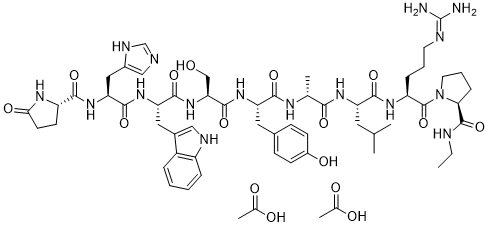
Physicochemical Properties
| Molecular Formula | C60H86N16O16 |
| Molecular Weight | 1287.42 |
| Exact Mass | 1286.64 |
| Elemental Analysis | C, 55.98; H, 6.73; N, 17.41; O, 19.88 |
| CAS # | 79561-22-1 |
| Related CAS # | (Des-Gly10,D-Ala6,Pro-NHEt9)-LHRH; 52435-06-0 |
| PubChem CID | 9855027 |
| Appearance | White to off-white solid powder |
| Density | 1.482 g/cm3 |
| Index of Refraction | 1.694 |
| LogP | -0.5 |
| Hydrogen Bond Donor Count | 15 |
| Hydrogen Bond Acceptor Count | 14 |
| Rotatable Bond Count | 30 |
| Heavy Atom Count | 84 |
| Complexity | 2320 |
| Defined Atom Stereocenter Count | 9 |
| SMILES | C(=O)(O)C.C(C1=CNC2C=CC=CC1=2)[C@@H](C(=O)N[C@@H](CO)C(=O)N[C@H](C(=O)N[C@H](C)C(=O)N[C@@H](CC(C)C)C(=O)N[C@@H](CCCNC(N)=N)C(N1CCC[C@H]1C(=O)NCC)=O)CC1C=CC(O)=CC=1)NC(=O)[C@@H](NC([C@@H]1CCC(=O)N1)=O)CC1NC=NC=1 |
| InChi Key | DPWSRXJWCYEGIV-PFHUABGLSA-N |
| InChi Code | InChI=1S/C56H78N16O12.2C2H4O2/c1-5-60-54(83)45-13-9-21-72(45)55(84)39(12-8-20-61-56(57)58)66-50(79)40(22-30(2)3)67-47(76)31(4)64-49(78)41(23-32-14-16-35(74)17-15-32)68-53(82)44(28-73)71-51(80)42(24-33-26-62-37-11-7-6-10-36(33)37)69-52(81)43(25-34-27-59-29-63-34)70-48(77)38-18-19-46(75)65-38;2*1-2(3)4/h6-7,10-11,14-17,26-27,29-31,38-45,62,73-74H,5,8-9,12-13,18-25,28H2,1-4H3,(H,59,63)(H,60,83)(H,64,78)(H,65,75)(H,66,79)(H,67,76)(H,68,82)(H,69,81)(H,70,77)(H,71,80)(H4,57,58,61);2*1H3,(H,3,4)/t31-,38+,39+,40+,41+,42+,43+,44+,45+;;/m1../s1 |
| Chemical Name | acetic acid;(2S)-N-[(2S)-1-[[(2S)-1-[[(2S)-1-[[(2S)-1-[[(2R)-1-[[(2S)-1-[[(2S)-5-(diaminomethylideneamino)-1-[(2S)-2-(ethylcarbamoyl)pyrrolidin-1-yl]-1-oxopentan-2-yl]amino]-4-methyl-1-oxopentan-2-yl]amino]-1-oxopropan-2-yl]amino]-3-(4-hydroxyphenyl)-1-oxopropan-2-yl]amino]-3-hydroxy-1-oxopropan-2-yl]amino]-3-(1H-indol-3-yl)-1-oxopropan-2-yl]amino]-3-(1H-imidazol-5-yl)-1-oxopropan-2-yl]-5-oxopyrrolidine-2-carboxamide |
| Synonyms | LHRH-A; larelin Acetate; Pyr-His-Trp-Ser-Tyr-D-Ala-Leu-Arg-Pro-NHEt; 6-D-Ala-10-D-gly-LHRH-ethylamide; 6-D-Ala-10-D-gly-LHRH-ethylamide |
| HS Tariff Code | 2934.99.9001 |
| Storage |
Powder-20°C 3 years 4°C 2 years In solvent -80°C 6 months -20°C 1 month Note: Please store this product in a sealed and protected environment, avoid exposure to moisture. |
| Shipping Condition | Room temperature (This product is stable at ambient temperature for a few days during ordinary shipping and time spent in Customs) |
Biological Activity
| ln Vitro | Alarelin considerably reduced the cell viability when compared to when it wasn't present. A concentration of 10-5 M was found to have the greatest stimulatory effect on cell viability, and this effect was dose-dependent[1]. |
| ln Vivo | Alarelin has the ability to directly affect rat parietal cells and also inhibit vagous function, which can both reduce the secretion of gastric acid[2]. Alarelin has the ability to dramatically increase the G1 phase ratio and decrease the S phase ratio in rats' GSMC[1]. |
| Cell Assay | The cells are seeded in a 96-well plate after being trypsinized in a 2.5 g/L trypsin solution. Following a 24-hour growth period to a subconfluent state of about 800 g/L, each well is supplemented with 0.1 mL of a medium containing 2.5% calf serum and varying concentrations (0.001, 0.1, and 10 μM) of alarelin. The wells are then incubated for a full day in a CO2 incubator. At least twelve wells are used to test each concentration. In summary, each well receives 15 μL of MTT solution, which is then incubated for four hours. Once the medium and MTT are taken out, each well receives 150 μL of DMSO, which is added and shaken for 10 minutes to dissolve the crystal. An ELISA reader is used to measure the OD at 490 nm[1]. |
| Animal Protocol | Rats: There are two groups of male Sprague-Dawley rats. Group I: A chambered stomach is used to measure the amount of gastric acid secreted. In short, the abdomen is cut, the stomach and duodemun are exposed and tied, respectively, and 1.5 mL of 0.9% sodium chloride (containing 2 μg/kg of Alarelin) is infused into each of the stomach's chambers. The pH is measured in the ABL-500 after 15, 30, 45, and 60 minutes, respectively, and the gastric juice is extracted from the chambered stomach. Saline is infused in place of alarelin as the control. Group II: Following anesthesia, 2 mL of Alarelin (2 μg/kg) is injected into the vein of the tail. Saline is injected as the control rather than alarelin. After that, the duodenum and stomach are tied off and given an instant 1.5 mL saline infusion. |
| References |
[1]. Expression of gonadotropin-releasing hormone receptor and effect of gonadotropin-releasing hormone analogue on proliferation of cultured gastric smooth muscle cells of rats. World J Gastroenterol. 2004 Jun 15;10(12):1780-4. [2]. Distribution, cloning and sequencing of GnRH, its receptor, and effects of gastric acid secretion of GnRH analogue in gastric parietal cells of rats. Life Sci. 2005 Feb 4;76(12):1351-65. |
| Additional Infomation | See also: LHRH, Ala(6)-Gly(10)-ethylamide- (annotation moved to); Surfagon (annotation moved to). |
Solubility Data
| Solubility (In Vitro) |
DMSO: ~62.5 mg/mL (~48.6 mM) H2O: ~100 mg/mL (~77.7 mM) |
| Solubility (In Vivo) |
Solubility in Formulation 1: ≥ 2.08 mg/mL (1.62 mM) (saturation unknown) in 10% DMSO + 40% PEG300 + 5% Tween80 + 45% Saline (add these co-solvents sequentially from left to right, and one by one), clear solution. For example, if 1 mL of working solution is to be prepared, you can add 100 μL of 20.8 mg/mL clear DMSO stock solution to 400 μL PEG300 and mix evenly; then add 50 μL Tween-80 to the above solution and mix evenly; then add 450 μL normal saline to adjust the volume to 1 mL. Preparation of saline: Dissolve 0.9 g of sodium chloride in 100 mL ddH₂ O to obtain a clear solution. Solubility in Formulation 2: ≥ 2.08 mg/mL (1.62 mM) (saturation unknown) in 10% DMSO + 90% (20% SBE-β-CD in Saline) (add these co-solvents sequentially from left to right, and one by one), clear solution. For example, if 1 mL of working solution is to be prepared, you can add 100 μL of 20.8 mg/mL clear DMSO stock solution to 900 μL of 20% SBE-β-CD physiological saline solution and mix evenly. Preparation of 20% SBE-β-CD in Saline (4°C,1 week): Dissolve 2 g SBE-β-CD in 10 mL saline to obtain a clear solution. Solubility in Formulation 3: ≥ 2.08 mg/mL (1.62 mM) (saturation unknown) in 10% DMSO + 90% Corn Oil (add these co-solvents sequentially from left to right, and one by one), clear solution. For example, if 1 mL of working solution is to be prepared, you can add 100 μL of 20.8 mg/mL clear DMSO stock solution to 900 μL of corn oil and mix evenly. Solubility in Formulation 4: 100 mg/mL (77.67 mM) in PBS (add these co-solvents sequentially from left to right, and one by one), clear solution; with ultrasonication. (Please use freshly prepared in vivo formulations for optimal results.) |
| Preparing Stock Solutions | 1 mg | 5 mg | 10 mg | |
| 1 mM | 0.7767 mL | 3.8837 mL | 7.7675 mL | |
| 5 mM | 0.1553 mL | 0.7767 mL | 1.5535 mL | |
| 10 mM | 0.0777 mL | 0.3884 mL | 0.7767 mL |