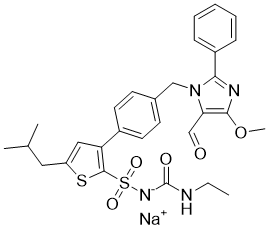
AVE0991 sodium, the sodium salt of AVE-0991, is a novel, orally bioactive non-peptide mimic and high affinity agonist of angiotensin-(1-7) with an IC50 of 21 nM.
Physicochemical Properties
| Molecular Formula | C29H31N4O5S2-.NA+ |
| Molecular Weight | 602.7 |
| Exact Mass | 602.16 |
| Elemental Analysis | C, 57.79; H, 5.18; N, 9.30; Na, 3.81; O, 13.27; S, 10.64 |
| CAS # | 306288-04-0 |
| Related CAS # | AVE 0991; 304462-19-9 |
| PubChem CID | 78357809 |
| Appearance | White to yellow solid powder |
| Hydrogen Bond Donor Count | 1 |
| Hydrogen Bond Acceptor Count | 8 |
| Rotatable Bond Count | 11 |
| Heavy Atom Count | 41 |
| Complexity | 938 |
| Defined Atom Stereocenter Count | 0 |
| InChi Key | GABSTAFOMFJFOI-UHFFFAOYSA-M |
| InChi Code | InChI=1S/C29H32N4O5S2.Na/c1-5-30-29(35)32-40(36,37)28-24(16-23(39-28)15-19(2)3)21-13-11-20(12-14-21)17-33-25(18-34)27(38-4)31-26(33)22-9-7-6-8-10-22;/h6-14,16,18-19H,5,15,17H2,1-4H3,(H2,30,32,35);/q;+1/p-1 |
| Chemical Name | sodium;ethylcarbamoyl-[3-[4-[(5-formyl-4-methoxy-2-phenylimidazol-1-yl)methyl]phenyl]-5-(2-methylpropyl)thiophen-2-yl]sulfonylazanide |
| Synonyms | AVE-0991 sodium salt; AVE 0991; AVE-0991; AVE0991 |
| HS Tariff Code | 2934.99.9001 |
| Storage |
Powder-20°C 3 years 4°C 2 years In solvent -80°C 6 months -20°C 1 month Note: Please store this product in a sealed and protected environment, avoid exposure to moisture. |
| Shipping Condition | Room temperature (This product is stable at ambient temperature for a few days during ordinary shipping and time spent in Customs) |
Biological Activity
| Targets | Ang-(1-7) receptor ( IC50 = 21±35 nM ) |
| ln Vitro | AVE 0991 is a nonpeptide compound that acts on the endothelium in a manner akin to that of Ang-(1-3). The high-affinity binding of [125I]-Ang-(1-7) to bovine aortic endothelial cell membranes is competitive between AVE 0991 and unlabeled Ang-(1–7), with IC50s of 220±280 nM and 21±35 nM, respectively. The release of NO and O2-at peak concentrations by AVE 0991 sodium salt and Ang-(1–7) (both 10 μM) do not differ significantly (NO: 295±20 and 270±25 nM; O2-: 18±2 and 20±4 nM). In contrast to Ang-(1-7)[1], the amount of bioactive NO released by AVE 0991 is approximately five times greater. |
| ln Vivo | AVE 0991 (0.58 nmol/g) results in a significant reduction of water diuresis in WT mice as compared to animals treated with the vehicle (0.06±0.03 mL versus 0.27±0.05; n = 9 for each group; P<0.01). The antidiuretic action of AVE 0991 (AVE) is linked to a rise in urine osmolality (1669±231.0 mOsm/KgH2O) in comparison to 681.1±165.8 mOsm/KgH2O in mice treated with vehicle; P<0.01). When water is added, the antidiuretic effect of AVE 0991 is eliminated due to the genetic deletion of Mas (0.37±0.10 mL [n=9] versus 0.27±0.03 mL [n=11] in mice treated with AVE 0991). Administration of AVE 0991 (0.58 nmol/g) to water-loaded Swiss mice results in a significantly lower urinary volume than animals treated with a vehicle (0.13±0.05 mL [n=16] versus 0.51±0.04 mL [n=40]; P<0.01)[2]. This observation was also made with C57BL/6 mice on the same subject. AVE-0991 treatment for one week results in a significant decrease in perfusion pressure (56.55±0.86 vs. 68.73±0.69 mmHg in vehicle-treated rats) and an increase in systolic tension (11.40±0.05 vs. 9.84±0.15 g in vehicle-treated rats).It also causes a rise in the rate of tension (+dT/dt; 184.30±0.50 vs. 155.20±1.97 g/s in vehicle-treated rats), a fall in the rate of tension (dT/dt; 179.60±1.39 vs. 150.80±2.42 g/s in vehicle-treated rats). Notably, rats treated with vehicles showed a marginally higher heart rate (HR) of 220.40±0.71 beats/min as opposed to 214.20±0.74 beats/min[3]. |
| Animal Protocol |
Mice: The mice used are male Swiss mice, male Mas-KO (Mas-/-) mice on the pure genetic background C57BL/6, and male WT C57BL/6 control mice (Mas+/+). In conscious mice, an intraperitoneal water injection (0.05 mL/g of body weight [BW]) causes water diuresis. Predetermined volumes of water load (0.01 mL/g BW) are used to administer drugs in the same injection. In the first set of experiments, either vehicle for AVE 0991 (10 μM KOH, 0.01 mL/g; n = 9 control; n = 9 Mas-KO) or 0.58 nmol/g AVE 0991 (n = 9 control; n = 11 Mas-KO mice) is administered to WT (C57BL/6, control group) or Mas-KO mice. Swiss mice in the second set receive the following treatments: (1) vehicle (n = 36); (2) 0.58 nmol/g AVE 0991 (n = 16); (3) 46 pmol/g Ang-(1-7) antagonist A-779 (n = 4); (4) 2 nmol/g DuP-753 or CGP 48933 (n = 5); (5) 2 nmol/g AT2 receptor antagonists PD123319 or PD123177 (n = 9); (6) AVE 0991 combined with A-779; (7) AVE 0991 combined with DuP-753 or CGP 48933 (n = 4 for each); (8) or AVE 0991 combined with PD123319 (n = 5) or PD123177 (n = 4). The dosage of AVE 0991 is determined by means of pilot studies conducted on Swiss mice. Rats: We use male Wistar rats weighing between 250 and 300 grams. Rats are given AVE-0991 (1 mg/kg, n = 9) or vehicle (0.9% NaCl, n = 11) orally via gavage. |
| References |
[1]. AVE 0991, a nonpeptide mimic of the effects of angiotensin-(1-7) on the endothelium. Hypertension. 2002 Dec;40(6):847-52. [2]. Nonpeptide AVE 0991 is an angiotensin-(1-7) receptor Mas agonist in the mouse kidney. Hypertension. 2004 Oct;44(4):490-6. [3]. The nonpeptide angiotensin-(1-7) receptor Mas agonist AVE-0991 attenuates heart failure induced by myocardial infarction. Am J Physiol Heart Circ Physiol. 2007 Feb;292(2):H1113-9. [4]. AVE 0991 attenuates oxidative stress and neuronal apoptosis via Mas/PKA/CREB/UCP-2 pathway after subarachnoid hemorrhage in rats. Redox Biol. 2018 Sep 28;20:75-86. |
Solubility Data
| Solubility (In Vitro) |
DMSO: ≥ 55 mg/mL (~91.3 mM) H2O: ~50 mg/mL (~83 mM) |
| Solubility (In Vivo) |
Solubility in Formulation 1: ≥ 2.08 mg/mL (3.45 mM) (saturation unknown) in 10% DMSO + 40% PEG300 + 5% Tween80 + 45% Saline (add these co-solvents sequentially from left to right, and one by one), clear solution. For example, if 1 mL of working solution is to be prepared, you can add 100 μL of 20.8 mg/mL clear DMSO stock solution to 400 μL PEG300 and mix evenly; then add 50 μL Tween-80 to the above solution and mix evenly; then add 450 μL normal saline to adjust the volume to 1 mL. Preparation of saline: Dissolve 0.9 g of sodium chloride in 100 mL ddH₂ O to obtain a clear solution. Solubility in Formulation 2: ≥ 2.08 mg/mL (3.45 mM) (saturation unknown) in 10% DMSO + 90% (20% SBE-β-CD in Saline) (add these co-solvents sequentially from left to right, and one by one), clear solution. For example, if 1 mL of working solution is to be prepared, you can add 100 μL of 20.8 mg/mL clear DMSO stock solution to 900 μL of 20% SBE-β-CD physiological saline solution and mix evenly. Preparation of 20% SBE-β-CD in Saline (4°C,1 week): Dissolve 2 g SBE-β-CD in 10 mL saline to obtain a clear solution. Solubility in Formulation 3: ≥ 2.08 mg/mL (3.45 mM) (saturation unknown) in 10% DMSO + 90% Corn Oil (add these co-solvents sequentially from left to right, and one by one), clear solution. For example, if 1 mL of working solution is to be prepared, you can add 100 μL of 20.8 mg/mL clear DMSO stock solution to 900 μL of corn oil and mix evenly. (Please use freshly prepared in vivo formulations for optimal results.) |
| Preparing Stock Solutions | 1 mg | 5 mg | 10 mg | |
| 1 mM | 1.6592 mL | 8.2960 mL | 16.5920 mL | |
| 5 mM | 0.3318 mL | 1.6592 mL | 3.3184 mL | |
| 10 mM | 0.1659 mL | 0.8296 mL | 1.6592 mL |