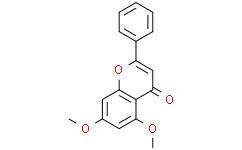
Physicochemical Properties
| Molecular Formula | C17H14O4 |
| Molecular Weight | 282.2907 |
| Exact Mass | 282.089 |
| CAS # | 21392-57-4 |
| PubChem CID | 88881 |
| Appearance | White to yellow solid powder |
| Density | 1.2±0.1 g/cm3 |
| Boiling Point | 476.6±45.0 °C at 760 mmHg |
| Melting Point | 150-152ºC |
| Flash Point | 213.4±28.8 °C |
| Vapour Pressure | 0.0±1.2 mmHg at 25°C |
| Index of Refraction | 1.598 |
| LogP | 3.27 |
| Hydrogen Bond Donor Count | 0 |
| Hydrogen Bond Acceptor Count | 4 |
| Rotatable Bond Count | 3 |
| Heavy Atom Count | 21 |
| Complexity | 411 |
| Defined Atom Stereocenter Count | 0 |
| InChi Key | JRFZSUMZAUHNSL-UHFFFAOYSA-N |
| InChi Code | InChI=1S/C17H14O4/c1-19-12-8-15(20-2)17-13(18)10-14(21-16(17)9-12)11-6-4-3-5-7-11/h3-10H,1-2H3 |
| Chemical Name | 5,7-dimethoxy-2-phenylchromen-4-one |
| HS Tariff Code | 2934.99.9001 |
| Storage |
Powder-20°C 3 years 4°C 2 years In solvent -80°C 6 months -20°C 1 month Note: This product requires protection from light (avoid light exposure) during transportation and storage. |
| Shipping Condition | Room temperature (This product is stable at ambient temperature for a few days during ordinary shipping and time spent in Customs) |
Biological Activity
| ln Vitro | In MDCK/Bcrp1 cells, 5,7-Dimethoxyflavone (5 and 50 μM, 1 hour) inhibits Bcrp1-mediated sorafenib efflux [2]. In B16F10 melanoma cells, 5,7-dimethoxyflavone (0-25 μM, 48 hours) promotes melanogenesis by raising cAMP [4]. 5,7-dimethoxyflavone (0 - 100 μM, 48 hours) can block ischemia, promote oxidative termination, and trigger apoptosis in VK2/E6E7 and End1/E6E7 cells. It can also dilute the cells in cells by accumulation of TG in 3T3-L1 adipocytes [6].Cell. |
| ln Vivo | In mouse liver, 5,7-dimethoxyflavone (10 mg/kg, facial, once daily for 10 days) can lower the expression levels of CYP3A11 and CYP3A25 proteins [1]. In HFD mice, 5,7-Dimethoxyflavone (25 and 50 mg/kg, face) and 5,7-Dimethoxyflavone (50 mg/kg/d, epidermis, for 6 weeks) decrease body weight while increasing and inhibiting liver function[5]. |
| Cell Assay |
Western Blot Analysis[4] Cell Types: B16F10 melanoma cells Tested Concentrations: 0-25 μM Incubation Duration: 48 hrs (hours) Experimental Results: Induces CREB phosphorylation and inhibits Akt and GSK-3β phosphorylation. |
| Animal Protocol |
Animal/Disease Models: Aged mice [3] Doses: 25 and 50 mg/kg Route of Administration: Oral Experimental Results: Increased grip strength and running endurance. Increase muscle size, weight, and cross-sectional area. Serum and gastrocnemius muscle IL-6 and TNF-α levels were diminished. |
| References |
[1]. Effect of the active ingredient of Kaempferia parviflora, 5,7-dimethoxyflavone, on the pharmacokinetics of midazolam. J Nat Med. 2018 Jun;72(3):607-614. [2]. Effect of 5,7-dimethoxyflavone on Bcrp1-mediated transport of sorafenib in vitro and in vivo in mice. Eur J Pharm Sci. 2018 May 30;117:27-34. [3]. Kim C, Hwang JK. The 5,7-Dimethoxyflavone Suppresses Sarcopenia by Regulating Protein Turnover and Mitochondria Biogenesis-Related Pathways. Nutrients. 2020 Apr 13;12(4):1079. [4]. 5,7-dimethoxyflavone induces melanogenesis in B16F10 melanoma cells through cAMP-dependent signalling. Exp Dermatol. 2011 May;20(5):445-7. [5]. 5,7-Dimethoxyflavone Attenuates Obesity by Inhibiting Adipogenesis in 3T3-L1 Adipocytes and High-Fat Diet-Induced Obese C57BL/6J Mice. J Med Food. 2016 Dec;19(12):1111-1119. [6]. 5,7-Dimethoxyflavone induces apoptotic cell death in human endometriosis cell lines by activating the endoplasmic reticulum stress pathway. Phytother Res. 2020 Sep;34(9):2275-2286. |
| Additional Infomation |
Chrysin 5,7-dimethyl ether is a dimethoxyflavone that is the 5,7-dimethyl ether derivative of chrysin. It has a role as a plant metabolite. It is functionally related to a chrysin. 5,7-Dimethoxyflavone has been reported in Boesenbergia rotunda, Kaempferia parviflora, and other organisms with data available. |
Solubility Data
| Solubility (In Vitro) | DMSO : ~62.5 mg/mL (~221.40 mM) |
| Solubility (In Vivo) |
Solubility in Formulation 1: ≥ 2.5 mg/mL (8.86 mM) (saturation unknown) in 10% DMSO + 40% PEG300 + 5% Tween80 + 45% Saline (add these co-solvents sequentially from left to right, and one by one), clear solution. For example, if 1 mL of working solution is to be prepared, you can add 100 μL of 25.0 mg/mL clear DMSO stock solution to 400 μL PEG300 and mix evenly; then add 50 μL Tween-80 to the above solution and mix evenly; then add 450 μL normal saline to adjust the volume to 1 mL. Preparation of saline: Dissolve 0.9 g of sodium chloride in 100 mL ddH₂ O to obtain a clear solution. Solubility in Formulation 2: ≥ 2.5 mg/mL (8.86 mM) (saturation unknown) in 10% DMSO + 90% Corn Oil (add these co-solvents sequentially from left to right, and one by one), clear solution. For example, if 1 mL of working solution is to be prepared, you can add 100 μL of 25.0 mg/mL clear DMSO stock solution to 900 μL of corn oil and mix evenly. Solubility in Formulation 3: ≥ 2.08 mg/mL (7.37 mM) (saturation unknown) in 10% DMSO + 90% (20% SBE-β-CD in Saline) (add these co-solvents sequentially from left to right, and one by one), clear solution. For example, if 1 mL of working solution is to be prepared, you can add 100 μL of 20.8 mg/mL clear DMSO stock solution to 900 μL of 20% SBE-β-CD physiological saline solution and mix evenly. Preparation of 20% SBE-β-CD in Saline (4°C,1 week): Dissolve 2 g SBE-β-CD in 10 mL saline to obtain a clear solution. (Please use freshly prepared in vivo formulations for optimal results.) |
| Preparing Stock Solutions | 1 mg | 5 mg | 10 mg | |
| 1 mM | 3.5425 mL | 17.7123 mL | 35.4246 mL | |
| 5 mM | 0.7085 mL | 3.5425 mL | 7.0849 mL | |
| 10 mM | 0.3542 mL | 1.7712 mL | 3.5425 mL |