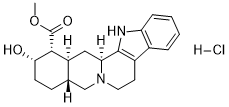
Yohimbine HCl (Antagonil; Corynine; Quebrachin; Quebrachine; Yohimex; Yocon; APHRODINE; Aphrodyne; Aphrosol; Johimbin), the hydrochloride salt of Yohimbine, is a potent alpha 2-adrenoreceptor antagonist used as a mydriatic for the treatment of impotence. It is an indole alkaloid derived from the bark of the Pausinystalia yohimbe tree in Central Africa. Yohimbine is also alleged to be an aphrodisiac. Yohimbine may exert its beneficial effect on erectile ability through blockade of central alpha 2-adrenergic receptors producing an increase in sympathetic drive secondary to an increase in norepinephrine release and in firing rate of cells in the brain noradrenergic nuclei.
Physicochemical Properties
| Molecular Formula | C21H26N2O3.HCL | |
| Molecular Weight | 390.9 | |
| Exact Mass | 390.171 | |
| Elemental Analysis | C, 64.52; H, 6.96; Cl, 9.07; N, 7.17; O, 12.28 | |
| CAS # | 65-19-0 | |
| Related CAS # | Rauwolscine hydrochloride; 6211-32-1; Yohimbine; 146-48-5; Rauwolscine; 131-03-3 | |
| PubChem CID | 6169 | |
| Appearance | White to light yellow solid powder | |
| Boiling Point | 542.979ºC at 760 mmHg | |
| Melting Point | 288-290 °C (dec.)(lit.) | |
| Flash Point | 282.184ºC | |
| Index of Refraction | 103 ° (C=1, H2O) | |
| LogP | 3.387 | |
| Hydrogen Bond Donor Count | 3 | |
| Hydrogen Bond Acceptor Count | 4 | |
| Rotatable Bond Count | 2 | |
| Heavy Atom Count | 27 | |
| Complexity | 555 | |
| Defined Atom Stereocenter Count | 5 | |
| SMILES | Cl[H].O([H])[C@@]1([H])C([H])([H])C([H])([H])[C@@]2([H])C([H])([H])N3C([H])([H])C([H])([H])C4C5=C([H])C([H])=C([H])C([H])=C5N([H])C=4[C@]3([H])C([H])([H])[C@]2([H])[C@@]1([H])C(=O)OC([H])([H])[H] |
|
| InChi Key | PIPZGJSEDRMUAW-VJDCAHTMSA-N | |
| InChi Code | InChI=1S/C21H26N2O3.ClH/c1-26-21(25)19-15-10-17-20-14(13-4-2-3-5-16(13)22-20)8-9-23(17)11-12(15)6-7-18(19)24;/h2-5,12,15,17-19,22,24H,6-11H2,1H3;1H/t12-,15-,17-,18-,19+;/m0./s1 | |
| Chemical Name | methyl (1S,15R,18S,19R,20S)-18-hydroxy-1,3,11,12,14,15,16,17,18,19,20,21-dodecahydroyohimban-19-carboxylate;hydrochloride | |
| Synonyms |
|
|
| HS Tariff Code | 2934.99.9001 | |
| Storage |
Powder-20°C 3 years 4°C 2 years In solvent -80°C 6 months -20°C 1 month Note: Please store this product in a sealed and protected environment, avoid exposure to moisture. |
|
| Shipping Condition | Room temperature (This product is stable at ambient temperature for a few days during ordinary shipping and time spent in Customs) |
Biological Activity
| Targets | alpha 2-adrenergic receptor | ||
| ln Vitro |
|
||
| ln Vivo |
|
||
| Animal Protocol |
|
||
| ADME/Pharmacokinetics |
Absorption Rapidly absorbed following oral administration. Bioavailability is highly variable, ranging from 7 to 87% (mean 33%). Metabolism / Metabolites Yohimbine appears to undergo extensive metabolism in an organ of high flow such as the liver or kidney, however, the precise metabolic fate of yohimbine has not been fully determined. Biological Half-Life Elimination half-life is approximately 36 minutes. |
||
| Toxicity/Toxicokinetics |
rat LD50 intraperitoneal 55 mg/kg Hepatotoxicity In small clinical trials and case series, yohimbine therapy has not been linked to serum enzyme elevations or clinical liver disease. Although yohimbine is often found in weight loss and muscle building herbal combinations, it has not been associated with cases of clinically apparent acute liver injury.br> Likelihood score: E (unlikely cause of clinically apparent liver injury). |
||
| References |
[1]. J Urol . 1998 Feb;159(2):433-6. [2]. J Neurosci . 2006 Nov 1;26(44):11442-53. [3]. J Chem Ecol, 1998, 24(11), 1881-1937. |
||
| Additional Infomation |
A plant alkaloid with alpha-2-adrenergic blocking activity. Yohimbine has been used as a mydriatic and in the treatment of ERECTILE DYSFUNCTION. See also: Yohimbine (has active moiety). |
Solubility Data
| Solubility (In Vitro) |
|
|||
| Solubility (In Vivo) |
Solubility in Formulation 1: ≥ 2.5 mg/mL (6.40 mM) (saturation unknown) in 10% DMSO + 40% PEG300 + 5% Tween80 + 45% Saline (add these co-solvents sequentially from left to right, and one by one), clear solution. For example, if 1 mL of working solution is to be prepared, you can add 100 μL of 25.0 mg/mL clear DMSO stock solution to 400 μL PEG300 and mix evenly; then add 50 μL Tween-80 to the above solution and mix evenly; then add 450 μL normal saline to adjust the volume to 1 mL. Preparation of saline: Dissolve 0.9 g of sodium chloride in 100 mL ddH₂ O to obtain a clear solution. Solubility in Formulation 2: ≥ 2.5 mg/mL (6.40 mM) (saturation unknown) in 10% DMSO + 90% (20% SBE-β-CD in Saline) (add these co-solvents sequentially from left to right, and one by one), clear solution. For example, if 1 mL of working solution is to be prepared, you can add 100 μL of 25.0 mg/mL clear DMSO stock solution to 900 μL of 20% SBE-β-CD physiological saline solution and mix evenly. Preparation of 20% SBE-β-CD in Saline (4°C,1 week): Dissolve 2 g SBE-β-CD in 10 mL saline to obtain a clear solution. Solubility in Formulation 3: ≥ 2.5 mg/mL (6.40 mM) (saturation unknown) in 10% DMSO + 90% Corn Oil (add these co-solvents sequentially from left to right, and one by one), clear solution. For example, if 1 mL of working solution is to be prepared, you can add 100 μL of 25.0 mg/mL clear DMSO stock solution to 900 μL of corn oil and mix evenly. (Please use freshly prepared in vivo formulations for optimal results.) |
| Preparing Stock Solutions | 1 mg | 5 mg | 10 mg | |
| 1 mM | 2.5582 mL | 12.7910 mL | 25.5820 mL | |
| 5 mM | 0.5116 mL | 2.5582 mL | 5.1164 mL | |
| 10 mM | 0.2558 mL | 1.2791 mL | 2.5582 mL |