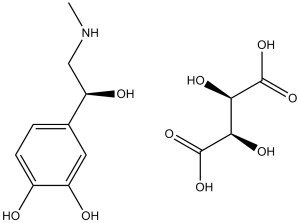
Epinephrine bitartrate (Adrenalinium; L-Adrenaline, l-Epinephrine, (-)-Adrenaline acid, (-)-Adrenaline), the bitartrate salt of epinenphrine which is the active sympathomimetic hormone from the adrenal medulla, is an alpha- and beta-adrenergic receptor stimulator. It causes gastrointestinal relaxation and vasoconstriction, stimulates the heart, dilates bronchi and cerebral vessels, and activates the alpha- and beta-adrenergic systems. It is used to postpone the absorption of local anesthetics and to treat asthma and heart failure.
Physicochemical Properties
| Molecular Formula | C13H19NO9 | |
| Molecular Weight | 333.29 | |
| Exact Mass | 333.105 | |
| Elemental Analysis | C, 46.85; H, 5.75; N, 4.20; O, 43.20 | |
| CAS # | 51-42-3 | |
| Related CAS # |
|
|
| PubChem CID | 5815 | |
| Appearance | Solid powder | |
| Boiling Point | 413.1ºC at 760 mmHg | |
| Melting Point | ~155 °C (dec.) | |
| Flash Point | 207.9ºC | |
| Index of Refraction | -16.5 ° (C=2, H2O) | |
| Hydrogen Bond Donor Count | 8 | |
| Hydrogen Bond Acceptor Count | 10 | |
| Rotatable Bond Count | 6 | |
| Heavy Atom Count | 23 | |
| Complexity | 288 | |
| Defined Atom Stereocenter Count | 3 | |
| SMILES | O([H])[C@@]([H])(C([H])([H])N([H])C([H])([H])[H])C1C([H])=C([H])C(=C(C=1[H])O[H])O[H].O([H])[C@@]([H])(C(=O)O[H])[C@]([H])(C(=O)O[H])O[H] |
|
| InChi Key | YLXIPWWIOISBDD-NDAAPVSOSA-N | |
| InChi Code | InChI=1S/C9H13NO3.C4H6O6/c1-10-5-9(13)6-2-3-7(11)8(12)4-6;5-1(3(7)8)2(6)4(9)10/h2-4,9-13H,5H2,1H3;1-2,5-6H,(H,7,8)(H,9,10)/t9-;1-,2-/m01/s1 | |
| Chemical Name | (2R,3R)-2,3-dihydroxybutanedioic acid;4-[(1R)-1-hydroxy-2-(methylamino)ethyl]benzene-1,2-diol | |
| Synonyms |
|
|
| HS Tariff Code | 2934.99.9001 | |
| Storage |
Powder-20°C 3 years 4°C 2 years In solvent -80°C 6 months -20°C 1 month |
|
| Shipping Condition | Room temperature (This product is stable at ambient temperature for a few days during ordinary shipping and time spent in Customs) |
Biological Activity
| Targets | α2 adr; α2-adrenergic receptor; α-adrenergic receptor; β-adrenergic receptor |
| ln Vitro |
Dose and time response study on the effect of epinephrine on the Na+/K+-ATPase Epinephrine (dissolved in ascorbic acid 0.5M) reduced in a dose and time-dependent manner the activity of the Na+/K+ ATPase in Caco-2 cells. The highest inhibitory effect was observed at 20 min and at a dose of 0.5 mM. Accordingly in all other experiments cell were treated with epinephrine for 20min and at a concentration of 0.5mM. Ascorbic acid alone exerted no significant effect on the activity of the pump. Epinephrine acts via alpha-2 adrenergic receptors The inhibitory effect of epinephrine on the Na+/K+-ATPase persisted when the cells were pre- incubated with of 0.03 mM propranolol (non selective β-adrenergic blocker) or 50 μM prazosin (selective α1 antagonist), but was no longer apparent in the presence of 0.1 mM yohimbine, a selective α2- adrenergic antagonist, suggesting that epinephrine exerts its effect by exclusively binding to its α2-adrenergic receptors.[2] |
| ln Vivo | The present study examined the memory modulatory effect of epinephrine on latent learning of an inhibitory avoidance task. Male Sprague-Dawley rats on the first day were subjected to one of three conditions (no, short or long) in pre-exposure to the task apparatus. One day or several days later, they received the typical inhibitory avoidance training with a 0.5 mA/0.5 s foot shock. Memory of the inhibitory avoidance response was tested one day after the foot-shock training. The long pre-exposure group showed better memory than the no or short pre-exposure group, and this latent memory could last for 6 days: Retention scores of the long pre-exposure group were significantly better than those of the no pre-exposure group if the shock training was given 3 or 6 days, but not 12 or 21 days, after the pre-exposure. Epinephrine injected after the pre-exposure training modulated the latent memory in a dose- and time-dependent manner: 0.01 mg/kg given shortly after the short pre-exposure enhanced the memory, but 0.5 mg/kg given shortly after the long pre-exposure impaired it. Epinephrine injected 4 h after the pre-exposure had no effect, neither did that given to rats pre-exposed to a different context. Epinephrine (0.01 mg/kg) also made the latent memory lasting longer as the rats treated with it showed significant avoidance behavior when they had the shock training at 12 or 21 days after the pre-exposure. These findings suggest that epinephrine could modulate memory formed in the latent learning.[3] |
| Enzyme Assay | Effect of epinephrine on the activity of the Na+/K+-ATPase Dose and time response studies were conducted. Caco-2 cells were treated with epinephrine for different time intervals (0; 10; 20; 45;75 min) and at different concentrations (0; 0.05; 0.2; 0.5; 0.8 mM). Epinephrine was dissolved in 0.5M ascorbic acid. The positive and negative control groups were incubated with and without ascorbic acid respectively.[2] |
| Cell Assay | Cell culture of CaCo-2 cells CaCo-2 cells were used at passages 25–32. They were grown, at a density of 1200,000/well, on 100mm culture dishes in DMEM containing 4500 mg L-1 Glucose, sodium pyruvate, 1% Penicillin (100 μg mL-1), streptomycin (100 μg mL-1), 10% FBS, in a humidified incubator (95% O2, 5% CO2) at 37°C. Cells were always treated at 80–90% confluence.[2] |
| Animal Protocol | Epinephrine in a 1 mg/ml solution and diluted by 0.9% saline to the appropriate concentrations for subcutaneous injections. For the immediate injection, rats were retrieved from the apparatus at the end of the pre-exposure phase and given the assigned injection before returning to their home cages. For the delayed injection, rats returned to their home cages after the pre-exposure training and received the drug 4 h later.[3] |
| References |
[1]. Am J Physiol. 1982 Apr;242(4):H593-601. [2]. PLoS One. 2018; 13(2): e0193139. [3]. Neurobiol Learn Mem. 2021 Jul:182:107447. |
| Additional Infomation |
Epinephrine Bitartrate is the bitartrate salt form of epinephrine, a direct-acting sympathomimetic amine with bronchodilator and vasoconstricting activity. Epinephrine Bitartrate is the bitartrate salt form of epinephrine, a direct-acting sympathomimetic amine with bronchodilator and vasoconstricting activity. Epinephrine bitartrate acts on both alpha and beta adrenergic receptors. By stimulating alpha adrenergic receptors locally, this agent causes vasoconstriction and reduces vascular blood flow. Administered in the conjunctiva, epinephrine bitartrate induces vasoconstriction and decreases the production of aqueous humor mediated through alpha-adrenergic receptors. Through its beta-stimulating actions, this agent relaxes bronchial smooth muscle and causes bronchodilation. The active sympathomimetic hormone from the ADRENAL MEDULLA. It stimulates both the alpha- and beta- adrenergic systems, causes systemic VASOCONSTRICTION and gastrointestinal relaxation, stimulates the HEART, and dilates BRONCHI and cerebral vessels. It is used in ASTHMA and CARDIAC FAILURE and to delay absorption of local ANESTHETICS. See also: Epinephrine (has active moiety); Articaine Hydrochloride; Epinephrine Bitartrate (component of); Epinephrine Bitartrate; prilocaine hydrochloride (component of) ... View More ... |
Solubility Data
| Solubility (In Vitro) |
|
|||
| Solubility (In Vivo) | N/A (Please use freshly prepared in vivo formulations for optimal results.) |
| Preparing Stock Solutions | 1 mg | 5 mg | 10 mg | |
| 1 mM | 3.0004 mL | 15.0020 mL | 30.0039 mL | |
| 5 mM | 0.6001 mL | 3.0004 mL | 6.0008 mL | |
| 10 mM | 0.3000 mL | 1.5002 mL | 3.0004 mL |