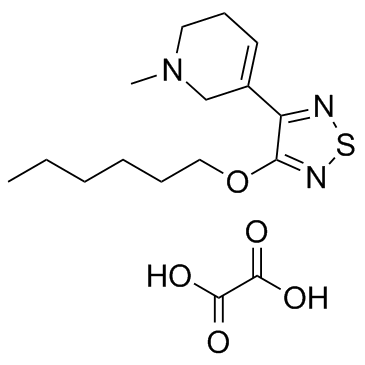
Xanomeline oxalate (also known as LY246708) is a novel, potent and selective M1 muscarinic receptor agonist with good selectivity for the M1 and M4 subtypes. It has been researched for treating negative and cognitive symptoms of schizophrenia as well as Alzheimer's disease, though gastrointestinal side effects caused a high clinical trial dropout rate. In spite of this, xanomeline has been demonstrated to be reasonably effective in treating the symptoms of schizophrenia. A recent study conducted on humans revealed that xanomeline treatment was associated with significant improvements in verbal learning and short-term memory.
Physicochemical Properties
| Molecular Formula | C16H25N3O5S |
| Molecular Weight | 371.4518 |
| Exact Mass | 371.151 |
| Elemental Analysis | C, 51.74; H, 6.78; N, 11.31; O, 21.54; S, 8.63 |
| CAS # | 141064-23-5 |
| Related CAS # | Xanomeline; 131986-45-3 |
| PubChem CID | 18920248 |
| Appearance | White to off-white solid powder |
| LogP | 2.309 |
| Hydrogen Bond Donor Count | 2 |
| Hydrogen Bond Acceptor Count | 9 |
| Rotatable Bond Count | 8 |
| Heavy Atom Count | 25 |
| Complexity | 370 |
| Defined Atom Stereocenter Count | 0 |
| SMILES | CN1CCC=C(C2=NSN=C2OCCCCCC)C1.O=C(O)C(O)=O |
| InChi Key | ZJOUESNWCLASJP-UHFFFAOYSA-N |
| InChi Code | InChI=1S/C14H23N3OS.C2H2O4/c1-3-4-5-6-10-18-14-13(15-19-16-14)12-8-7-9-17(2)11-12;3-1(4)2(5)6/h8H,3-7,9-11H2,1-2H3;(H,3,4)(H,5,6)hI=1S/C14H23N3OS.C2H2O4/c1-3-4-5-6-10-18-14-13(15-19-16-14)12-8-7-9-17(2)11-12;3-1(4)2(5)6/h8H,3-7,9-11H2,1-2H3;(H,3,4)(H,5,6) |
| Chemical Name | 3-hexoxy-4-(1-methyl-3,6-dihydro-2H-pyridin-5-yl)-1,2,5-thiadiazole;oxalic acid |
| Synonyms | LY-246708; LY246708; LY 246708; Memcor; NNC-110232; Hexyloxy-TZTP; HexyloxyTZTP |
| HS Tariff Code | 2934.99.9001 |
| Storage |
Powder-20°C 3 years 4°C 2 years In solvent -80°C 6 months -20°C 1 month Note: Please store this product in a sealed and protected environment, avoid exposure to moisture. |
| Shipping Condition | Room temperature (This product is stable at ambient temperature for a few days during ordinary shipping and time spent in Customs) |
Biological Activity
| Targets | muscarinic receptor |
| ln Vitro | Xanomeline oxalate stimulates phosphoinositide (PI) potential in A9 L m1 cells [1]. M) binds to the brain with Ki of 7 and 3 nM respectively[1]. |
| ln Vivo | Xanomeline oxalate strongly stimulates PI responses in vivo, and this effect is boiled by muscarinic-selective antioxidants, suggesting that it is mediated by muscarinic receptors. In mice, the ED100 of [3H]-IP accumulation in the hippocampus induced by Xanomeline oxalate was 54 μMole/kg. In the trajectory, the ED100 of [3H]-IP accumulation in the hippocampus induced by Xanomeline oxalate was 8.1 μMole/kg[1]. Animal model: Male CF1 mice weighing 18-20 g were injected with [3H]-inositol[1]. Dosage: 8.1-81 μmole/kg. Administration method: subcutaneous injection; 1 hour before sacrifice and 1 hour after administration. Results: Lithium levels increased in a dose-related manner in the hippocampus, cortex, and neostriatum, up to 130%, 75%, and 60%, respectively. and does not increase the accumulation of [3H]-IP in the brainstem. Induces salivation, tremors and hypothermia in mice with an ED50 of 13.7±0.8 μmole/kg. Animal model: Rats were injected with [3H]-inositol[1]. Dosage: 2.7-81 μmole/kg. Administration method: subcutaneous injection; 1 hour before sacrifice and 1 hour after administration. Results: [3H]-IP formation in hippocampus. Dose-dependent increase, 221% higher than lithium control. |
| Animal Protocol |
Male CF1 mice weighing 18-20 g are injected [3H]-myoinositol 8.1-81 μmole/kg S.c. injections; 1 h prior to killing and 1 h after the administration |
| References |
[1]. Xanomeline Compared to Other Muscarinic Agents on Stimulation of Phosphoinositide Hydrolysis in Vivo and Other Cholinomimetic Effects. Brain Res. 1998 Jun 8; 795(1-2):179-90. |
Solubility Data
| Solubility (In Vitro) | DMSO: ~50 mg/mL (~134.6 mM) |
| Solubility (In Vivo) |
Solubility in Formulation 1: ≥ 2.5 mg/mL (6.73 mM) (saturation unknown) in 10% DMSO + 40% PEG300 + 5% Tween80 + 45% Saline (add these co-solvents sequentially from left to right, and one by one), clear solution. For example, if 1 mL of working solution is to be prepared, you can add 100 μL of 25.0 mg/mL clear DMSO stock solution to 400 μL PEG300 and mix evenly; then add 50 μL Tween-80 to the above solution and mix evenly; then add 450 μL normal saline to adjust the volume to 1 mL. Preparation of saline: Dissolve 0.9 g of sodium chloride in 100 mL ddH₂ O to obtain a clear solution. Solubility in Formulation 2: ≥ 2.5 mg/mL (6.73 mM) (saturation unknown) in 10% DMSO + 90% (20% SBE-β-CD in Saline) (add these co-solvents sequentially from left to right, and one by one), clear solution. For example, if 1 mL of working solution is to be prepared, you can add 100 μL of 25.0 mg/mL clear DMSO stock solution to 900 μL of 20% SBE-β-CD physiological saline solution and mix evenly. Preparation of 20% SBE-β-CD in Saline (4°C,1 week): Dissolve 2 g SBE-β-CD in 10 mL saline to obtain a clear solution. Solubility in Formulation 3: ≥ 2.5 mg/mL (6.73 mM) (saturation unknown) in 10% DMSO + 90% Corn Oil (add these co-solvents sequentially from left to right, and one by one), clear solution. For example, if 1 mL of working solution is to be prepared, you can add 100 μL of 25.0 mg/mL clear DMSO stock solution to 900 μL of corn oil and mix evenly. (Please use freshly prepared in vivo formulations for optimal results.) |
| Preparing Stock Solutions | 1 mg | 5 mg | 10 mg | |
| 1 mM | 2.6922 mL | 13.4608 mL | 26.9215 mL | |
| 5 mM | 0.5384 mL | 2.6922 mL | 5.3843 mL | |
| 10 mM | 0.2692 mL | 1.3461 mL | 2.6922 mL |