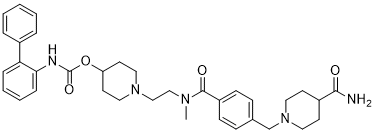
Revefenacin (formerly known as TD-4208; GSK-1160724; trade name: Yupelri) is a long-acting, potent mAChR (muscarinic acetylcholine receptor) antagonist with a high affinity on M3 receptor with a Ki of 0.18 nM. It may be applied in the management of respiratory conditions. The FDA approved revefenacin on November 8, 2018, for the treatment of patients with chronic obstructive pulmonary disease (COPD). Prior to this, Tiotropium was the only once-daily long-acting muscarinic antagonist (LAMA) that was authorized for the treatment of COPD in the US and other nations. Recently, the European Union approved glycopyrronium as a once-daily maintenance treatment for COPD, based on its promising performance as a LAMA. In summary, revefenacin may be used once daily to treat respiratory disorders as a long-acting bronchodilator. In comparison to commercially available muscarinic receptor antagonists, it may have a better tolerability profile due to its increased functional selectivity for the lung in preclinical models.
Physicochemical Properties
| Molecular Formula | C35H43N5O4 |
| Molecular Weight | 597.76 |
| Exact Mass | 597.331 |
| Elemental Analysis | C, 70.33; H, 7.25; N, 11.72; O, 10.71 |
| CAS # | 864750-70-9 |
| Related CAS # | 864750-70-9; 864751-51-9 (phosphate); 864751-53-1 (sulfate); 864751-55-3 (oxalate) |
| PubChem CID | 11753673 |
| Appearance | White to off-white solid powder |
| Density | 1.3±0.1 g/cm3 |
| Boiling Point | 777.5±60.0 °C at 760 mmHg |
| Flash Point | 424.0±32.9 °C |
| Vapour Pressure | 0.0±2.7 mmHg at 25°C |
| Index of Refraction | 1.645 |
| LogP | 3.22 |
| Hydrogen Bond Donor Count | 2 |
| Hydrogen Bond Acceptor Count | 6 |
| Rotatable Bond Count | 11 |
| Heavy Atom Count | 44 |
| Complexity | 918 |
| Defined Atom Stereocenter Count | 0 |
| SMILES | O=C(NC1C(C2C=CC=CC=2)=CC=CC=1)OC1CCN(CCN(C)C(C2C=CC(CN3CCC(C(N)=O)CC3)=CC=2)=O)CC1 |
| InChi Key | FYDWDCIFZSGNBU-UHFFFAOYSA-N |
| InChi Code | InChI=1S/C35H43N5O4/c1-38(34(42)29-13-11-26(12-14-29)25-40-19-15-28(16-20-40)33(36)41)23-24-39-21-17-30(18-22-39)44-35(43)37-32-10-6-5-9-31(32)27-7-3-2-4-8-27/h2-14,28,30H,15-25H2,1H3,(H2,36,41)(H,37,43) |
| Chemical Name | [1-[2-[[4-[(4-carbamoylpiperidin-1-yl)methyl]benzoyl]-methylamino]ethyl]piperidin-4-yl] N-(2-phenylphenyl)carbamate |
| Synonyms | TD-4208; TD4208; GSK-1160724; GSK-1160724; TD 4208; GSK1160724; trade name: Yupelri; TD-4208; GSK 1160724 |
| HS Tariff Code | 2934.99.9001 |
| Storage |
Powder-20°C 3 years 4°C 2 years In solvent -80°C 6 months -20°C 1 month |
| Shipping Condition | Room temperature (This product is stable at ambient temperature for a few days during ordinary shipping and time spent in Customs) |
Biological Activity
| Targets | M1 ( Ki = 0.42 nM ); M2 ( Ki = 0.32 nM ); M3 ( Ki = 0.18 nM ); M4 ( Ki = 0.56 nM ); M5 ( Ki = 6.7 nM ) | |
| ln Vitro |
|
|
| ln Vivo |
|
|
| Animal Protocol | Rats: Rats are exposed by inhaling a nebulized solution of either vehicle (sterile water) or revefenacin (3–3000 µg/mL), tiotropium (0.3–300 µg/mL), or glycopyrronium (1–1000 µg/mL) to ascertain the bronchoprotective and antisialagogue potency after a single dose. 24 hours after the dosage, bronchoprotective activity is evaluated. The antisialagogue effect's peak effect time is determined by measuring the inhibition of Pilo 1, 6, or 12 hours after an effective dose of the test compound was inhaled. At this point in time, all subsequent doses are measured[2]. | |
| ADME/Pharmacokinetics |
Absorption, Distribution and Excretion In pharmacokinetic studies, revefenacin was absorbed very rapidly and presented a linear increase in plasma exposure with Cmax, tmax and AUC that ranged between 0.02-0.15 ng/ml, 0.48-0.51 hours and 0.03-0.36 ng.h/ml, respectively. The bioaccumulation of revefenacin was very limited and the steady-state was achieved by day 7. After reaching maximum concentration, revefenacin concentrations decline in a biphasic manner. This elimination kinetics is observed by a rapid declining plasma concentration followed by a slow apparent bi-exponential elimination. Renal elimination of revefenacin is limited and it presents a mean cumulative amount excreted in urine as the unchanged drug of < 0.2% of the administered dose. Following intravenous revefenacin administration, 54% of the dose is recovered in feces and 27% was recovered in urine which confirms a high hepatobiliary processing. After intravenous administration of revefenacin, the reported volume of distribution is 218 L which suggests an extensive distribution to the tissues. The renal clearance of revefenacin is negligible and thus, the clearance rate is not a major parameter for this drug. Metabolism / Metabolites Revefenacin presents a high metabolic liability producing a rapid metabolic turnover after being distributed from the lung. This metabolic process is done primarily via enzymatic hydrolysis via CYP2D6 to its major hydrolytic metabolite THRX-195518. Biological Half-Life The apparent terminal half-life of a dose of 350 mcg of revefenacin was 22.3-70 hours. |
|
| Toxicity/Toxicokinetics |
Hepatotoxicity Like other anticholinergic agents, revefenacin has not been linked to episodes of liver enzyme elevations or clinically apparent liver injury. Another reason for its hepatic safety may relate to its low systemic absorption when administered by inhaler. Likelihood score: E (unlikely cause of clinically apparent liver injury). Drug Class: Anticholinergic Agents Effects During Pregnancy and Lactation ◉ Summary of Use during Lactation No information is available on the use of revefenacin during breastfeeding. Because the drug is only 3% absorbed orally, it is unlikely to affect the breastfed infant. Long-term use of revefenacin might reduce milk production or milk letdown. During long-term use, observe for signs of decreased lactation (e.g., insatiety, poor weight gain). ◉ Effects in Breastfed Infants Relevant published information was not found as of the revision date. ◉ Effects on Lactation and Breastmilk Relevant published information was not found as of the revision date. Protein Binding The protein binding of revefenacin and its active metabolite is of 71% and 42% respectively. |
|
| References |
[1]. In vitro characterization of TD-4208, a lung-selective and long-acting muscarinic antagonist bronchodilator (Abstract). Am J Respir Crit Care Med 179:A4553. [2]. In vivo pharmacological characterization of TD-4208, a novel lung-selective inhaled muscarinic antagonist with sustained bronchoprotective effect in experimental animal models. J Pharmacol Exp Ther. 2013 Aug;346(2):241-50. |
|
| Additional Infomation |
Revefenacin is a novel biphenyl carbamate tertiary amine agent that belongs to the family of the long-acting muscarinic antagonists (LAMA). The labile primary amide in the structure produces a "soft-drug" site that allows rapid systemic clearance and minimizing of the systemically mediated adverse reactions. The LAMA group falls into a parent category known as long-acting inhaled bronchodilators and this type of agents are recommended as a maintenance therapy for chronic obstructive pulmonary disease (COPD). From the LAMA group, revefenacin is the first once-daily nebulized LAMA treatment. It was developed by Theravance Biopharma and FDA approved on November 9, 2018. Revefenacin is an Anticholinergic. The mechanism of action of revefenacin is as a Cholinergic Antagonist. Revefenacin is a synthetic anticholinergic agent that is used as a once daily, nebulized inhalant for maintenance treatment of patients with chronic obstructive pulmonary disease. Revefenacin has not been implicated in causing liver enzyme elevations or clinically apparent acute liver injury. Drug Indication Revefenacin is indicated as an inhalation solution for the maintenance treatment of patients with chronic obstructive pulmonary disease (COPD). COPD is a growing disease being the third leading cause of death in the US. This disease is characterized by not fully reversible airflow limitation. FDA Label Mechanism of Action Revefenacin is an inhaled bronchodilator muscarinic antagonist with a long-acting bronchodilation activity. It has been shown to present a high affinity and behaved as a competitive antagonist of the five muscarinic cholinergic receptors. Studies have indicated that revefenacin dissociates significantly slower from the muscarinic receptor M3 (hM3) when compared to the receptor M2 (hM2) which indicates a kinetic selectivity for this subtype. This competitive antagonism produces a suppressive action of the acetylcholine-evoked calcium mobilization and contractile responses in the airway tissue. Lastly, due to the duration of the bronchodilation, revefenacin is considered a long-acting muscarinic antagonist which allows it to be dosed once daily. This response is very important for the therapy of COPD as the main goal is the reduce the frequency and severity of exacerbations which are normally driven by the presence of elevated cholinergic bronchoconstrictor tone mediated by muscarinic receptors on parasympathetic ganglia and airway smooth muscle. Hence, the activity of revefenacin produces a potent and long-lasting protection against the bronchoconstrictor response to acetylcholine or methacholine. Pharmacodynamics Revefenacin has been reported to produce a sustained, long-acting bronchodilation with lower anti-muscarinic-related side effects. In clinical trials, revefenacin demonstrated to be of a long duration of action and low systemic exposure in patients with COPD. Also, it was reported that a dose of 88 mcg can produce a clinically effective bronchodilation measured by through forced expiratory volume in 1s and serial spirometric assessments. In placebo-controlled trials, revefenacin showed a decrease in the use of albuterol rescue inhalers and sustained increases in the peak expiratory flow rate that reached a steady state at a maximum in day 7. As well, there was a reported superior lung selectivity index when compared with other LAMAs such as glycopyrronium and tiotropium which produced a decreased sialagogue effect. |
Solubility Data
| Solubility (In Vitro) |
|
|||
| Solubility (In Vivo) |
Solubility in Formulation 1: ≥ 2.5 mg/mL (4.18 mM) (saturation unknown) in 10% DMSO + 40% PEG300 + 5% Tween80 + 45% Saline (add these co-solvents sequentially from left to right, and one by one), clear solution. For example, if 1 mL of working solution is to be prepared, you can add 100 μL of 25.0 mg/mL clear DMSO stock solution to 400 μL PEG300 and mix evenly; then add 50 μL Tween-80 to the above solution and mix evenly; then add 450 μL normal saline to adjust the volume to 1 mL. Preparation of saline: Dissolve 0.9 g of sodium chloride in 100 mL ddH₂ O to obtain a clear solution. Solubility in Formulation 2: ≥ 2.5 mg/mL (4.18 mM) (saturation unknown) in 10% DMSO + 90% (20% SBE-β-CD in Saline) (add these co-solvents sequentially from left to right, and one by one), clear solution. For example, if 1 mL of working solution is to be prepared, you can add 100 μL of 25.0 mg/mL clear DMSO stock solution to 900 μL of 20% SBE-β-CD physiological saline solution and mix evenly. Preparation of 20% SBE-β-CD in Saline (4°C,1 week): Dissolve 2 g SBE-β-CD in 10 mL saline to obtain a clear solution. Solubility in Formulation 3: ≥ 2.5 mg/mL (4.18 mM) (saturation unknown) in 10% DMSO + 90% Corn Oil (add these co-solvents sequentially from left to right, and one by one), clear solution. For example, if 1 mL of working solution is to be prepared, you can add 100 μL of 25.0 mg/mL clear DMSO stock solution to 900 μL of corn oil and mix evenly. (Please use freshly prepared in vivo formulations for optimal results.) |
| Preparing Stock Solutions | 1 mg | 5 mg | 10 mg | |
| 1 mM | 1.6729 mL | 8.3646 mL | 16.7291 mL | |
| 5 mM | 0.3346 mL | 1.6729 mL | 3.3458 mL | |
| 10 mM | 0.1673 mL | 0.8365 mL | 1.6729 mL |