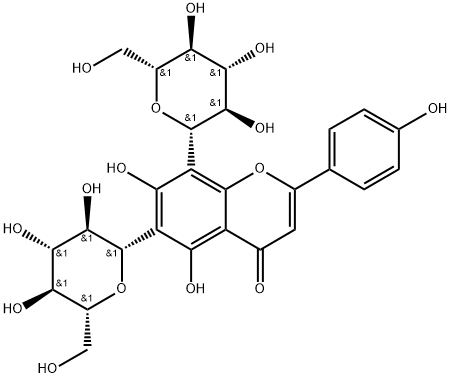
Physicochemical Properties
| Molecular Formula | C27H30O15 |
| Molecular Weight | 594.52 |
| Exact Mass | 594.158 |
| CAS # | 23666-13-9 |
| PubChem CID | 442664 |
| Appearance | White to yellow solid powder |
| Density | 1.8±0.1 g/cm3 |
| Boiling Point | 974.7±65.0 °C at 760 mmHg |
| Flash Point | 323.7±27.8 °C |
| Vapour Pressure | 0.0±0.3 mmHg at 25°C |
| Index of Refraction | 1.749 |
| LogP | -0.1 |
| Hydrogen Bond Donor Count | 11 |
| Hydrogen Bond Acceptor Count | 15 |
| Rotatable Bond Count | 5 |
| Heavy Atom Count | 42 |
| Complexity | 987 |
| Defined Atom Stereocenter Count | 10 |
| SMILES | C1=CC(=CC=C1C2=CC(=O)C3=C(C(=C(C(=C3O2)[C@H]4[C@@H]([C@H]([C@@H]([C@H](O4)CO)O)O)O)O)[C@H]5[C@@H]([C@H]([C@@H]([C@H](O5)CO)O)O)O)O)O |
| InChi Key | FIAAVMJLAGNUKW-VQVVXJKKSA-N |
| InChi Code | InChI=1S/C27H30O15/c28-6-12-17(32)21(36)23(38)26(41-12)15-19(34)14-10(31)5-11(8-1-3-9(30)4-2-8)40-25(14)16(20(15)35)27-24(39)22(37)18(33)13(7-29)42-27/h1-5,12-13,17-18,21-24,26-30,32-39H,6-7H2/t12-,13-,17-,18-,21+,22+,23-,24-,26+,27+/m1/s1 |
| Chemical Name | 5,7-dihydroxy-2-(4-hydroxyphenyl)-6,8-bis[(2S,3R,4R,5S,6R)-3,4,5-trihydroxy-6-(hydroxymethyl)oxan-2-yl]chromen-4-one |
| Synonyms | Vicenin2 Vicenin-2 Vicenin 2 |
| HS Tariff Code | 2934.99.9001 |
| Storage |
Powder-20°C 3 years 4°C 2 years In solvent -80°C 6 months -20°C 1 month Note: This product requires protection from light (avoid light exposure) during transportation and storage. |
| Shipping Condition | Room temperature (This product is stable at ambient temperature for a few days during ordinary shipping and time spent in Customs) |
Biological Activity
| ln Vitro | In NCI-H23 cells, vicenin 2 (10–100 µM; 24 hours) exhibits cytotoxic effects that increase with dosage. Vicenin 2 is harmless to fibroblasts and has radioprotective properties. It can raise caspase-3 activity, increase DNA fragmentation, increase Rad50 levels, and decrease MMP-2 and p21 protein levels [2]. |
| ln Vivo | In DSS-induced ductal inflammation, vicenin 2 (50 mg/kg; lung; for 7 days) efficiently lowers MPO activity and inhibits the expression of pro-inflammatory cytokines and other critical indicators [3]. |
| Cell Assay |
Cell viability assay[2] Cell Types: NCI-H23 Cell Tested Concentrations: 10 µM, 20 µM, 30 µM, 40 µM, 50 µM, 60 µM, 70 µM, 80 µM, 90 µM, 100 µM Incubation Duration: 24 hrs (hours) Experimental Results: demonstrated cytotoxic effect on NCI-H23 cells. |
| Animal Protocol |
Animal/Disease Models: Male C57BL/dextran sodium sulfate (DSS)-treated 6J mice (25g)[3] Doses: 50mg/kg Route of Administration: Oral; continued for 7 days Experimental Results: Effectively inhibited DSS by attenuating the expression of key inflammatory mediators Induced colitis. |
| References |
[1]. Bioassay-guided preparative separation of angiotensin-converting enzyme inhibitory C-flavone glycosides from Desmodium styracifolium by recycling complexation high-speed counter-current chromatography. J Pharm Biomed Anal. 2015 Jan;102:276-81. [2]. Vicenin-2: a potential radiosensitizer of non-small cell lung cancer cells. Mol Biol Rep. 2018 Oct;45(5):1219-1225. [3]. Anti-inflammatory effects of Vicenin-2 on dextran sulfate sodium-induced colitis in mice. Drug Dev Res. 2019 Aug;80(5):546-555. |
| Additional Infomation |
Isovitexin 8-C-beta-glucoside is a C-glycosyl compound that is isovitexin in which the hydrogen at position 8 is replaced by a beta-D-glucosyl residue. It has a role as a metabolite. It is a trihydroxyflavone and a C-glycosyl compound. It is functionally related to an isovitexin. Vicenin-2 has been reported in Camellia sinensis, Acanthus ebracteatus, and other organisms with data available. |
Solubility Data
| Solubility (In Vitro) |
DMSO : ~33.33 mg/mL (~56.06 mM) H2O : < 0.1 mg/mL |
| Solubility (In Vivo) |
Solubility in Formulation 1: ≥ 2.5 mg/mL (4.21 mM) (saturation unknown) in 10% DMSO + 40% PEG300 + 5% Tween80 + 45% Saline (add these co-solvents sequentially from left to right, and one by one), clear solution. For example, if 1 mL of working solution is to be prepared, you can add 100 μL of 25.0 mg/mL clear DMSO stock solution to 400 μL PEG300 and mix evenly; then add 50 μL Tween-80 to the above solution and mix evenly; then add 450 μL normal saline to adjust the volume to 1 mL. Preparation of saline: Dissolve 0.9 g of sodium chloride in 100 mL ddH₂ O to obtain a clear solution. Solubility in Formulation 2: ≥ 2.5 mg/mL (4.21 mM) (saturation unknown) in 10% DMSO + 90% (20% SBE-β-CD in Saline) (add these co-solvents sequentially from left to right, and one by one), clear solution. For example, if 1 mL of working solution is to be prepared, you can add 100 μL of 25.0 mg/mL clear DMSO stock solution to 900 μL of 20% SBE-β-CD physiological saline solution and mix evenly. Preparation of 20% SBE-β-CD in Saline (4°C,1 week): Dissolve 2 g SBE-β-CD in 10 mL saline to obtain a clear solution. (Please use freshly prepared in vivo formulations for optimal results.) |
| Preparing Stock Solutions | 1 mg | 5 mg | 10 mg | |
| 1 mM | 1.6820 mL | 8.4101 mL | 16.8203 mL | |
| 5 mM | 0.3364 mL | 1.6820 mL | 3.3641 mL | |
| 10 mM | 0.1682 mL | 0.8410 mL | 1.6820 mL |