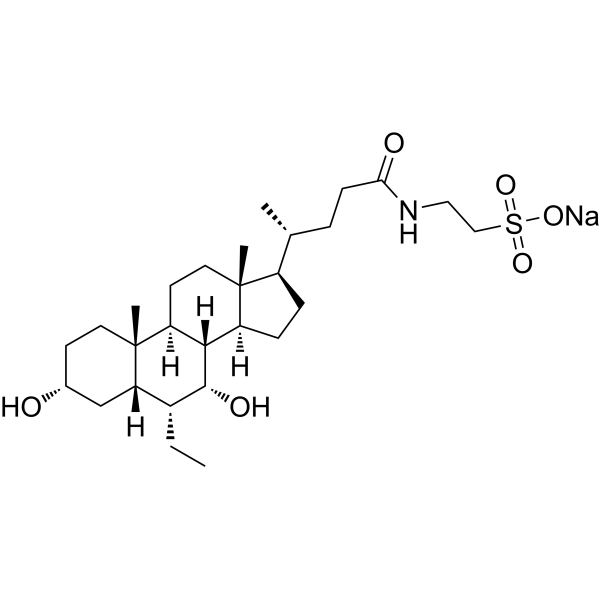
Physicochemical Properties
| Molecular Formula | C28H48NNAO6S |
| Molecular Weight | 549.74 |
| CAS # | 2278141-79-8 |
| Related CAS # | 863239-61-6 (Tauro-obeticholic acid); Tauro-obeticholic acid-d5 sodium |
| Appearance | Typically exists as solids at room temperature |
| SMILES | S(CCNC(CC[C@@H](C)[C@H]1CC[C@@H]2[C@]1(C)CC[C@@H]1[C@@]3(C)CC[C@H](C[C@H]3[C@@H](CC)[C@H]([C@H]12)O)O)=O)(=O)(=O)[O-].[Na+] |
| Synonyms | Tauro-Obeticholic Acid (sodium salt); 2278141-79-8; Tauro 6-Ethylchenodeoxycholic Acid Sodium SaltREPLACES E917458.; 2-?[[(3a,?5ss,?6a,?7a)?-?6-Ethyl-?3,?7-?dihydroxy-?24-?oxocholan-?24-?yl]?amino]?ethanesulfonic Acid Sodium Salt; Tauro-Obeticholic Acid Sodium Salt;; orb1980007; Tauro-obeticholic acid (sodium); HY-135399A; Tauro 6-Ethylchenodeoxycholic Acid Sodium Salt |
| HS Tariff Code | 2934.99.9001 |
| Storage |
Powder-20°C 3 years 4°C 2 years In solvent -80°C 6 months -20°C 1 month |
| Shipping Condition | Room temperature (This product is stable at ambient temperature for a few days during ordinary shipping and time spent in Customs) |
Biological Activity
| ADME/Pharmacokinetics |
- Plasma exposure parameters:
- In healthy Chinese subjects, tauro-obeticholic acid (Tauro-OCA) demonstrated bioequivalence between generic and branded formulations of obeticholic acid (OCA) under both fasting and fed conditions. The 90% confidence intervals (CIs) for the ratios of Cmax, AUC₀₋ₜ, and AUC₀₋∞ of Tauro-OCA were within the 80%–125% range required for bioequivalence. [1] - Food effect:Fed conditions increased plasma exposure of Tauro-OCA by 30–36% compared to fasting conditions, with Cmax and AUC₀₋∞ values showing statistically significant differences. [1] - Sex effect:Plasma exposure of Tauro-OCA was 37–84% higher in women compared to men under both fasting and fed conditions, with Cmax and AUC₀₋∞ values significantly influenced by sex. [1] - Pharmacokinetic parameters: - Tmax: Median time to reach Cmax for Tauro-OCA was 6–24 hours. [1] - Half-life (t₁/₂): Terminal elimination half-life of Tauro-OCA was approximately 44 hours. [1] |
| Toxicity/Toxicokinetics |
- Safety profile:Tauro-obeticholic acid was well tolerated in healthy Chinese subjects, with no significant differences in adverse event rates between generic and branded OCA formulations. Common adverse effects included headache, nausea, and fatigue, which were mild to moderate in severity. [1] - Plasma protein binding:Plasma protein binding of Tauro-OCA was >99%, primarily bound to albumin. [1] |
| References |
[1]. Comparison of the Pharmacokinetics of Generic Versus Branded Obeticholic Acid in a Chinese Population: Effects of Food and Sex. Clin Pharmacol Drug Dev. 2021 Jul;10(7):797-806. |
| Additional Infomation |
- Metabolic activation:Tauro-obeticholic acid is an active metabolite of OCA, formed through conjugation with taurine in the liver. Its pharmacological activity is mediated through activation of the farnesoid X receptor (FXR), similar to OCA. [1] - Clinical relevance:The higher plasma exposure of Tauro-OCA in women and under fed conditions suggests potential sex- and food-dependent dosing adjustments may be necessary for optimal therapeutic efficacy. [1] - Formulation:Both generic and branded OCA formulations were administered as 10-mg tablets under fasting or fed conditions. [1] |
Solubility Data
| Solubility (In Vitro) | May dissolve in DMSO (in most cases), if not, try other solvents such as H2O, Ethanol, or DMF with a minute amount of products to avoid loss of samples |
| Solubility (In Vivo) |
Note: Listed below are some common formulations that may be used to formulate products with low water solubility (e.g. < 1 mg/mL), you may test these formulations using a minute amount of products to avoid loss of samples. Injection Formulations (e.g. IP/IV/IM/SC) Injection Formulation 1: DMSO : Tween 80: Saline = 10 : 5 : 85 (i.e. 100 μL DMSO stock solution → 50 μL Tween 80 → 850 μL Saline) *Preparation of saline: Dissolve 0.9 g of sodium chloride in 100 mL ddH ₂ O to obtain a clear solution. Injection Formulation 2: DMSO : PEG300 :Tween 80 : Saline = 10 : 40 : 5 : 45 (i.e. 100 μL DMSO → 400 μLPEG300 → 50 μL Tween 80 → 450 μL Saline) Injection Formulation 3: DMSO : Corn oil = 10 : 90 (i.e. 100 μL DMSO → 900 μL Corn oil) Example: Take the Injection Formulation 3 (DMSO : Corn oil = 10 : 90) as an example, if 1 mL of 2.5 mg/mL working solution is to be prepared, you can take 100 μL 25 mg/mL DMSO stock solution and add to 900 μL corn oil, mix well to obtain a clear or suspension solution (2.5 mg/mL, ready for use in animals). Injection Formulation 4: DMSO : 20% SBE-β-CD in saline = 10 : 90 [i.e. 100 μL DMSO → 900 μL (20% SBE-β-CD in saline)] *Preparation of 20% SBE-β-CD in Saline (4°C,1 week): Dissolve 2 g SBE-β-CD in 10 mL saline to obtain a clear solution. Injection Formulation 5: 2-Hydroxypropyl-β-cyclodextrin : Saline = 50 : 50 (i.e. 500 μL 2-Hydroxypropyl-β-cyclodextrin → 500 μL Saline) Injection Formulation 6: DMSO : PEG300 : castor oil : Saline = 5 : 10 : 20 : 65 (i.e. 50 μL DMSO → 100 μLPEG300 → 200 μL castor oil → 650 μL Saline) Injection Formulation 7: Ethanol : Cremophor : Saline = 10: 10 : 80 (i.e. 100 μL Ethanol → 100 μL Cremophor → 800 μL Saline) Injection Formulation 8: Dissolve in Cremophor/Ethanol (50 : 50), then diluted by Saline Injection Formulation 9: EtOH : Corn oil = 10 : 90 (i.e. 100 μL EtOH → 900 μL Corn oil) Injection Formulation 10: EtOH : PEG300:Tween 80 : Saline = 10 : 40 : 5 : 45 (i.e. 100 μL EtOH → 400 μLPEG300 → 50 μL Tween 80 → 450 μL Saline) Oral Formulations Oral Formulation 1: Suspend in 0.5% CMC Na (carboxymethylcellulose sodium) Oral Formulation 2: Suspend in 0.5% Carboxymethyl cellulose Example: Take the Oral Formulation 1 (Suspend in 0.5% CMC Na) as an example, if 100 mL of 2.5 mg/mL working solution is to be prepared, you can first prepare 0.5% CMC Na solution by measuring 0.5 g CMC Na and dissolve it in 100 mL ddH2O to obtain a clear solution; then add 250 mg of the product to 100 mL 0.5% CMC Na solution, to make the suspension solution (2.5 mg/mL, ready for use in animals). Oral Formulation 3: Dissolved in PEG400 Oral Formulation 4: Suspend in 0.2% Carboxymethyl cellulose Oral Formulation 5: Dissolve in 0.25% Tween 80 and 0.5% Carboxymethyl cellulose Oral Formulation 6: Mixing with food powders Note: Please be aware that the above formulations are for reference only. InvivoChem strongly recommends customers to read literature methods/protocols carefully before determining which formulation you should use for in vivo studies, as different compounds have different solubility properties and have to be formulated differently. (Please use freshly prepared in vivo formulations for optimal results.) |
| Preparing Stock Solutions | 1 mg | 5 mg | 10 mg | |
| 1 mM | 1.8190 mL | 9.0952 mL | 18.1904 mL | |
| 5 mM | 0.3638 mL | 1.8190 mL | 3.6381 mL | |
| 10 mM | 0.1819 mL | 0.9095 mL | 1.8190 mL |