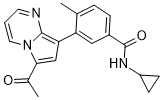
Physicochemical Properties
| Molecular Formula | C₂₀H₁₉N₃O₂ |
| Molecular Weight | 333.38 |
| Exact Mass | 333.147 |
| CAS # | 2079895-62-6 |
| PubChem CID | 123773279 |
| Appearance | Light yellow to yellow solid powder |
| Density | 1.3±0.1 g/cm3 |
| Index of Refraction | 1.681 |
| LogP | 1.25 |
| Hydrogen Bond Donor Count | 1 |
| Hydrogen Bond Acceptor Count | 3 |
| Rotatable Bond Count | 4 |
| Heavy Atom Count | 25 |
| Complexity | 533 |
| Defined Atom Stereocenter Count | 0 |
| InChi Key | RPBMXJHQYJLPDN-UHFFFAOYSA-N |
| InChi Code | InChI=1S/C20H19N3O2/c1-12-4-5-14(20(25)22-15-6-7-15)10-16(12)17-11-18(13(2)24)23-9-3-8-21-19(17)23/h3-5,8-11,15H,6-7H2,1-2H3,(H,22,25) |
| Chemical Name | 3-(6-acetylpyrrolo[1,2-a]pyrimidin-8-yl)-N-cyclopropyl-4-methylbenzamide |
| Synonyms | TP472 TP 472 |
| HS Tariff Code | 2934.99.9001 |
| Storage |
Powder-20°C 3 years 4°C 2 years In solvent -80°C 6 months -20°C 1 month |
| Shipping Condition | Room temperature (This product is stable at ambient temperature for a few days during ordinary shipping and time spent in Customs) |
Biological Activity
| ln Vitro | Concentration-dependent growth abnormalities in ESCs are caused by TP-472 (1 µM, 3 µM; 24-216 hours) [2]. At dosages of 5 and 10 μM, TP-472 (0.1-10 μM; 24 hours) efficiently suppresses the development of BRAF mutant melanoma cell lines [3]. At doses of 5 and 10 µM, TP-472 also significantly reduces the long-term survival of several melanoma cell lines (M14, SKMEL-28, A375, and A2058; this effect lasts for two weeks) [3]. When A375 cells are treated with TP-472 (5–10 μM) for 24 hours, the genes that encode several extracellular matrix (ECM) proteins, such as integrins, collagen, and fibronectin, are downregulated [3]. In A375 cells, TP-472 (0.1-10 μM; 24 hours) induces pro-apoptotic genes (BAX, MDM2, CDKN1A) to be upregulated [3]. |
| ln Vivo | TP-472 (20 mg/kg; i.p.; 3 times per week; for 5 weeks) effectively suppressed subcutaneous tumor growth in a melanoma xenograft mice model [3]. |
| Cell Assay |
Cell Viability Assay[2] Cell Types: Embryonic Stem Cells Tested Concentrations: 1 µM, 3 µM Incubation Duration: 24 hrs (hours), 72 hrs (hours), 120 hrs (hours), 168 hrs (hours), 216 hrs (hours) Experimental Results: Concentration-dependent growth defects in ESCs. Cell proliferation assay[3] Cell Types: M14 and SKMEL-28 cells[3] Tested Concentrations: 0.1 μM, 0.5 μM, 1 μM, 2 μM, 5 μM, 10 μM Incubation Duration: 24 hrs (hours) Experimental Results: Effectively inhibited the growth of both BRAF mutant melanoma cell lines. Western Blot Analysis[3] Cell Types: A375 Cell Tested Concentrations: 10 μM Incubation Duration: 24 hrs (hours) Experimental Results: Result in upregulation of pro-apoptotic genes. |
| Animal Protocol |
Animal/Disease Models: NSG mice (male, five to six weeks old) injected with A375-MA2 cells [3] Doses: 20 mg/kg Route of Administration: intraperitoneal (ip) injection; three times a week; for 5 consecutive weeks Experimental Results: Dramatically inhibited melanoma subcutaneoustumor growth in xenograft mouse models. |
| References |
[1]. Chemical probes and inhibitors of bromodomains outside the BET family. Medchemcomm. 2016 Dec 7;7(12):2246-2264. [2]. A non-canonical BRD9-containing BAF chromatin remodeling complex regulates naive pluripotency in mouse embryonic stem cells. Nat Commun. 2018 Dec 3;9(1):5139. [3]. The BRD9/7 Inhibitor TP-472 Blocks Melanoma Tumor Growth by Suppressing ECM-Mediated Oncogenic Signaling and Inducing Apoptosis. Cancers (Basel). 2021 Nov 3;13(21):5516. |
Solubility Data
| Solubility (In Vitro) | DMSO : ~100 mg/mL (~299.96 mM) |
| Solubility (In Vivo) |
Solubility in Formulation 1: ≥ 2.5 mg/mL (7.50 mM) (saturation unknown) in 10% DMSO + 40% PEG300 + 5% Tween80 + 45% Saline (add these co-solvents sequentially from left to right, and one by one), clear solution. For example, if 1 mL of working solution is to be prepared, you can add 100 μL of 25.0 mg/mL clear DMSO stock solution to 400 μL PEG300 and mix evenly; then add 50 μL Tween-80 to the above solution and mix evenly; then add 450 μL normal saline to adjust the volume to 1 mL. Preparation of saline: Dissolve 0.9 g of sodium chloride in 100 mL ddH₂ O to obtain a clear solution. Solubility in Formulation 2: ≥ 2.5 mg/mL (7.50 mM) (saturation unknown) in 10% DMSO + 90% (20% SBE-β-CD in Saline) (add these co-solvents sequentially from left to right, and one by one), clear solution. For example, if 1 mL of working solution is to be prepared, you can add 100 μL of 25.0 mg/mL clear DMSO stock solution to 900 μL of 20% SBE-β-CD physiological saline solution and mix evenly. Preparation of 20% SBE-β-CD in Saline (4°C,1 week): Dissolve 2 g SBE-β-CD in 10 mL saline to obtain a clear solution. (Please use freshly prepared in vivo formulations for optimal results.) |
| Preparing Stock Solutions | 1 mg | 5 mg | 10 mg | |
| 1 mM | 2.9996 mL | 14.9979 mL | 29.9958 mL | |
| 5 mM | 0.5999 mL | 2.9996 mL | 5.9992 mL | |
| 10 mM | 0.3000 mL | 1.4998 mL | 2.9996 mL |