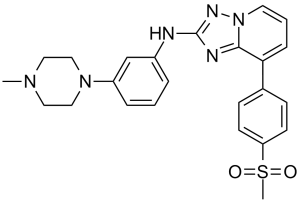
CEP33779 is a novel, potent, orally bioactive, highly selective inhibitor of JAK2 (Janus kinase) with potential antitumor and anti-inflammatory activity. It inhibits JAK2 with an IC50 of 1.8 nM, and exhibits >40- and >800-fold selectivity for JAK2 over JAK1 and TYK2. CEP33779 showed high activity in mice with collagen-induced arthritis (CIA) and collagen-antibody induced arthritis (CAIA). It induced regression of established colorectal tumors, reduced angiogenesis, and reduced proliferation of tumor cells. The ability of CEP-33779 to suppress growth of colorectal tumors by inhibiting the IL-6/JAK2/STAT3 signaling suggests a potential therapeutic utility of JAK2 inhibitors in multiple tumors types, particularly those with a strong inflammatory component.
Physicochemical Properties
| Molecular Formula | C24H26N6O2S | |
| Molecular Weight | 462.57 | |
| Exact Mass | 462.183 | |
| CAS # | 1257704-57-6 | |
| Related CAS # |
|
|
| PubChem CID | 57336812 | |
| Appearance | Light yellow to yellow solid powder | |
| Density | 1.4±0.1 g/cm3 | |
| Index of Refraction | 1.693 | |
| LogP | 2.02 | |
| Hydrogen Bond Donor Count | 1 | |
| Hydrogen Bond Acceptor Count | 7 | |
| Rotatable Bond Count | 5 | |
| Heavy Atom Count | 33 | |
| Complexity | 745 | |
| Defined Atom Stereocenter Count | 0 | |
| InChi Key | RFZKSQIFOZZIAQ-UHFFFAOYSA-N | |
| InChi Code | InChI=1S/C24H26N6O2S/c1-28-13-15-29(16-14-28)20-6-3-5-19(17-20)25-24-26-23-22(7-4-12-30(23)27-24)18-8-10-21(11-9-18)33(2,31)32/h3-12,17H,13-16H2,1-2H3,(H,25,27) | |
| Chemical Name | N-(3-(4-methylpiperazin-1-yl)phenyl)-8-(4-(methylsulfonyl)phenyl)-[1,2,4]triazolo[1,5-a]pyridin-2-amine | |
| Synonyms | CEP-33779; CEP 33779; CEP33779 | |
| HS Tariff Code | 2934.99.9001 | |
| Storage |
Powder-20°C 3 years 4°C 2 years In solvent -80°C 6 months -20°C 1 month |
|
| Shipping Condition | Room temperature (This product is stable at ambient temperature for a few days during ordinary shipping and time spent in Customs) |
Biological Activity
| ln Vitro | At non-toxic concentrations, P-glycoprotein-overexpressing multidrug-resistant cells' overexpression sensitivity to CEP-33779's anti-cancer substrates is markedly increased. Through inhibition of P-glycoprotein transport function overexpression, CEP-33779 drastically lowers doxorubicin efflux and increases intracellular accumulation [3]. | ||
| ln Vivo | In nude mice, CEP-33779 showed a good PK profile with an intravenous half-life of one hour, a moderate distribution (Vd=2.6 L/kg), and a detectable oral exposure with an estimated 33% bioavailability. In the CWR22 xenograft model, it demonstrated antitumor efficacy; oral administration at 30 mg/kg bid for 14 days led to tumor stasis and partial regression in 5/10 animals [1]. Most animals that received CEP-33779 had almost total tumor shrinkage; the few tumor nodules that remained were tiny, poorly vascularized, and appeared necrotic. Tumor-associated NF-κB activation is inhibited by CEP-33779 [2]. | ||
| Animal Protocol |
|
||
| References |
[1]. A selective, orally bioavailable 1,2,4-triazolo[1,5-a]pyridine-based inhibitor of Janus kinase 2 for use in anticancer therapy: discovery of CEP-33779. J Med Chem. 2012 Jun 14;55(11):5243-54. [2]. Therapeutic efficacy of CEP-33779, a novel selective JAK2 inhibitor, in a mouse model of colitis-induced colorectal cancer. Mol Cancer Ther. 2012 Apr;11(4):984-93. [3]. CEP-33779 antagonizes ATP-binding cassette subfamily B member 1 mediated multidrug resistance by inhibiting its transport function. Biochem Pharmacol. 2014 Sep 15;91(2):144-56. |
Solubility Data
| Solubility (In Vitro) |
|
|||
| Solubility (In Vivo) |
Solubility in Formulation 1: ≥ 2.5 mg/mL (5.40 mM) (saturation unknown) in 10% DMSO + 40% PEG300 + 5% Tween80 + 45% Saline (add these co-solvents sequentially from left to right, and one by one), clear solution. For example, if 1 mL of working solution is to be prepared, you can add 100 μL of 25.0 mg/mL clear DMSO stock solution to 400 μL PEG300 and mix evenly; then add 50 μL Tween-80 to the above solution and mix evenly; then add 450 μL normal saline to adjust the volume to 1 mL. Preparation of saline: Dissolve 0.9 g of sodium chloride in 100 mL ddH₂ O to obtain a clear solution. Solubility in Formulation 2: ≥ 2.5 mg/mL (5.40 mM) (saturation unknown) in 10% DMSO + 90% (20% SBE-β-CD in Saline) (add these co-solvents sequentially from left to right, and one by one), clear solution. For example, if 1 mL of working solution is to be prepared, you can add 100 μL of 25.0 mg/mL clear DMSO stock solution to 900 μL of 20% SBE-β-CD physiological saline solution and mix evenly. Preparation of 20% SBE-β-CD in Saline (4°C,1 week): Dissolve 2 g SBE-β-CD in 10 mL saline to obtain a clear solution. Solubility in Formulation 3: ≥ 2.5 mg/mL (5.40 mM) (saturation unknown) in 10% DMSO + 90% Corn Oil (add these co-solvents sequentially from left to right, and one by one), clear solution. For example, if 1 mL of working solution is to be prepared, you can add 100 μL of 25.0 mg/mL clear DMSO stock solution to 900 μL of corn oil and mix evenly. Solubility in Formulation 4: 1% DMSO+30% polyethylene glycol+1% Tween 80:30 mg/mL Solubility in Formulation 5: 10 mg/mL (21.62 mM) in 50% PEG300 50% Saline (add these co-solvents sequentially from left to right, and one by one), suspension solution; with ultrasonication. Preparation of saline: Dissolve 0.9 g of sodium chloride in 100 mL ddH₂ O to obtain a clear solution. (Please use freshly prepared in vivo formulations for optimal results.) |
| Preparing Stock Solutions | 1 mg | 5 mg | 10 mg | |
| 1 mM | 2.1618 mL | 10.8092 mL | 21.6183 mL | |
| 5 mM | 0.4324 mL | 2.1618 mL | 4.3237 mL | |
| 10 mM | 0.2162 mL | 1.0809 mL | 2.1618 mL |