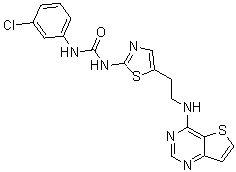
SNS-314 (SNS314) is a novel, potent and selective, synthetic small molecule inhibitor of Aurora A/B/C with anticancer activity. It inhibits Aurora kinases with IC50 of 9 nM, 31 nM, and 3 nM for Aurora A/B/C, respectively. It is less potent to Trk A/B, Flt4, Fms, Axl, c-Raf and DDR2. SNS-314 has potential antineoplastic activity. The mechanism of SNS-314 is to selectively bind to and inhibit Aurora kinases (AK) A and B, which may result in the inhibition of cellular division and proliferation in tumor cells that overexpress Aurora kinases. Aurora kinases are serine-threonine kinases that play essential roles in mitotic checkpoint control during mitosis.
Physicochemical Properties
| Molecular Formula | C18H15CLN6OS2 |
| Molecular Weight | 430.93 |
| Exact Mass | 430.043 |
| CAS # | 1057249-41-8 |
| Related CAS # | SNS-314 mesylate;1146618-41-8 |
| PubChem CID | 24995524 |
| Appearance | Typically exists as solid at room temperature |
| Density | 1.6±0.1 g/cm3 |
| Index of Refraction | 1.815 |
| LogP | 5.36 |
| Hydrogen Bond Donor Count | 3 |
| Hydrogen Bond Acceptor Count | 7 |
| Rotatable Bond Count | 6 |
| Heavy Atom Count | 28 |
| Complexity | 532 |
| Defined Atom Stereocenter Count | 0 |
| SMILES | ClC1=CC=CC(=C1)NC(NC1=NC=C(CCNC2=C3C(C=CS3)=NC=N2)S1)=O |
| InChi Key | FAYAUAZLLLJJGH-UHFFFAOYSA-N |
| InChi Code | InChI=1S/C18H15ClN6OS2/c19-11-2-1-3-12(8-11)24-17(26)25-18-21-9-13(28-18)4-6-20-16-15-14(5-7-27-15)22-10-23-16/h1-3,5,7-10H,4,6H2,(H,20,22,23)(H2,21,24,25,26) |
| Chemical Name | N-(3-Chlorophenyl)-N'-[5-[2-(thieno[3,2-d]pyrimidin-4-ylamino)ethyl]-2-thiazolyl]urea. |
| Synonyms | SNS314; SNS-314; SNS 314 |
| HS Tariff Code | 2934.99.9001 |
| Storage |
Powder-20°C 3 years 4°C 2 years In solvent -80°C 6 months -20°C 1 month |
| Shipping Condition | Room temperature (This product is stable at ambient temperature for a few days during ordinary shipping and time spent in Customs) |
Biological Activity
| ln Vitro | SNS-314 inhibits the growth of a wide range of tumor cell lines, including HeLa, PC-3, A2780, MDA-MB-231, H-1299, and HT29. The IC50 values of these cell lines range from 1.8 nM in ovarian cancer cells to 24 nM in colon cancer cells, A2780, and HT29[2]. | ||
| ln Vivo | The treatment of 50 and 100 mg/kg SNS-314 causes dose-dependent suppression of histone H3 phosphorylation in the HCT116 human colon cancer xenograft model, which lasts for at least 10 hours. SNS-314 exhibits dose-dependent substantial tumor growth inhibition when administered according to a range of regimens, such as weekly, biweekly, or five days on and nine days off[2]. | ||
| Animal Protocol |
|
||
| References |
[1]. Discovery of a potent and selective aurora kinase inhibitor. Bioorg Med Chem Lett. 2008 Sep 1;18(17):4880-4. [2]. SNS-314, a pan-Aurora kinase inhibitor, shows potent anti-tumor activity and dosing flexibility in vivo. Cancer Chemother Pharmacol. 2010 Mar;65(4):707-17. |
||
| Additional Infomation |
1-(3-chlorophenyl)-3-[5-[2-(4-thieno[3,2-d]pyrimidinylamino)ethyl]-2-thiazolyl]urea is a member of ureas. SNS-314 is a potent and selective inhibitor of Aurora kinases A, B, and C. Proliferating cells treated with SNS-314 bypass the mitotic spindle checkpoint and fail to undergo cytokinesis, leading to multiple rounds of endoreduplication and eventually cell death. SNS-314 inhibits tumor growth in a variety of preclinical models, and it is now being tested in single agent Phase 1 studies in patients with advanced solid tumours. Aurora Kinase Inhibitor SNS-314 is a synthetic small molecule Aurora kinase (AK) inhibitor with potential antineoplastic activity. Aurora kinase inhibitor SNS-314 selectively binds to and inhibits AKs A and B, which may result in the inhibition of cellular division and proliferation in tumor cells that overexpress AKs. AKs are serine-threonine kinases that play essential roles in mitotic checkpoint control during mitosis. Drug Indication Investigated for use/treatment in solid tumors. Mechanism of Action The process of cell division, or mitosis, plays a critical role in the uncontrolled proliferation that is a hallmark of cancer. During mitosis, a cell aligns duplicate copies of its DNA along a mitotic spindle and subdivides itself through a process called cytokinesis, creating two identical daughter cells. This process is often poorly regulated in cancer, leading to rapid proliferation and tissue growth. Aurora kinases (A, B, and C) play important, though differentiated, roles in mitosis. Aurora A controls the formation of the spindle assembly, while Aurora B ensures that the DNA is appropriately aligned and that cytokinesis proceeds successfully. Less is known about Aurora C, though it is thought to serve many of the same functions as Aurora B. Elevated expression of Aurora A has been detected in a high percentage of colon, breast, ovarian, gastric, and pancreatic tumors. Aurora B and C are also expressed at high levels in primary tumors. Given the central roles of all three Aurora kinases in regulating mitosis and the association between their overexpression and tumorigenesis, they are being evaluated as potential targets in cancer therapy. SNS-314 is a potent inhibitor of all 3 Aurora kinases. Cells treated with SNS-314 make additional copies of their DNA, but are unable to create functional spindle assemblies or replicate. As a result, these cells are unable to progress, and ultimately die by a variety of mechanisms. Since most normal cells are not undergoing mitosis in their normal settings, SNS-314 is expected to affect only highly proliferating tissues, particularly tumor tissues. SNS-314 is being tested in a Phase 1 trial in patients with advanced solid tumor malignancies. |
Solubility Data
| Solubility (In Vitro) |
|
|||
| Solubility (In Vivo) |
Note: Listed below are some common formulations that may be used to formulate products with low water solubility (e.g. < 1 mg/mL), you may test these formulations using a minute amount of products to avoid loss of samples. Injection Formulations (e.g. IP/IV/IM/SC) Injection Formulation 1: DMSO : Tween 80: Saline = 10 : 5 : 85 (i.e. 100 μL DMSO stock solution → 50 μL Tween 80 → 850 μL Saline) *Preparation of saline: Dissolve 0.9 g of sodium chloride in 100 mL ddH ₂ O to obtain a clear solution. Injection Formulation 2: DMSO : PEG300 :Tween 80 : Saline = 10 : 40 : 5 : 45 (i.e. 100 μL DMSO → 400 μLPEG300 → 50 μL Tween 80 → 450 μL Saline) Injection Formulation 3: DMSO : Corn oil = 10 : 90 (i.e. 100 μL DMSO → 900 μL Corn oil) Example: Take the Injection Formulation 3 (DMSO : Corn oil = 10 : 90) as an example, if 1 mL of 2.5 mg/mL working solution is to be prepared, you can take 100 μL 25 mg/mL DMSO stock solution and add to 900 μL corn oil, mix well to obtain a clear or suspension solution (2.5 mg/mL, ready for use in animals). Injection Formulation 4: DMSO : 20% SBE-β-CD in saline = 10 : 90 [i.e. 100 μL DMSO → 900 μL (20% SBE-β-CD in saline)] *Preparation of 20% SBE-β-CD in Saline (4°C,1 week): Dissolve 2 g SBE-β-CD in 10 mL saline to obtain a clear solution. Injection Formulation 5: 2-Hydroxypropyl-β-cyclodextrin : Saline = 50 : 50 (i.e. 500 μL 2-Hydroxypropyl-β-cyclodextrin → 500 μL Saline) Injection Formulation 6: DMSO : PEG300 : castor oil : Saline = 5 : 10 : 20 : 65 (i.e. 50 μL DMSO → 100 μLPEG300 → 200 μL castor oil → 650 μL Saline) Injection Formulation 7: Ethanol : Cremophor : Saline = 10: 10 : 80 (i.e. 100 μL Ethanol → 100 μL Cremophor → 800 μL Saline) Injection Formulation 8: Dissolve in Cremophor/Ethanol (50 : 50), then diluted by Saline Injection Formulation 9: EtOH : Corn oil = 10 : 90 (i.e. 100 μL EtOH → 900 μL Corn oil) Injection Formulation 10: EtOH : PEG300:Tween 80 : Saline = 10 : 40 : 5 : 45 (i.e. 100 μL EtOH → 400 μLPEG300 → 50 μL Tween 80 → 450 μL Saline) Oral Formulations Oral Formulation 1: Suspend in 0.5% CMC Na (carboxymethylcellulose sodium) Oral Formulation 2: Suspend in 0.5% Carboxymethyl cellulose Example: Take the Oral Formulation 1 (Suspend in 0.5% CMC Na) as an example, if 100 mL of 2.5 mg/mL working solution is to be prepared, you can first prepare 0.5% CMC Na solution by measuring 0.5 g CMC Na and dissolve it in 100 mL ddH2O to obtain a clear solution; then add 250 mg of the product to 100 mL 0.5% CMC Na solution, to make the suspension solution (2.5 mg/mL, ready for use in animals). Oral Formulation 3: Dissolved in PEG400 Oral Formulation 4: Suspend in 0.2% Carboxymethyl cellulose Oral Formulation 5: Dissolve in 0.25% Tween 80 and 0.5% Carboxymethyl cellulose Oral Formulation 6: Mixing with food powders Note: Please be aware that the above formulations are for reference only. InvivoChem strongly recommends customers to read literature methods/protocols carefully before determining which formulation you should use for in vivo studies, as different compounds have different solubility properties and have to be formulated differently. (Please use freshly prepared in vivo formulations for optimal results.) |
| Preparing Stock Solutions | 1 mg | 5 mg | 10 mg | |
| 1 mM | 2.3206 mL | 11.6028 mL | 23.2056 mL | |
| 5 mM | 0.4641 mL | 2.3206 mL | 4.6411 mL | |
| 10 mM | 0.2321 mL | 1.1603 mL | 2.3206 mL |