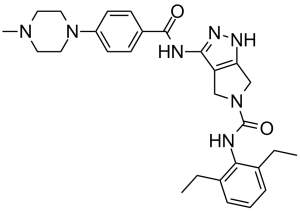
PHA-680632 (PHA680632) is a novel and potent pan-aurora kinase inhibitor with potential antitumor activity. It inhibits Aurora A/B/C with IC50s of 27 nM, 135 nM and 120 nM, respectively, and shows 10- to 200-fold higher selectivity for aurora over FGFR1, FLT3, LCK, PLK1, STLK2, and VEGFR2/3. Moreover, PHA 680632 shows potent in vitro antiproliferative activity and high in vivo antitumor efficacy. It potently inhibits proliferation of various cancer cells including HCT116, A2780, HL60 and Hela cells with IC50 values in the nanomolar to micromolar range (0.06 to 7.15 μM).
Physicochemical Properties
| Molecular Formula | C28H35N7O2 | |
| Molecular Weight | 501.62 | |
| Exact Mass | 501.285 | |
| CAS # | 398493-79-3 | |
| Related CAS # |
|
|
| PubChem CID | 11249084 | |
| Appearance | White to off-white solid powder | |
| Density | 1.3±0.1 g/cm3 | |
| Boiling Point | 709.0±60.0 °C at 760 mmHg | |
| Flash Point | 382.6±32.9 °C | |
| Vapour Pressure | 0.0±2.3 mmHg at 25°C | |
| Index of Refraction | 1.676 | |
| LogP | 3.04 | |
| Hydrogen Bond Donor Count | 3 | |
| Hydrogen Bond Acceptor Count | 5 | |
| Rotatable Bond Count | 6 | |
| Heavy Atom Count | 37 | |
| Complexity | 769 | |
| Defined Atom Stereocenter Count | 0 | |
| InChi Key | OBWNXGOQPLDDPS-UHFFFAOYSA-N | |
| InChi Code | InChI=1S/C28H35N7O2/c1-4-19-7-6-8-20(5-2)25(19)29-28(37)35-17-23-24(18-35)31-32-26(23)30-27(36)21-9-11-22(12-10-21)34-15-13-33(3)14-16-34/h6-12H,4-5,13-18H2,1-3H3,(H,29,37)(H2,30,31,32,36) | |
| Chemical Name | N-(2,6-diethylphenyl)-3-(4-(4-methylpiperazin-1-yl)benzamido)pyrrolo[3,4-c]pyrazole-5(1H,4H,6H)-carboxamide | |
| Synonyms | PHA 680632; PHA-680632; PHA 680632. | |
| HS Tariff Code | 2934.99.9001 | |
| Storage |
Powder-20°C 3 years 4°C 2 years In solvent -80°C 6 months -20°C 1 month |
|
| Shipping Condition | Room temperature (This product is stable at ambient temperature for a few days during ordinary shipping and time spent in Customs) |
Biological Activity
| ln Vitro | PHA-680632 exhibits 30- to 200-fold higher IC50 values for FLT3, LCK, PLK1, STLK2, VEGFR2, and VEGFR3 in comparison to Aurora A. Strong antiproliferative action against a variety of cell types is exhibited by PHA-680632. The following have different IC50 values: 0.32, 0.41, 0.06, 1.17, 0.56, 0.62, 0.29, 0.11, 1.56, 0.62, 0.07 for C33A, HeLa, HCT116, HT29, LOVO, A549, MCF7, A2780, U2OS, DU145, U937, HL60, and NHDF. ,0.13,0.41 micrometers. Tumor cells become polyploid due to PHA-680632. Treatment with PHA-680632 cells produces a phenotype resembling Aurora A or B depletion [1]. In certain cancer cell lines, PHA680632 induces polyploidy and inhibits colony formation. Cancer cells respond better to radiation when PHA680632 inhibits Aurora-A, particularly p53-deficient cells [2]. | ||
| ln Vivo | In animal studies, PHA-680632 reduces the growth of tumors. When PHA-680632 was administered at a dose of 45 mg/kg in the HL60 human acute myeloid leukemia xenograft model, 85% of TGIs occurred without any severe side effects. PHA-680632 therapy at 60 mg/kg iv for 5 days produced 78% of TGIs without any toxicities in the A2780 human ovarian cancer model [1]. PHA680632 does not function as a radiosensitizer, but it is linked to radiation-associated additive effects in cancer cells, especially in p53-deficient cells [2]. | ||
| Animal Protocol |
|
||
| References |
[1]. PHA-680632, a novel Aurora kinase inhibitor with potent antitumoral activity. Clin Cancer Res. 2006 Jul 1;12(13):4080-9. [2]. Enhancement of radiation response by inhibition of Aurora-A kinase using siRNA or a selective Aurora kinase inhibitor PHA680632 in p53-deficient cancer cells. Br J Cancer. 2007 Dec 17;97(12):1664-72. |
Solubility Data
| Solubility (In Vitro) |
|
|||
| Solubility (In Vivo) |
Solubility in Formulation 1: ≥ 2.08 mg/mL (4.15 mM) (saturation unknown) in 10% DMSO + 40% PEG300 + 5% Tween80 + 45% Saline (add these co-solvents sequentially from left to right, and one by one), clear solution. For example, if 1 mL of working solution is to be prepared, you can add 100 μL of 20.8 mg/mL clear DMSO stock solution to 400 μL PEG300 and mix evenly; then add 50 μL Tween-80 to the above solution and mix evenly; then add 450 μL normal saline to adjust the volume to 1 mL. Preparation of saline: Dissolve 0.9 g of sodium chloride in 100 mL ddH₂ O to obtain a clear solution. Solubility in Formulation 2: ≥ 2.08 mg/mL (4.15 mM) (saturation unknown) in 10% DMSO + 90% (20% SBE-β-CD in Saline) (add these co-solvents sequentially from left to right, and one by one), clear solution. For example, if 1 mL of working solution is to be prepared, you can add 100 μL of 20.8 mg/mL clear DMSO stock solution to 900 μL of 20% SBE-β-CD physiological saline solution and mix evenly. Preparation of 20% SBE-β-CD in Saline (4°C,1 week): Dissolve 2 g SBE-β-CD in 10 mL saline to obtain a clear solution. Solubility in Formulation 3: ≥ 2.08 mg/mL (4.15 mM) (saturation unknown) in 10% DMSO + 90% Corn Oil (add these co-solvents sequentially from left to right, and one by one), clear solution. For example, if 1 mL of working solution is to be prepared, you can add 100 μL of 20.8 mg/mL clear DMSO stock solution to 900 μL of corn oil and mix evenly. Solubility in Formulation 4: 10% Tween 80: 30 mg/mL (Please use freshly prepared in vivo formulations for optimal results.) |
| Preparing Stock Solutions | 1 mg | 5 mg | 10 mg | |
| 1 mM | 1.9935 mL | 9.9677 mL | 19.9354 mL | |
| 5 mM | 0.3987 mL | 1.9935 mL | 3.9871 mL | |
| 10 mM | 0.1994 mL | 0.9968 mL | 1.9935 mL |