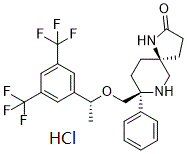
Physicochemical Properties
| Molecular Formula | C25H27CLF6N2O2 |
| Molecular Weight | 536.937506914139 |
| Exact Mass | 536.167 |
| CAS # | 858102-79-1 |
| Related CAS # | Rolapitant;552292-08-7;Rolapitant hydrochloride hydrate;914462-92-3 |
| PubChem CID | 71587824 |
| Appearance | Typically exists as solid at room temperature |
| LogP | 7.189 |
| Hydrogen Bond Donor Count | 3 |
| Hydrogen Bond Acceptor Count | 9 |
| Rotatable Bond Count | 5 |
| Heavy Atom Count | 36 |
| Complexity | 731 |
| Defined Atom Stereocenter Count | 3 |
| SMILES | Cl.FC(C1C=C(C(F)(F)F)C=C(C=1)[C@@H](C)OC[C@@]1(C2C=CC=CC=2)CC[C@]2(CCC(N2)=O)CN1)(F)F |
| InChi Key | VEWAWEMXVUFANV-PVBCUUEWSA-N |
| InChi Code | InChI=1S/C25H26F6N2O2.ClH/c1-16(17-11-19(24(26,27)28)13-20(12-17)25(29,30)31)35-15-23(18-5-3-2-4-6-18)10-9-22(14-32-23)8-7-21(34)33-22;/h2-6,11-13,16,32H,7-10,14-15H2,1H3,(H,33,34);1H/t16-,22-,23-;/m1./s1 |
| Chemical Name | (5S,8S)-8-[[(1R)-1-[3,5-bis(trifluoromethyl)phenyl]ethoxy]methyl]-8-phenyl-1,9-diazaspiro[4.5]decan-2-one;hydrochloride |
| HS Tariff Code | 2934.99.9001 |
| Storage |
Powder-20°C 3 years 4°C 2 years In solvent -80°C 6 months -20°C 1 month |
| Shipping Condition | Room temperature (This product is stable at ambient temperature for a few days during ordinary shipping and time spent in Customs) |
Biological Activity
| ln Vitro | Rolapitant exhibits superior affinity for NK1 receptors in humans, guinea pigs, gerbils, and monkeys compared to rat, mouse, and rabbit, and it has over 1000-fold selectivity for human NK2 and NK3 isoforms [1]. In CHO cells expressing human NK1 receptor, rolapitant (1-1000 nM) competitively and concentration-dependently blocks calcium efflux generated by GR-73632, an NK1 receptor agonist [1]. |
| ln Vivo | In Mongolian gerbils, rolapitant (0.03–1 mg/kg orally, 0.3–1 mg/kg intravenously; single dose) reduces the foot tapping response induced by GR-73632 [1]. Rolapitant (0.03-1 mg/kg; oral; single dose; observed for 72 hours) inhibits the acute vomiting that ferrets experience when given apomorphine and cisplatin [1]. |
| Animal Protocol |
Animal/Disease Models: Female Mongolian gerbil (30-60 g; anesthetized with oxygen:isoflurane mixture immediately after 4 h PO or immediately after IV, followed by ICV injection of 5 μl of 3 pmol GR-73632 solution) [1] Doses: 0.03 orally , 0.1, 0.3 and 1 mg/kg, IV 0.3 and 1 mg/kg Dosing: Oral or IV, single dose Experimental Results: GR-73632-induced foot tapping response was attenuated when administered PO 4, dose-dependent One hour before the dependence test, the ID90 is 0.3 mg/kg, and foot pedaling is inhibited for at least 24 hrs (hrs (hours)). When administered intravenously (iv) (iv)(iv), GR-73632 induced a dose-dependent blockade of foot tapping, with complete blockade observed at 1 mg/kg. Animal/Disease Models: Ferrets (treated with 0.125 mg/kg apomorphine subcutaneously (sc) (sc) or 10 mg/kg cisplatin intraperitoneally (ip) (ip)) [1] Doses: 0.03, 0.1, 0.3 and 1 mg/kg Route of Administration: PO; single dose; Results observed for 72 hrs (hrs (hours)): Blocked dose-dependent acute vomiting in ferrets induced by apomorphine and cisplatin. Retching and vomiting were significan |
| References |
[1]. Rolapitant (SCH 619734): a potent, selective and orally active neurokininNK1 receptor antagonist with centrally-mediated antiemetic effects inferrets. Pharmacol Biochem Behav. 2012 Jul;102(1):95-100. [2]. Study of rolapitant, a novel, long-acting, NK-1 receptor antagonist, for the prevention of chemotherapy-induced nausea and vomiting (CINV) due to highly emetogenic chemotherapy (HEC). Support Care Cancer. 2015 Nov;23(11):3281-8. |
| Additional Infomation |
Rolapitant hydrochloride (anhydrous) is a hydrochloride obtained by combining irinotecan with one molar equivalent of hydrochloric acid. Used (in the form of the hydrate) for the prevention of delayed nausea and vomiting associated with initial and repeat courses of emetogenic cancer chemotherapy. It has a role as an antiemetic and a neurokinin-1 receptor antagonist. It contains a rolapitant(1+). See also: Rolapitant Hydrochloride (annotation moved to). |
Solubility Data
| Solubility (In Vitro) | May dissolve in DMSO (in most cases), if not, try other solvents such as H2O, Ethanol, or DMF with a minute amount of products to avoid loss of samples |
| Solubility (In Vivo) |
Note: Listed below are some common formulations that may be used to formulate products with low water solubility (e.g. < 1 mg/mL), you may test these formulations using a minute amount of products to avoid loss of samples. Injection Formulations (e.g. IP/IV/IM/SC) Injection Formulation 1: DMSO : Tween 80: Saline = 10 : 5 : 85 (i.e. 100 μL DMSO stock solution → 50 μL Tween 80 → 850 μL Saline) *Preparation of saline: Dissolve 0.9 g of sodium chloride in 100 mL ddH ₂ O to obtain a clear solution. Injection Formulation 2: DMSO : PEG300 :Tween 80 : Saline = 10 : 40 : 5 : 45 (i.e. 100 μL DMSO → 400 μLPEG300 → 50 μL Tween 80 → 450 μL Saline) Injection Formulation 3: DMSO : Corn oil = 10 : 90 (i.e. 100 μL DMSO → 900 μL Corn oil) Example: Take the Injection Formulation 3 (DMSO : Corn oil = 10 : 90) as an example, if 1 mL of 2.5 mg/mL working solution is to be prepared, you can take 100 μL 25 mg/mL DMSO stock solution and add to 900 μL corn oil, mix well to obtain a clear or suspension solution (2.5 mg/mL, ready for use in animals). Injection Formulation 4: DMSO : 20% SBE-β-CD in saline = 10 : 90 [i.e. 100 μL DMSO → 900 μL (20% SBE-β-CD in saline)] *Preparation of 20% SBE-β-CD in Saline (4°C,1 week): Dissolve 2 g SBE-β-CD in 10 mL saline to obtain a clear solution. Injection Formulation 5: 2-Hydroxypropyl-β-cyclodextrin : Saline = 50 : 50 (i.e. 500 μL 2-Hydroxypropyl-β-cyclodextrin → 500 μL Saline) Injection Formulation 6: DMSO : PEG300 : castor oil : Saline = 5 : 10 : 20 : 65 (i.e. 50 μL DMSO → 100 μLPEG300 → 200 μL castor oil → 650 μL Saline) Injection Formulation 7: Ethanol : Cremophor : Saline = 10: 10 : 80 (i.e. 100 μL Ethanol → 100 μL Cremophor → 800 μL Saline) Injection Formulation 8: Dissolve in Cremophor/Ethanol (50 : 50), then diluted by Saline Injection Formulation 9: EtOH : Corn oil = 10 : 90 (i.e. 100 μL EtOH → 900 μL Corn oil) Injection Formulation 10: EtOH : PEG300:Tween 80 : Saline = 10 : 40 : 5 : 45 (i.e. 100 μL EtOH → 400 μLPEG300 → 50 μL Tween 80 → 450 μL Saline) Oral Formulations Oral Formulation 1: Suspend in 0.5% CMC Na (carboxymethylcellulose sodium) Oral Formulation 2: Suspend in 0.5% Carboxymethyl cellulose Example: Take the Oral Formulation 1 (Suspend in 0.5% CMC Na) as an example, if 100 mL of 2.5 mg/mL working solution is to be prepared, you can first prepare 0.5% CMC Na solution by measuring 0.5 g CMC Na and dissolve it in 100 mL ddH2O to obtain a clear solution; then add 250 mg of the product to 100 mL 0.5% CMC Na solution, to make the suspension solution (2.5 mg/mL, ready for use in animals). Oral Formulation 3: Dissolved in PEG400 Oral Formulation 4: Suspend in 0.2% Carboxymethyl cellulose Oral Formulation 5: Dissolve in 0.25% Tween 80 and 0.5% Carboxymethyl cellulose Oral Formulation 6: Mixing with food powders Note: Please be aware that the above formulations are for reference only. InvivoChem strongly recommends customers to read literature methods/protocols carefully before determining which formulation you should use for in vivo studies, as different compounds have different solubility properties and have to be formulated differently. (Please use freshly prepared in vivo formulations for optimal results.) |
| Preparing Stock Solutions | 1 mg | 5 mg | 10 mg | |
| 1 mM | 1.8624 mL | 9.3120 mL | 18.6241 mL | |
| 5 mM | 0.3725 mL | 1.8624 mL | 3.7248 mL | |
| 10 mM | 0.1862 mL | 0.9312 mL | 1.8624 mL |