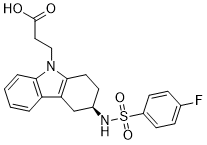
Ramatroban is a novel, potent and selective antagonist of thromboxane A2 (TxA2) with an IC50 of 14 nM. It also inhibits PGD2 binding, which antagonizes CRTH2 (IC50=113 nM). In addition to treating asthma, ramatroban is recommended for the treatment of coronary artery disease.
Physicochemical Properties
| Molecular Formula | C21H21FN2O4S |
| Molecular Weight | 416.4658 |
| Exact Mass | 416.12 |
| Elemental Analysis | C, 60.56; H, 5.08; F, 4.56; N, 6.73; O, 15.37; S, 7.70 |
| CAS # | 116649-85-5 |
| Related CAS # | Ramatroban-d4 |
| PubChem CID | 123879 |
| Appearance | White to off-white solid powder |
| Density | 1.4±0.1 g/cm3 |
| Boiling Point | 654.7±65.0 °C at 760 mmHg |
| Flash Point | 349.7±34.3 °C |
| Vapour Pressure | 0.0±2.1 mmHg at 25°C |
| Index of Refraction | 1.664 |
| LogP | 4.09 |
| Hydrogen Bond Donor Count | 2 |
| Hydrogen Bond Acceptor Count | 6 |
| Rotatable Bond Count | 6 |
| Heavy Atom Count | 29 |
| Complexity | 689 |
| Defined Atom Stereocenter Count | 1 |
| SMILES | S(C1C([H])=C([H])C(=C([H])C=1[H])F)(N([H])[C@]1([H])C([H])([H])C([H])([H])C2=C(C3=C([H])C([H])=C([H])C([H])=C3N2C([H])([H])C([H])([H])C(=O)O[H])C1([H])[H])(=O)=O |
| InChi Key | LDXDSHIEDAPSSA-OAHLLOKOSA-N |
| InChi Code | InChI=1S/C21H21FN2O4S/c22-14-5-8-16(9-6-14)29(27,28)23-15-7-10-20-18(13-15)17-3-1-2-4-19(17)24(20)12-11-21(25)26/h1-6,8-9,15,23H,7,10-13H2,(H,25,26)/t15-/m1/s1 |
| Chemical Name | 3-[(3R)-3-[(4-fluorophenyl)sulfonylamino]-1,2,3,4-tetrahydrocarbazol-9-yl]propanoic acid |
| Synonyms | Ramatroban; Bay u 3406; Bay u-3405; BAY u3405; EN 137774 |
| HS Tariff Code | 2934.99.9001 |
| Storage |
Powder-20°C 3 years 4°C 2 years In solvent -80°C 6 months -20°C 1 month |
| Shipping Condition | Room temperature (This product is stable at ambient temperature for a few days during ordinary shipping and time spent in Customs) |
Biological Activity
| Targets | hTP ( IC50 = 14 nM ); hDP2 ( IC50 = 113 nM ); hDP2 ( IC50 = 33.4 μM ) |
| ln Vitro | Ramatroban is a strong antagonist of the human thromboxane receptor (hTP), showing an IC50 of 18 nM in an assay for human TP binding. In a human DP2 binding assay, RAMATroban inhibits prostaglandin D2 receptor DP2 (CRTH2) with an IC50 of 113 nM. Additionally, human CYP isoform CYP2C9 is inhibited by RAMATroban, with an IC50 of 15 μM[1]. A specific antagonist of the thromboxane-type prostanoid (TP) receptor is called RAMATroban. It has been demonstrated that PGD2-stimulated human eosinophil migration is solely mediated by CRTH2 activation; remarkably, Ramatroban completely blocks these effects. Ramatroban is an antagonist for CRTH2, and through CRTH2 blockade, it prevents PGD2-induced eosinophil migration. 3H-labeled PGD2 has a strong affinity (KD=6.3 nM, Bmax=450 pM) for a single site on CRTH2 transfectants. With an EC50 value of 2.7 nM, nonlabeled PGD2 inhibits the binding of 3H-labeled PGD2 to CRTH2 transfectants in a concentration-dependent manner. Although with much lower potency (IC50=100 nM), metbatroban exhibits significant inhibitory effects on the binding of 3H-labeled PGD2 to CRTH2. With an IC50 value of 30 nM, ramatroban also blocks PGD2-induced Ca2+ mobilization in CRTH2 transfectants to a nearly identical degree. With an IC50 value of 170 nM, ramatroban completely inhibits the PGD2-induced migration of eosinophils in a concentration-dependent manner[2]. |
| ln Vivo | Ramatroban is a CRTH2 small molecule antagonist that is bioavailable when taken orally. The effects of systemic Ramatroban (30 mg/kg) administration in CRTH2+/+ mice are identical to those observed in CRTH2 deficiency. Ramatroban completely blocks LPS-induced decreases in social and object exploratory behavior (p<0.01). In addition, tumor-impaired social interaction and object exploratory behavior in CRTH2+/+ mice are completely reversed by a single injection of Ramatroban, even when the tumor is enlarged[3]. |
| Enzyme Assay | In binding buffer (50 mM Tris-HCl, pH 7.4, 40 mM MgCl2, 0.1% BSA, 0.1% NaN3), CRTH2 transfectants are resuspended. A 96-well U-bottomed polypropylene plate is then filled with a cell suspension (2 ×10⁵ cells), 3H-labeled PGD2, and different concentrations of Ramatroban (0.1 nM, 1 nM, 10 nM, 100 nM, 1 μM, and 10 μM). The mixture is then incubated for 60 minutes at room temperature in a final volume of 100 μL. Following the incubation period, the cell suspension is moved to a filtration plate and subjected to three binding buffer washes. A scintillation counter is used to measure the amount of radioactivity that remains on the filter after scintillant has been added to the filtration plate. By allowing the cell suspension and 3H-labeled PGD2 to coexist with 1 μM unlabeled PGD2, nonspecific binding can be ascertained[2]. |
| Cell Assay | In migration buffer (20 mM HEPES, pH 7.6, 0.1% BSA, Hanks' solution), human eosinophils are purified and resuspended at a density of 6 ×10⁶ cells/mL. The 96-well type chemotaxis chamber (pore diameter = 5 μm) has its upper chamber filled with 50 microliters of the cell suspension (3×10⁵ cells/well), while the lower chamber receives 30 μL of ligand solution. A preincubation period of 10 minutes is allowed for the cells to be exposed to different concentrations of BWA868C or Ramatroban (0.1 nM, 1 nM, 10 nM, 100 nM, 1 μM, and 10 μM). The migration experiments take place for two hours at 37°C and 5% CO2 in a humidified incubator. There is a count of the cells that migrate into the lower chamber[2]. |
| Animal Protocol | Mice: CRTH2+/+ mice are intraperitoneally injected with five micrograms of either saline (open columns) or lipopolysaccharide (closed columns). 30 mg/kg of Ramatroban is given intraperitoneally to CRTH2+/+ mice for one hour as a pretreatment. |
| References |
[1]. Novel tricyclic antagonists of the prostaglandin D2 receptor DP2 with efficacy in a murine modelof allergic rhinitis. Bioorg Med Chem Lett. 2009 Aug 15;19(16):4647-51. [2]. An orally bioavailable small molecule antagonist of CRTH2, ramatroban (BAY u3405), inhibits prostaglandin D2-induced eosinophil migration in vitro. J Pharmacol Exp Ther. 2003 Apr;305(1):347-52. [3]. Central CRTH2, a second prostaglandin D2 receptor, mediates emotional impairment in the lipopolysaccharide and tumor-induced sickness behavior model. J Neurosci. 2014 Feb 12;34(7):2514-23. |
| Additional Infomation |
Ramatroban is an organic molecular entity. Ramatroban has been used in trials studying the treatment of Asthma. |
Solubility Data
| Solubility (In Vitro) |
DMSO: 83~125 mg/mL (199.3~300.1 mM) Ethanol: 83 mg/mL |
| Solubility (In Vivo) |
Solubility in Formulation 1: ≥ 2.08 mg/mL (4.99 mM) (saturation unknown) in 10% DMSO + 40% PEG300 + 5% Tween80 + 45% Saline (add these co-solvents sequentially from left to right, and one by one), clear solution. For example, if 1 mL of working solution is to be prepared, you can add 100 μL of 20.8 mg/mL clear DMSO stock solution to 400 μL PEG300 and mix evenly; then add 50 μL Tween-80 to the above solution and mix evenly; then add 450 μL normal saline to adjust the volume to 1 mL. Preparation of saline: Dissolve 0.9 g of sodium chloride in 100 mL ddH₂ O to obtain a clear solution. Solubility in Formulation 2: ≥ 2.08 mg/mL (4.99 mM) (saturation unknown) in 10% DMSO + 90% (20% SBE-β-CD in Saline) (add these co-solvents sequentially from left to right, and one by one), clear solution. For example, if 1 mL of working solution is to be prepared, you can add 100 μL of 20.8 mg/mL clear DMSO stock solution to 900 μL of 20% SBE-β-CD physiological saline solution and mix evenly. Preparation of 20% SBE-β-CD in Saline (4°C,1 week): Dissolve 2 g SBE-β-CD in 10 mL saline to obtain a clear solution. Solubility in Formulation 3: ≥ 2.08 mg/mL (4.99 mM) (saturation unknown) in 10% DMSO + 90% Corn Oil (add these co-solvents sequentially from left to right, and one by one), clear solution. For example, if 1 mL of working solution is to be prepared, you can add 100 μL of 20.8 mg/mL clear DMSO stock solution to 900 μL of corn oil and mix evenly. (Please use freshly prepared in vivo formulations for optimal results.) |
| Preparing Stock Solutions | 1 mg | 5 mg | 10 mg | |
| 1 mM | 2.4011 mL | 12.0057 mL | 24.0113 mL | |
| 5 mM | 0.4802 mL | 2.4011 mL | 4.8023 mL | |
| 10 mM | 0.2401 mL | 1.2006 mL | 2.4011 mL |