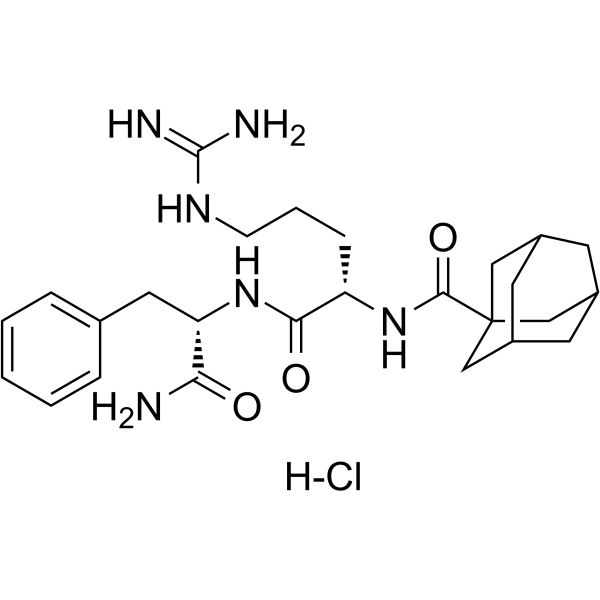
Physicochemical Properties
| Molecular Formula | C26H39CLN6O3 |
| Molecular Weight | 519.08 |
| Related CAS # | RF9;876310-60-0 |
| Appearance | White to off-white solid powder |
| HS Tariff Code | 2934.99.9001 |
| Storage |
Powder-20°C 3 years 4°C 2 years In solvent -80°C 6 months -20°C 1 month Note: Please store this product in a sealed and protected environment, avoid exposure to moisture. |
| Shipping Condition | Room temperature (This product is stable at ambient temperature for a few days during ordinary shipping and time spent in Customs) |
Biological Activity
| Targets | hNPFF1R 58 nM (Ki) hNPFF2R 75 nM (Ki) |
| ln Vitro | RF9 (10 μM) partially prevents Neuro 2A cells' neurite outgrowth that is caused by NPFF[2]. |
| ln Vivo | Tolerance and heroin-induced delayed hyperalgesia are avoided when RF9 (0.1 mg/kg, sc) is also administered[1]. No discernible change in heart rate or MAP occurs when RF9 (10 μg) is administered alone. In contrast, when NPFF is administered in combination with RF9, the MAP and heart rate increases elicited by NPFF are greatly inhibited[1]. |
| Animal Protocol |
Animal/Disease Models: Rats[1] Doses: 0.1 mg/kg. Route of Administration: SC 30 min before 0.3 mg/kg heroin or saline on basal nociceptive threshold in rats. Experimental Results: Opposed to delaye heroin-induced hyperalgesia and associated tolerance. |
| References |
[1]. RF9, a potent and selective neuropeptide FF receptor antagonist, prevents opioid-induced tolerance associated with hyperalgesia. Proc Natl Acad Sci U S A. 2006 Jan 10;103(2):466-71. [2]. Discovery of Two Novel Branched Peptidomimetics Containing endomorphin-2 and RF9 Pharmacophores: Synthesis and Neuropharmacological Evaluation. Bioorg Med Chem. 2019 Feb 15;27(4):630-643. |
Solubility Data
| Solubility (In Vitro) | DMSO :~50 mg/mL (~96.32 mM) |
| Solubility (In Vivo) |
Solubility in Formulation 1: ≥ 2.08 mg/mL (4.01 mM) (saturation unknown) in 10% DMSO + 40% PEG300 + 5% Tween80 + 45% Saline (add these co-solvents sequentially from left to right, and one by one), clear solution. For example, if 1 mL of working solution is to be prepared, you can add 100 μL of 20.8 mg/mL clear DMSO stock solution to 400 μL PEG300 and mix evenly; then add 50 μL Tween-80 to the above solution and mix evenly; then add 450 μL normal saline to adjust the volume to 1 mL. Preparation of saline: Dissolve 0.9 g of sodium chloride in 100 mL ddH₂ O to obtain a clear solution. Solubility in Formulation 2: ≥ 2.08 mg/mL (4.01 mM) (saturation unknown) in 10% DMSO + 90% (20% SBE-β-CD in Saline) (add these co-solvents sequentially from left to right, and one by one), clear solution. For example, if 1 mL of working solution is to be prepared, you can add 100 μL of 20.8 mg/mL clear DMSO stock solution to 900 μL of 20% SBE-β-CD physiological saline solution and mix evenly. Preparation of 20% SBE-β-CD in Saline (4°C,1 week): Dissolve 2 g SBE-β-CD in 10 mL saline to obtain a clear solution. Solubility in Formulation 3: ≥ 2.08 mg/mL (4.01 mM) (saturation unknown) in 10% DMSO + 90% Corn Oil (add these co-solvents sequentially from left to right, and one by one), clear solution. For example, if 1 mL of working solution is to be prepared, you can add 100 μL of 20.8 mg/mL clear DMSO stock solution to 900 μL of corn oil and mix evenly. (Please use freshly prepared in vivo formulations for optimal results.) |
| Preparing Stock Solutions | 1 mg | 5 mg | 10 mg | |
| 1 mM | 1.9265 mL | 9.6324 mL | 19.2649 mL | |
| 5 mM | 0.3853 mL | 1.9265 mL | 3.8530 mL | |
| 10 mM | 0.1926 mL | 0.9632 mL | 1.9265 mL |