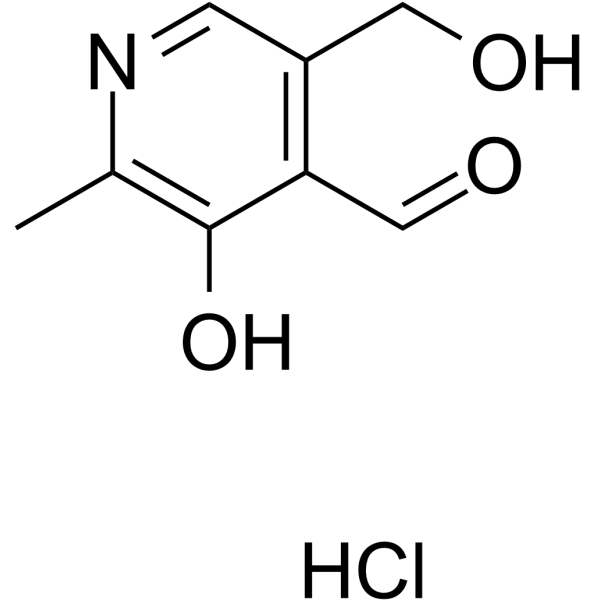
Physicochemical Properties
| Molecular Formula | C8H10CLNO3 |
| Molecular Weight | 203.62 |
| Exact Mass | 203.034 |
| CAS # | 65-22-5 |
| PubChem CID | 6171 |
| Appearance | Off-white to light yellow solid powder |
| Boiling Point | 412.8ºC at 760 mmHg |
| Melting Point | 173 °C (dec.)(lit.) |
| Flash Point | 203.5ºC |
| LogP | 1.202 |
| Hydrogen Bond Donor Count | 3 |
| Hydrogen Bond Acceptor Count | 4 |
| Rotatable Bond Count | 2 |
| Heavy Atom Count | 13 |
| Complexity | 162 |
| Defined Atom Stereocenter Count | 0 |
| InChi Key | FCHXJFJNDJXENQ-UHFFFAOYSA-N |
| InChi Code | InChI=1S/C8H9NO3.ClH/c1-5-8(12)7(4-11)6(3-10)2-9-5;/h2,4,10,12H,3H2,1H3;1H |
| Chemical Name | 3-hydroxy-5-(hydroxymethyl)-2-methylpyridine-4-carbaldehyde;hydrochloride |
| HS Tariff Code | 2934.99.9001 |
| Storage |
Powder-20°C 3 years 4°C 2 years In solvent -80°C 6 months -20°C 1 month Note: Please store this product in a sealed and protected environment (e.g. under nitrogen), avoid exposure to moisture. |
| Shipping Condition | Room temperature (This product is stable at ambient temperature for a few days during ordinary shipping and time spent in Customs) |
Biological Activity
| References |
[1]. The vitamin B6 paradox: Supplementation with high concentrations of pyridoxine leads to decreased vitamin B6 function. Toxicol In Vitro. 2017 Oct;44:206-212. [2]. Pyridoxine hydrochloride treatment of carpal tunnel syndrome: a review. Nutr Rev. 2004 Mar;62(3):96-104. [3]. Solvolysis of pyridoxal hydrochloride in alcohols. Chemical and pharmaceutical bulletin, 1993, 41(6): 1019-1022. |
| Additional Infomation | Pyridoxal hydrochloride is a hydrochloride obtained by combining pyridoxal with one molar equivalent of hydrochloric acid. It has a role as an Escherichia coli metabolite, a Saccharomyces cerevisiae metabolite, a cofactor, a human metabolite and a mouse metabolite. It is a hydrochloride, a pyridinium salt and a vitamin B6. It contains a pyridoxal(1+). |
Solubility Data
| Solubility (In Vitro) |
DMSO :~62.5 mg/mL (~306.94 mM ) H2O :~33.33 mg/mL (~163.69 mM) |
| Solubility (In Vivo) |
Solubility in Formulation 1: 2.08 mg/mL (10.22 mM) in 10% DMSO + 40% PEG300 + 5% Tween80 + 45% Saline (add these co-solvents sequentially from left to right, and one by one), clear solution; with sonication. For example, if 1 mL of working solution is to be prepared, you can add 100 μL of 20.8 mg/mL clear DMSO stock solution to 400 μL PEG300 and mix evenly; then add 50 μL Tween-80 to the above solution and mix evenly; then add 450 μL normal saline to adjust the volume to 1 mL. Preparation of saline: Dissolve 0.9 g of sodium chloride in 100 mL ddH₂ O to obtain a clear solution. Solubility in Formulation 2: ≥ 2.08 mg/mL (10.22 mM) (saturation unknown) in 10% DMSO + 90% (20% SBE-β-CD in Saline) (add these co-solvents sequentially from left to right, and one by one), clear solution. For example, if 1 mL of working solution is to be prepared, you can add 100 μL of 20.8 mg/mL clear DMSO stock solution to 900 μL of 20% SBE-β-CD physiological saline solution and mix evenly. Preparation of 20% SBE-β-CD in Saline (4°C,1 week): Dissolve 2 g SBE-β-CD in 10 mL saline to obtain a clear solution. Solubility in Formulation 3: ≥ 2.08 mg/mL (10.22 mM) (saturation unknown) in 10% DMSO + 90% Corn Oil (add these co-solvents sequentially from left to right, and one by one), clear solution. For example, if 1 mL of working solution is to be prepared, you can add 100 μL of 20.8 mg/mL clear DMSO stock solution to 900 μL of corn oil and mix evenly. Solubility in Formulation 4: 100 mg/mL (491.11 mM) in PBS (add these co-solvents sequentially from left to right, and one by one), clear solution; with ultrasonication. (Please use freshly prepared in vivo formulations for optimal results.) |
| Preparing Stock Solutions | 1 mg | 5 mg | 10 mg | |
| 1 mM | 4.9111 mL | 24.5555 mL | 49.1111 mL | |
| 5 mM | 0.9822 mL | 4.9111 mL | 9.8222 mL | |
| 10 mM | 0.4911 mL | 2.4556 mL | 4.9111 mL |