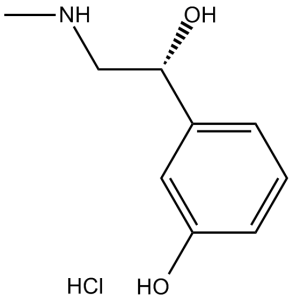
Phenylephrine HCl (Metaoxedrine chloride; NCIc-55641; NCI c55641; Neosympatol; Oftalfrine; Mezaton; Neo Synephrine; Neo-Synephrine), the hydrochloride salt of Phenylephrine, is a potent and selective α1-adrenergic receptor agonist that is primarily used as a decongestant. It is a nasal decongestant, mydriatic, and cardiotonic agent.
Physicochemical Properties
| Molecular Formula | C9H14CLNO2 | |
| Molecular Weight | 203.67 | |
| Exact Mass | 203.071 | |
| Elemental Analysis | C, 53.08; H, 6.93; Cl, 17.41; N, 6.88; O, 15.71 | |
| CAS # | 61-76-7 | |
| Related CAS # | Phenylephrine-2,4,6-d3 hydrochloride; 1276197-50-2; Phenylephrine; 59-42-7; Phenylephrine-d3 hydrochloride; 1217858-50-8; (S)-Phenylephrine-d6 hydrochloride; Phenylephrine-d6 hydrochloride; 1089675-56-8 | |
| PubChem CID | 5284443 | |
| Appearance | White to off-white solid powder | |
| Boiling Point | 341.1ºC at 760 mmHg | |
| Melting Point | 143-145 °C(lit.) | |
| Flash Point | 163.4ºC | |
| Index of Refraction | -45.5 ° (C=1, H2O) | |
| LogP | 1.837 | |
| Hydrogen Bond Donor Count | 4 | |
| Hydrogen Bond Acceptor Count | 3 | |
| Rotatable Bond Count | 3 | |
| Heavy Atom Count | 13 | |
| Complexity | 130 | |
| Defined Atom Stereocenter Count | 1 | |
| SMILES | Cl[H].O([H])[C@]([H])(C1C([H])=C([H])C([H])=C(C=1[H])O[H])C([H])([H])N([H])C([H])([H])[H] |
|
| InChi Key | OCYSGIYOVXAGKQ-FVGYRXGTSA-N | |
| InChi Code | InChI=1S/C9H13NO2.ClH/c1-10-6-9(12)7-3-2-4-8(11)5-7;/h2-5,9-12H,6H2,1H3;1H/t9-;/m0./s1 | |
| Chemical Name | 3-[(1R)-1-hydroxy-2-(methylamino)ethyl]phenol;hydrochloride | |
| Synonyms |
|
|
| HS Tariff Code | 2934.99.9001 | |
| Storage |
Powder-20°C 3 years 4°C 2 years In solvent -80°C 6 months -20°C 1 month Note: Please store this product in a sealed and protected environment (e.g. under nitrogen), avoid exposure to moisture and light. |
|
| Shipping Condition | Room temperature (This product is stable at ambient temperature for a few days during ordinary shipping and time spent in Customs) |
Biological Activity
| Targets | α adrenergic receptor | ||
| ln Vitro |
|
||
| ln Vivo |
|
||
| Animal Protocol |
|
||
| References |
[1]. J Biol Chem . 1994 Dec 30;269(52):32848-57. [2]. Am J Physiol . 1992 Mar;262(3 Pt 2):H754-62. [3]. Cell Death Differ . 2000 Sep;7(9):773-84. [4]. Am J Physiol . 1993 Feb;264(2 Pt 2):H625-30. [5]. J Pharmacol Exp Ther . 1997 Sep;282(3):1146-54. [6]. J Physiol . 2005 Aug 15;567(Pt 1):143-57. |
||
| Additional Infomation |
Phenylephrine hydrochloride is an odorless white microcrystalline powder. Bitter taste. pH (1% aqueous solution) about 5. (NTP, 1992) Phenylephrine Hydrochloride is the hydrochloride salt form of phenylephrine, a direct-acting sympathomimetic amine chemically related to adrenaline and ephedrine with potent vasoconstrictor property. Phenylephrine is a post-synaptic alpha-adrenergic receptor agonist that causes vasoconstriction, increases systolic/diastolic pressures, reflex bradycardia, and stroke output. An alpha-1 adrenergic agonist used as a mydriatic, nasal decongestant, and cardiotonic agent. See also: Phenylephrine (has active moiety); Ibuprofen; PHENYLEPHRINE HYDROCHLORIDE (component of); Phenylephrine Hydrochloride; Tropicamide (component of) ... View More ... |
Solubility Data
| Solubility (In Vitro) |
|
|||
| Solubility (In Vivo) |
Solubility in Formulation 1: ≥ 2.08 mg/mL (10.21 mM) (saturation unknown) in 10% DMSO + 40% PEG300 + 5% Tween80 + 45% Saline (add these co-solvents sequentially from left to right, and one by one), clear solution. For example, if 1 mL of working solution is to be prepared, you can add 100 μL of 20.8 mg/mL clear DMSO stock solution to 400 μL PEG300 and mix evenly; then add 50 μL Tween-80 to the above solution and mix evenly; then add 450 μL normal saline to adjust the volume to 1 mL. Preparation of saline: Dissolve 0.9 g of sodium chloride in 100 mL ddH₂ O to obtain a clear solution. Solubility in Formulation 2: ≥ 2.08 mg/mL (10.21 mM) (saturation unknown) in 10% DMSO + 90% (20% SBE-β-CD in Saline) (add these co-solvents sequentially from left to right, and one by one), clear solution. For example, if 1 mL of working solution is to be prepared, you can add 100 μL of 20.8 mg/mL clear DMSO stock solution to 900 μL of 20% SBE-β-CD physiological saline solution and mix evenly. Preparation of 20% SBE-β-CD in Saline (4°C,1 week): Dissolve 2 g SBE-β-CD in 10 mL saline to obtain a clear solution. Solubility in Formulation 3: ≥ 2.08 mg/mL (10.21 mM) (saturation unknown) in 10% DMSO + 90% Corn Oil (add these co-solvents sequentially from left to right, and one by one), clear solution. For example, if 1 mL of working solution is to be prepared, you can add 100 μL of 20.8 mg/mL clear DMSO stock solution to 900 μL of corn oil and mix evenly. (Please use freshly prepared in vivo formulations for optimal results.) |
| Preparing Stock Solutions | 1 mg | 5 mg | 10 mg | |
| 1 mM | 4.9099 mL | 24.5495 mL | 49.0990 mL | |
| 5 mM | 0.9820 mL | 4.9099 mL | 9.8198 mL | |
| 10 mM | 0.4910 mL | 2.4550 mL | 4.9099 mL |