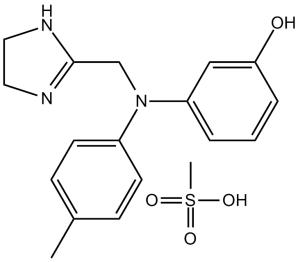
Phentolamine Mesylate (OraVerse, Regitine mesylate, Regitine, Regityn, Rogitine, Z-Max), the mesylate/mesilate/methanesulfonate salt of Phentolamine, is a reversible and nonselective alpha-adrenergic receptor antagonist with antihypertensive effects. It has been applied to stop or manage episodes of hypertension. In corpus cavernosum membranes, phentolamine mesylate selectively displaces the binding of alpha 1 receptor antagonists [125I]HEAT and [3H]prazosin, as well as alpha 2 receptor antagonists [3H]rauwolscine and [3H]RX 821002 with a relatively high affinity.
Physicochemical Properties
| Molecular Formula | C18H23N3O4S | |
| Molecular Weight | 377.46 | |
| Exact Mass | 377.14 | |
| Elemental Analysis | C, 57.28; H, 6.14; N, 11.13; O, 16.95; S, 8.49 | |
| CAS # | 65-28-1 | |
| Related CAS # | Phentolamine; 50-60-2; Phentolamine hydrochloride; 73-05-2; Phentolamine-d4 hydrochloride; 1346599-65-2; 65-28-1 (mesylate) | |
| PubChem CID | 91430 | |
| Appearance | White to off-white solid powder | |
| Boiling Point | 551ºC at 760 mmHg | |
| Melting Point | 180-182 °C(lit.) | |
| Flash Point | 287ºC | |
| LogP | 3.189 | |
| Hydrogen Bond Donor Count | 3 | |
| Hydrogen Bond Acceptor Count | 6 | |
| Rotatable Bond Count | 4 | |
| Heavy Atom Count | 26 | |
| Complexity | 456 | |
| Defined Atom Stereocenter Count | 0 | |
| SMILES | O1C([H])([H])C([H])([H])OC([H])([H])C([H])([H])OC2C3=C([H])C([H])=C([H])C=2C([H])([H])C2C([H])=C([H])C([H])=C4C=2OC([H])([H])C([H])([H])OC([H])([H])C([H])([H])OC([H])([H])C([H])([H])OC([H])([H])C([H])([H])OC([H])([H])C([H])([H])OC2C(=C([H])C([H])=C([H])C=2C3([H])[H])C([H])([H])C2=C([H])C([H])=C([H])C(=C2OC([H])([H])C([H])([H])OC([H])([H])C([H])([H])OC2C3=C([H])C([H])=C([H])C=2C([H])([H])C2=C([H])C([H])=C([H])C5=C2OC([H])([H])C([H])([H])OC([H])([H])C([H])([H])OC([H])([H])C([H])([H])OC([H])([H])C([H])([H])OC2C(=C([H])C([H])=C([H])C=2C([H])([H])C2=C([H])C([H])=C([H])C(=C12)C5([H])[H])C3([H])[H])C4([H])[H] |
|
| InChi Key | OGIYDFVHFQEFKQ-UHFFFAOYSA-N | |
| InChi Code | InChI=1S/C17H19N3O.CH4O3S/c1-13-5-7-14(8-6-13)20(12-17-18-9-10-19-17)15-3-2-4-16(21)11-15;1-5(2,3)4/h2-8,11,21H,9-10,12H2,1H3,(H,18,19);1H3,(H,2,3,4) | |
| Chemical Name | 3-[N-(4,5-dihydro-1H-imidazol-2-ylmethyl)-4-methylanilino]phenol;methanesulfonic acid | |
| Synonyms |
|
|
| HS Tariff Code | 2934.99.9001 | |
| Storage |
Powder-20°C 3 years 4°C 2 years In solvent -80°C 6 months -20°C 1 month Note: Please store this product in a sealed and protected environment (e.g. under nitrogen), avoid exposure to moisture and light. |
|
| Shipping Condition | Room temperature (This product is stable at ambient temperature for a few days during ordinary shipping and time spent in Customs) |
Biological Activity
| Targets | α-adrenergic receptor | |
| ln Vitro |
|
|
| ln Vivo |
|
|
| Enzyme Assay |
Aim of the study: To investigate the biochemical and physiological mechanisms of action of phentolamine mesylate (Vasomax) in regulating erectile tissue smooth muscle contractility in human and rabbit corpus cavernosum.[1] Methods: The binding activity of phentolamine was investigated in a cell-free system by displacement of specific and selective radiolabelled ligands to alpha 1 and 2 adrenergic receptors. The physiologic activity of phentolamine-mediated relaxation of adrenergic and non-adrenergic pre-contracted erectile tissue strips of human and rabbit corpus cavernosum were studied in organ bath chambers.[1] Results: In corpus cavernosum membranes, phentolamine displaced binding of the selective alpha 1 receptor antagonists [125I]HEAT and [3H]prazosin and the alpha 2 receptor antagonists [3H]rauwolscine and [3H]RX 821002 with relatively high affinity. Phentolamine caused concentration dependent relaxation in erectile tissue strips pre-contracted with adrenergic agonists phenylephrine, norepinephrine, oxymetazoline and UK 14,304, as well as with non-adrenergic contractile agents endothelin and KCl. Biochemical and physiologic studies reveal that the concentration of phentolamine required to displace half maximal binding or to produce half-maximal relaxation was similar to that found in human plasma 30 min after ingestion of 40 mg of Vasomax. Reversible inhibition of nitric oxide synthase by L-nitroarginine or mechanical disruption of endothelium diminished non-adrenergic phentolamine-mediated erectile tissue relaxation.[1] Conclusions: Phentolamine mesylate induced relaxation of corpus cavernosum erectile tissue by direct antagonism of alpha 1 and 2 adrenergic receptors and by indirect functional antagonism via a non-adrenergic, endothelium-mediated mechanism suggesting nitric oxide synthase activation.[1] |
|
| Cell Assay | The contribution of NO-cGMP dependent pathway to phentolamine mesylate-evoked nonadrenergic, noncholinergic relaxation of rabbit corpus cavernosum was investigated in vitro. Stimulation of nonadrenergic, noncholinergic neurons of the rabbit corpus cavernosum elicited frequency-related relaxation that was significantly attenuated by L-NAME (NO synthase inhibitor) or ODQ (an inhibitor of guanylate cyclase). Moreover, tetrodotoxin, a sodium channel blocker, abolished the electrical field stimulation-induced relaxation of rabbit corpus cavernosum, suggesting that neuronal release of NO mediates relaxation to electrical field stimulation. Phentolamine mesylate (30 and 100 nM) dose-dependently enhanced electrical field stimulation-induced relaxation of the rabbit corpus cavernosum. Prazosin (30 microM) and yohimbine (30 microM) failed to affect phentolamine mesylate-mediated nonadrenergic, noncholinergic rabbit penile smooth muscle relaxation, suggesting that phentolamine relaxes rabbit corpus cavernosum independent of alpha-adrenergic receptor blockade. In contrast, pretreatment of the rabbit cavernosal strips with L-NAME significantly-attenuated electrical field stimulation produced relaxations to phentolamine mesylate, suggesting that phentolamine mesylate relaxes rabbit corpus cavernosum by activating NO synthase. The data suggest that phentolamine mesylate relaxes nonadrenergic noncholinergic neurons of the rabbit corpus cavernosum by activating NO synthase and is independent of alpha-adrenergic receptor blockade[4]. | |
| Animal Protocol |
This was a single-center, open-label, 4-treatment, phase 1 crossover study designed and statistically powered to evaluate the pharmacokinetics of phentolamine mesylate and lidocaine with epinephrine. Local anesthesia characteristics and safety measurements were recorded and are briefly summarized in this report.[2] To obtain adequate pharmacokinetic data, 16 healthy adult volunteers (7 male, 9 female) were enrolled. A subject was considered to have completed the study if he/she provided evaluable data for the phentolamine mesylate and lidocaine pharmacokinetic analyses. The study was designed to have each subject randomly receive each of the 4 drug treatments as follows:[2] Treatment 1L1P: Subjects received 1 cartridge (1.8 mL) of 2% lidocaine HCl with 1 : 100,000 epinephrine administered as a supraperiosteal infiltration over the maxillary first molar. Thirty minutes later, subjects received 1 cartridge of phentolamine mesylate (0.4 mg in 1.7 mL) at the same location.[2] Treatment 1Piv: Subjects received 1 cartridge of phentolamine mesylate (0.4 mg in 1.7 mL) injected intravenously over 1 minute. No local anesthetic was administered in this treatment.[2] Treatment 4L2P: Subjects received 4 cartridges (7.2 mL) of 2% lidocaine HCl with 1 : 100,000 epinephrine; 3.6 mL was administered as an inferior alveolar nerve block and 3.6 mL as a supraperiosteal infiltration over the maxillary first molar. These injections were administered in the same side of the face. Thirty minutes after the first injection of anesthetic, 1 cartridge of phentolamine mesylate (1.7 mL) was injected at the mandibular site and 1 cartridge at the maxillary site where anesthetic had been previously given, using the same injection technique. The total dose of phentolamine in this treatment was 0.8 mg (3.4 mL).[2] Treatment 4L: Subjects received 4 cartridges of 2% lidocaine HCl with 1 : 100,000 epinephrine; 3.6 mL was administered as an inferior alveolar nerve block and 3.6 mL as a supraperiosteal infiltration over the maxillary first molar. These injections were administered in the same side of the face. Phentolamine mesylate was not administered to subjects in this treatment. The 4L treatment served as a control to the 4L2P treatment.[2] Treatments[2] Dental cartridges containing phentolamine mesylate (0.4 mg/1.7 mL) were prepared by Novocol, Inc (Cambridge, Ontario, Canada; Lot #3067) as a sterile, pyrogen-free, isotonic solution. The concentration of the active ingredient phentolamine mesylate was 0.235 mg/mL. Excipients included water for injection, ethylenediaminetetraacetic acid, d-mannitol, sodium acetate, acetic acid, and sodium hydroxide. Dental cartridges of 2% lidocaine with 1 : 100,000 epinephrine (1.8 mL) were obtained from a commercial supplier. Pharmacokinetics[2] Blood samples were drawn for measurements of concentrations of phentolamine, lidocaine, epinephrine, and N1-2[N-(3-hydroxyphenyl)-N-(4-toluyl)aminoacetyl] ethylenediamine (HTAEDA). HTAEDA is formed spontaneously in aqueous solutions of phentolamine and its measurement was included to assess its potential formation in the body. Eleven (treatment 1Piv) or 14 (treatments 1L1P, 4L2P, and 4L) blood samples were drawn for pharmacokinetic analysis, starting immediately prior to first injection of local anesthetic (if given) or intravenous injection of phentolamine mesylate, and ending 8.0–8.5 hours later. Because blood levels were expected to be close to physiologic concentrations and at the lower limits of detection, only selected samples were assayed for epinephrine. When values of epinephrine were below levels of detection, a value of zero was applied. |
|
| ADME/Pharmacokinetics |
Absorption, Distribution and Excretion The peak concentrations of phentolamine are achieved within 10 to 20 minutes following submucosal administration. The Cmax was higher in children with greater weights. Following topical ocular administration of phentolamine ophthalmic solution 0.75%, the peak concentration levels were achieved between 15 minutes and one hour after dosing with the median value of 0.45 ng/mL. Approximately 13% of a single intravenous dose appears in the urine as unchanged drug. While there is limited information on phentolamine distribution, the drug is reported to cross the blood-brain barrier. The Tmax is 30 to 60 minutes. Protein binding is less than 72%. It undergoes extensive hepatic metabolism, 80% renal excretion (10% to 13% excreted as unchanged drug) and 20% fecal excretion. Phentolamine is only about 20% as active after oral administration as after parenteral administration. About 10% of a parenteral dose can be recovered in the urine as active drug; the fate of the remainder is not known. It is not known whether the drug crosses the placenta or appears in milk. Metabolism / Metabolites Phentolamine has known human metabolites that include [3-[N-(4,5-dihydro-1H-imidazol-2-ylmethyl)-4-methylanilino]phenyl] hydrogen sulfate. Biological Half-Life Phentolamine has a half-life of 19 minutes following intravenous administration. The terminal elimination half-life of phentolamine was approximately two to three hours following submucosal administration. The elimination half life /of phentolamine/ is 19 minutes after intravenous administration, 5 to 7 hours after oral administration. |
|
| Toxicity/Toxicokinetics |
rat LDLo subcutaneous 275 mg/kg Drugs in Japan, 6(667), 1982 rat LDLo intravenous 75 mg/kg Drugs in Japan, 6(667), 1982 mouse LD50 intravenous 75 mg/kg Journal de Pharmacologie., 5(101), 1974 rabbit LDLo subcutaneous 200 mg/kg Drugs in Japan, 6(667), 1982 rabbit LDLo intravenous 35 mg/kg Drugs in Japan, 6(667), 1982 |
|
| References |
[1]. Int J Impot Res . 1998 Dec;10(4):215-23. [2]. Anesth Prog . 2008 Summer;55(2):40-8. [3]. J Pharm Pharmacol . 1995 Oct;47(10):837-45. [4]. Fundam Clin Pharmacol . 2001 Feb;15(1):1-7. |
|
| Additional Infomation |
Phentolamine Mesylate is the mesylate salt of a synthetic imidazoline with alpha-adrenergic antagonist activity. As a competitive alpha-adrenergic antagonist, phentolamine binds to alpha-1 and alpha-2 receptors, resulting in a decrease in peripheral vascular resistance and vasodilatation. This agent also may block 5-hydroxytryptamine (5-HT) receptors and stimulate release of histamine from mast cells. A nonselective alpha-adrenergic antagonist. It is used in the treatment of hypertension and hypertensive emergencies, pheochromocytoma, vasospasm of RAYNAUD DISEASE and frostbite, clonidine withdrawal syndrome, impotence, and peripheral vascular disease. See also: Phentolamine (has active moiety). Phentolamine mesylate accelerates recovery from oral soft tissue anesthesia in patients who have received local anesthetic injections containing a vasoconstrictor. The proposed mechanism is that phentolamine, an alpha-adrenergic antagonist, blocks the vasoconstriction associated with the epinephrine used in dental anesthetic formulations, thus enhancing the systemic absorption of the local anesthetic from the injection site. Assessments of the pharmacokinetics of lidocaine and phentolamine, and the impact of phentolamine on the pharmacokinetics of lidocaine with epinephrine were performed to characterize this potentially valuable strategy. The blood levels of phentolamine were determined following its administration intraorally and intravenously. Additionally, the effects of phentolamine mesylate on the pharmacokinetics of intraoral injections of lidocaine with epinephrine were evaluated. Sixteen subjects were enrolled in this phase 1 trial, each receiving 4 drug treatments: 1 cartridge lidocaine/epinephrine followed after 30 minutes by 1 cartridge phentolamine (1L1P), 1 cartridge phentolamine administered intravenously (1Piv), 4 cartridges lidocaine/epinephrine followed after 30 minutes by 2 cartridges phentolamine (4L2P), and 4 cartridges lidocaine/epinephrine followed by no phentolamine (4L). Pharmacokinetic parameters estimated for phentolamine, lidocaine, and epinephrine included peak plasma concentration (Cmax), time to peak plasma concentration (Tmax), area under the plasma concentration-time curve from 0 to the last time point (AUClast) or from time 0 to infinity (AUCinf), elimination half-life (t1/2), clearance (CL), and volume of distribution (Vd). The phentolamine Tmax occurred earlier following the intravenous administration of 1Piv (7 minutes than following its submucosal administration in treatment 1L1P (15 minutes) or 4L2P (11 minutes). The phentolamine t1/2, CL, and Vd values were similar for 1L1P, 1Piv, and 4L2P. The Tmax for lidocaine occurred later and the Cmax for lidocaine was slightly higher when comparing the 4L2P treatment and the 4L treatment. The phentolamine-induced delay of the lidocaine Tmax likely represents phentolamine's ability to accelerate the systemic absorption of lidocaine from oral tissues into the systemic circulation.[2] |
Solubility Data
| Solubility (In Vitro) |
|
|||
| Solubility (In Vivo) |
Solubility in Formulation 1: ≥ 2.5 mg/mL (6.62 mM) (saturation unknown) in 10% DMSO + 90% Corn Oil (add these co-solvents sequentially from left to right, and one by one), clear solution. For example, if 1 mL of working solution is to be prepared, you can add 100 μL of 25.0 mg/mL clear DMSO stock solution to 900 μL of corn oil and mix evenly. Solubility in Formulation 2: 100 mg/mL (264.93 mM) in PBS (add these co-solvents sequentially from left to right, and one by one), clear solution; with ultrasonication. (Please use freshly prepared in vivo formulations for optimal results.) |
| Preparing Stock Solutions | 1 mg | 5 mg | 10 mg | |
| 1 mM | 2.6493 mL | 13.2464 mL | 26.4929 mL | |
| 5 mM | 0.5299 mL | 2.6493 mL | 5.2986 mL | |
| 10 mM | 0.2649 mL | 1.3246 mL | 2.6493 mL |