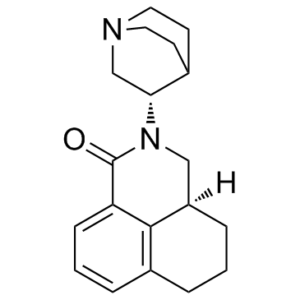
Palonosetron (formerly RS-25259, RS-25259 197; trade name: Aloxi and Akynzeo) is a 5-HT3 antagonist approved for use in the prevention and treatment of chemotherapy-induced nausea and vomiting. As of April 2018, the combination of fosnetupitant and palonosetron was approved by FDA to prevent acute and delayed nausea and vomiting associated with initial and repeat courses of highly emetogenic cancer chemotherapy. Palonosetron is a highly potent, selective, second-generation 5-HT3 receptor antagonist with a 5-HT3 receptor binding affinity that is ∼100-fold higher than other 5-HT3 receptor antagonists (pKi 10.5 compared with 8.91 for granisetron, 8.81 for tropisetron, 8.39 for ondansetron, 7.6 for dolasetron).
Physicochemical Properties
| Molecular Formula | C19H24N2O |
| Molecular Weight | 296.41 |
| Exact Mass | 296.188 |
| Elemental Analysis | C, 76.99; H, 8.16; N, 9.45; O, 5.40 |
| CAS # | 135729-61-2 |
| Related CAS # | Palonosetron hydrochloride; 135729-62-3; (R,R)-Palonosetron Hydrochloride; 135729-75-8 |
| PubChem CID | 6337614 |
| Appearance | Solid powder |
| Density | 1.2±0.1 g/cm3 |
| Boiling Point | 470.4±45.0 °C at 760 mmHg |
| Flash Point | 209.5±21.1 °C |
| Vapour Pressure | 0.0±1.2 mmHg at 25°C |
| Index of Refraction | 1.646 |
| LogP | 2.61 |
| Hydrogen Bond Donor Count | 0 |
| Hydrogen Bond Acceptor Count | 2 |
| Rotatable Bond Count | 1 |
| Heavy Atom Count | 22 |
| Complexity | 456 |
| Defined Atom Stereocenter Count | 2 |
| SMILES | O=C1N(C[C@@]([H])(CCC2)C3=C2C=CC=C13)[C@@H]4CN5CCC4CC5 |
| InChi Key | CPZBLNMUGSZIPR-NVXWUHKLSA-N |
| InChi Code | InChI=1S/C19H24N2O/c22-19-16-6-2-4-14-3-1-5-15(18(14)16)11-21(19)17-12-20-9-7-13(17)8-10-20/h2,4,6,13,15,17H,1,3,5,7-12H2/t15-,17-/m1/s1 |
| Chemical Name | (3aS)-2-[(3S)-1-azabicyclo[2.2.2]octan-3-yl]-3a,4,5,6-tetrahydro-3H-benzo[de]isoquinolin-1-one |
| Synonyms | RS 25259; RS 25259 197; RS 25233-197; RS25233-197; RS-25233-197; RS25233-198; RS-25233-198; RS 25233-198; RS-25259-197; Palonosetron; US brand name: Aloxi; Akynzeo |
| HS Tariff Code | 2934.99.9001 |
| Storage |
Powder-20°C 3 years 4°C 2 years In solvent -80°C 6 months -20°C 1 month |
| Shipping Condition | Room temperature (This product is stable at ambient temperature for a few days during ordinary shipping and time spent in Customs) |
Biological Activity
| Targets | 5-HT3 Receptor ( Ki = 0.17 nM ) | |
| ln Vitro |
|
|
| ln Vivo | Palonosetron surpasses the first-generation 5-HT3 receptor antagonists in both half-life and binding affinity. When palonosetron is given intravenously to both healthy individuals and cancer patients, the body gradually eliminates the drug after an initial drop in plasma concentration. Between 0.3 and 90 μg/kg, the mean maximum plasma concentration and the area under the concentration-time curves in both healthy individuals and cancer patients are typically dose-proportional. With a volume of distribution of 8.3 ± 2.5 L/kg, palonosetron is 62% bound to plasma proteins. Through metabolic processes and renal excretion, it is removed from the body. 40 hours is roughly the mean terminal elimination half-life[1]. | |
| Enzyme Assay | Palonosetron is a second-generation, highly selective, potent antagonist of the 5-HT3 receptor with a binding affinity for the receptor that is approximately 100 times higher than that of other antagonists of the 5-HT3 receptor (pKi 10.5 compared with 8.91 for granisetron, 8.81 for tropisetron, 8.39 for ondansetron, and 7.6 for dolasetron). | |
| Cell Assay | Palonosetron is a 5-HT3 antagonist used to treat and prevent nausea and vomiting brought on by chemotherapy (CINV). IC50 Value: Among the 5-HT3 antagonists, 5-HT3 Receptor Palonosetron is the most successful in managing delayed CINV nausea and vomiting that manifests over a 24-hour period following the initial dosage of a chemotherapy regimen. | |
| Animal Protocol |
Autoradiographical studies[3] Coronal sections of rat and mouse brains were cut at 20 ,um thickness. Sections were dried and pre-incubated in Tris-HCl buffer (50 mM Tris, 120 mM NaCl, pH 7.4, 22°C) for 30 min. The sections were then covered with the same buffer contain- -4 ing 1.0 nM [3H]-RS 42358-197 or [3H]-RS 25259-197 for 60 min at 22°C. Non-specific binding was defined in the presence of 1.0 tLM (S)-zacopride. The incubations were ter- -n minated by rinsing the slides for two washes of 5 min in ice cold buffer. The sections were dried and apposed, together with 3H polymer standards (Amersham, Inc.) to tritiumsensitive X-ray film for 24 weeks. The autoradiograms were then analysed by digital image analysis with the MCID imaging system (Imaging Research, Inc.). Brain areas were verified on cresyl violet stained sections after autoradiography, using the areas described in the rat brain atlas of Paxinos & Watson (1985). |
|
| ADME/Pharmacokinetics |
Absorption, Distribution and Excretion Low oral bioavailability. After a single intravenous dose of 10 mcg/kg [14C]-palonosetron, approximately 80% of the dose was recovered within 144 hours in the urine 8.3 ± 2.5 L/kg 160 +/- 35 mL/h/kg Metabolism / Metabolites Hepatic (50%), primarily CYP2D6-mediated, although CYP3A4 and CYP1A2 are also involved. Biological Half-Life Approximately 40 hours |
|
| Toxicity/Toxicokinetics |
Effects During Pregnancy and Lactation ◉ Summary of Use during Lactation No information is available on the use of palonosetron during breastfeeding. Until more data become available, palonosetron should be used with caution during breastfeeding. An alternate drug may be preferred. ◉ Effects in Breastfed Infants Relevant published information was not found as of the revision date. ◉ Effects on Lactation and Breastmilk Relevant published information was not found as of the revision date. Protein Binding 62% |
|
| References |
[1]. Cancer Manag Res. 2009; 1: 167–176. [2]. ACS Chem Neurosci. 2016 Dec 21;7(12):1641-1646. [3]. Br J Pharmacol. 1995 Feb;114(4):851-9. |
|
| Additional Infomation |
Pharmacodynamics Palonosetron is an antinauseant and antiemetic agent indicated for the prevention of nausea and vomiting associated with moderately-emetogenic cancer chemotherapy and for the prevention of postoperative nausea and vomiting. Palonosetron is a highly specific and selective serotonin 5-HT3 receptor antagonist that is pharmacologically related to other 5-HT3 receptor antagonists, but differs structurally. Palonosetron has a high affinity for 5-HT3 receptors, but has little to no affinity for other receptors. The serontonin 5-HT3 receptors are located on the nerve terminals of the vagus in the periphery, and centrally in the chemoreceptor trigger zone of the area postrema. It is suggested that chemotherapeutic agents release serotonin from the enterochromaffin cells of the small intestine by causing degenerative changes in the GI tract. The serotonin then stimulates the vagal and splanchnic nerve receptors that project to the medullary vomiting center, as well as the 5-HT3 receptors in the area postrema, thus initiating the vomiting reflex, causing nausea and vomiting. |
Solubility Data
| Solubility (In Vitro) |
|
|||
| Solubility (In Vivo) |
Note: Listed below are some common formulations that may be used to formulate products with low water solubility (e.g. < 1 mg/mL), you may test these formulations using a minute amount of products to avoid loss of samples. Injection Formulations (e.g. IP/IV/IM/SC) Injection Formulation 1: DMSO : Tween 80: Saline = 10 : 5 : 85 (i.e. 100 μL DMSO stock solution → 50 μL Tween 80 → 850 μL Saline) *Preparation of saline: Dissolve 0.9 g of sodium chloride in 100 mL ddH ₂ O to obtain a clear solution. Injection Formulation 2: DMSO : PEG300 :Tween 80 : Saline = 10 : 40 : 5 : 45 (i.e. 100 μL DMSO → 400 μLPEG300 → 50 μL Tween 80 → 450 μL Saline) Injection Formulation 3: DMSO : Corn oil = 10 : 90 (i.e. 100 μL DMSO → 900 μL Corn oil) Example: Take the Injection Formulation 3 (DMSO : Corn oil = 10 : 90) as an example, if 1 mL of 2.5 mg/mL working solution is to be prepared, you can take 100 μL 25 mg/mL DMSO stock solution and add to 900 μL corn oil, mix well to obtain a clear or suspension solution (2.5 mg/mL, ready for use in animals). Injection Formulation 4: DMSO : 20% SBE-β-CD in saline = 10 : 90 [i.e. 100 μL DMSO → 900 μL (20% SBE-β-CD in saline)] *Preparation of 20% SBE-β-CD in Saline (4°C,1 week): Dissolve 2 g SBE-β-CD in 10 mL saline to obtain a clear solution. Injection Formulation 5: 2-Hydroxypropyl-β-cyclodextrin : Saline = 50 : 50 (i.e. 500 μL 2-Hydroxypropyl-β-cyclodextrin → 500 μL Saline) Injection Formulation 6: DMSO : PEG300 : castor oil : Saline = 5 : 10 : 20 : 65 (i.e. 50 μL DMSO → 100 μLPEG300 → 200 μL castor oil → 650 μL Saline) Injection Formulation 7: Ethanol : Cremophor : Saline = 10: 10 : 80 (i.e. 100 μL Ethanol → 100 μL Cremophor → 800 μL Saline) Injection Formulation 8: Dissolve in Cremophor/Ethanol (50 : 50), then diluted by Saline Injection Formulation 9: EtOH : Corn oil = 10 : 90 (i.e. 100 μL EtOH → 900 μL Corn oil) Injection Formulation 10: EtOH : PEG300:Tween 80 : Saline = 10 : 40 : 5 : 45 (i.e. 100 μL EtOH → 400 μLPEG300 → 50 μL Tween 80 → 450 μL Saline) Oral Formulations Oral Formulation 1: Suspend in 0.5% CMC Na (carboxymethylcellulose sodium) Oral Formulation 2: Suspend in 0.5% Carboxymethyl cellulose Example: Take the Oral Formulation 1 (Suspend in 0.5% CMC Na) as an example, if 100 mL of 2.5 mg/mL working solution is to be prepared, you can first prepare 0.5% CMC Na solution by measuring 0.5 g CMC Na and dissolve it in 100 mL ddH2O to obtain a clear solution; then add 250 mg of the product to 100 mL 0.5% CMC Na solution, to make the suspension solution (2.5 mg/mL, ready for use in animals). Oral Formulation 3: Dissolved in PEG400 Oral Formulation 4: Suspend in 0.2% Carboxymethyl cellulose Oral Formulation 5: Dissolve in 0.25% Tween 80 and 0.5% Carboxymethyl cellulose Oral Formulation 6: Mixing with food powders Note: Please be aware that the above formulations are for reference only. InvivoChem strongly recommends customers to read literature methods/protocols carefully before determining which formulation you should use for in vivo studies, as different compounds have different solubility properties and have to be formulated differently. (Please use freshly prepared in vivo formulations for optimal results.) |
| Preparing Stock Solutions | 1 mg | 5 mg | 10 mg | |
| 1 mM | 3.3737 mL | 16.8685 mL | 33.7371 mL | |
| 5 mM | 0.6747 mL | 3.3737 mL | 6.7474 mL | |
| 10 mM | 0.3374 mL | 1.6869 mL | 3.3737 mL |