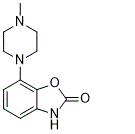
Pardoprunox (formerly known as SLV-308, DU-126891 or SME-308) is novel & potent dopamine D2/5-HT1A receptor agonist that has the potential for the treatment of Parkinson's disease. Pardoprunox acts by binding to dopamine D(2), D(3), and D(4) receptors and 5-HT(1) (A) receptors and is a partial agonist at dopamine D(2) and D(3) receptors and a full agonist at serotonin 5-HT(1) (A) receptors. SLV308 functioned as a strong but partial D(2) receptor agonist at cloned human dopamine D(2,L) receptors (pEC(50) = 8.0 and pA(2) = 8.4) with a 50% efficacy on forskolin stimulated cAMP accumulation. SLV308 functioned as a partial agonist at human recombinant dopamine D(3) receptors, inducing [(35)S]GTPgammaS binding (intrinsic activity of 67%; pEC(50) = 9.2) and inhibiting the dopamine-induced [(35)S]GTPgammaS binding (pA(2) = 9.0). On forskolin-induced cAMP accumulation at cloned human 5-HT(1) (A) receptors, SLV308 functioned as a full 5-HT(1) (A) receptor agonist, albeit with low potency (pEC(50) = 6.3).
Physicochemical Properties
| Molecular Formula | C12H15N3O2 | |
| Molecular Weight | 233.27 | |
| Exact Mass | 233.116 | |
| Elemental Analysis | C, 61.79; H, 6.48; N, 18.01; O, 13.72 | |
| CAS # | 269718-84-5 | |
| Related CAS # | Pardoprunox hydrochloride; 269718-83-4 | |
| PubChem CID | 6918525 | |
| Appearance | Solid powder | |
| LogP | 1.288 | |
| Hydrogen Bond Donor Count | 1 | |
| Hydrogen Bond Acceptor Count | 4 | |
| Rotatable Bond Count | 1 | |
| Heavy Atom Count | 17 | |
| Complexity | 302 | |
| Defined Atom Stereocenter Count | 0 | |
| SMILES | O=C1OC2=C(N3CCN(C)CC3)C=CC=C2N1 |
|
| InChi Key | YVPUUUDAZYFFQT-UHFFFAOYSA-N | |
| InChi Code | InChI=1S/C12H15N3O2/c1-14-5-7-15(8-6-14)10-4-2-3-9-11(10)17-12(16)13-9/h2-4H,5-8H2,1H3,(H,13,16) | |
| Chemical Name | 7-(4-methylpiperazin-1-yl)-3H-1,3-benzoxazol-2-one | |
| Synonyms |
|
|
| HS Tariff Code | 2934.99.9001 | |
| Storage |
Powder-20°C 3 years 4°C 2 years In solvent -80°C 6 months -20°C 1 month |
|
| Shipping Condition | Room temperature (This product is stable at ambient temperature for a few days during ordinary shipping and time spent in Customs) |
Biological Activity
| Targets | 5-HT1A Receptor ( pEC50 = 6.3 ); D2 Receptor ( pEC50 = 8 ); D3 Receptor ( pEC50 = 9.2 ) | ||
| ln Vitro |
|
||
| ln Vivo |
|
||
| Animal Protocol |
|
||
| References |
[1]. In vitro characterization of SLV308 (7-[4-methyl-1-piperazinyl]-2(3H)-benzoxazolone, monohydrochloride): a novel partial dopamine D2 and D3 receptor agonist and serotonin 5-HT1A receptor agonist. Synapse. 2006 Dec 15;60(8):599-608. [2]. Double-blind study of pardoprunox, a new partial dopamine agonist, in early Parkinson's disease. Mov Disord. 2010 Apr 30;25(6):738-46. [3]. In vivo effects of pardoprunox (SLV308), a partial D?/D? receptor and 5-HT1A receptor agonist, on rat dopamine and serotonin neuronal activity. Synapse. 2011 Oct;65(10):1042-51. |
||
| Additional Infomation |
Pardoprunox has been used in trials studying the treatment of Early Stage Parkinson's Disease and Advanced Stage Parkinson's Disease. Pardoprunox is a partial dopamine D2 agonist and noradrenergic agonist with serotonin 5-HT1A agonist properties. Mechanism of Action Pardoprunox binds to dopamine D(2), D(3), and D(4) receptors and 5-HT(1) (A) receptors and is a partial agonist at dopamine D(2) and D(3) receptors and a full agonist at serotonin 5-HT(1) (A) receptors. Pardoprunox combines high potency partial agonism at dopamine D(2) and D(3) receptors with full efficacy low potency serotonin 5-HT(1) (A) receptor agonism and is worthy of profiling in in vivo models of Parkinson's disease. |
Solubility Data
| Solubility (In Vitro) |
|
|||
| Solubility (In Vivo) |
|
| Preparing Stock Solutions | 1 mg | 5 mg | 10 mg | |
| 1 mM | 4.2869 mL | 21.4344 mL | 42.8688 mL | |
| 5 mM | 0.8574 mL | 4.2869 mL | 8.5738 mL | |
| 10 mM | 0.4287 mL | 2.1434 mL | 4.2869 mL |