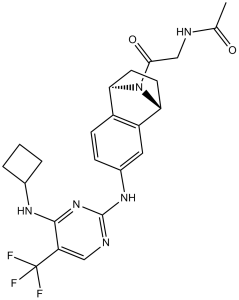
PF-03814735 (PF03814735) is a reversible, orally bioavailable, and ATP-competitive inhibitor of Aurora A/B kinases with potential antitumor activity. It inhibits Aurora A/B with IC50of 0.8 nM and 5 nM, respectively. PF-03814735 showed less potency against Flt3, FAK, TrkA, Met and FGFR1. It exhibits potent in vitro antiproliferative activity and high in vivo antitumor efficacy.
Physicochemical Properties
| Molecular Formula | C23H25F3N6O2 | |
| Molecular Weight | 474.48 | |
| Exact Mass | 474.199 | |
| CAS # | 942487-16-3 | |
| Related CAS # |
|
|
| PubChem CID | 51346455 | |
| Appearance | White to off-white solid powder | |
| Density | 1.4±0.1 g/cm3 | |
| Index of Refraction | 1.642 | |
| LogP | 2.11 | |
| Hydrogen Bond Donor Count | 3 | |
| Hydrogen Bond Acceptor Count | 9 | |
| Rotatable Bond Count | 6 | |
| Heavy Atom Count | 34 | |
| Complexity | 778 | |
| Defined Atom Stereocenter Count | 2 | |
| SMILES | CC(=O)NCC(=O)N1[C@H]2CC[C@@H]1C3=C2C=CC(=C3)NC4=NC=C(C(=N4)NC5CCC5)C(F)(F)F |
|
| InChi Key | RYYNGWLOYLRZLK-RBUKOAKNSA-N | |
| InChi Code | InChI=1S/C23H25F3N6O2/c1-12(33)27-11-20(34)32-18-7-8-19(32)16-9-14(5-6-15(16)18)30-22-28-10-17(23(24,25)26)21(31-22)29-13-3-2-4-13/h5-6,9-10,13,18-19H,2-4,7-8,11H2,1H3,(H,27,33)(H2,28,29,30,31)/t18-,19+/m0/s1 | |
| Chemical Name | N-(2-((1S,4R)-6-((4-(cyclobutylamino)-5-(trifluoromethyl)pyrimidin-2-yl)amino)-1,2,3,4-tetrahydro-1,4-epiminonaphthalen-9-yl)-2-oxoethyl)acetamide | |
| Synonyms | PF-03814735; PF 03814735; PF03814735 | |
| HS Tariff Code | 2934.99.9001 | |
| Storage |
Powder-20°C 3 years 4°C 2 years In solvent -80°C 6 months -20°C 1 month |
|
| Shipping Condition | Room temperature (This product is stable at ambient temperature for a few days during ordinary shipping and time spent in Customs) |
Biological Activity
| ln Vitro | Phosphorylated Aurora1, phosphorylated histone H3, and phosphorylated Aurora2 were all less abundant in intact cells as a result of PF-03814735's inhibitory action on the Aurora1 and Aurora2 kinases. The development of polyploid multinucleated cells and cell proliferation are inhibited by PF-03814735 because it suppresses cytokinesis [1]. High sensitivity to PF-03814735 has been shown in cell lines of small cell lung cancer (SCLC) and, to a lesser extent, colon cancer. There exists a substantial correlation between the effectiveness of PF-03814735 and the status of members of the retinoblastoma pathway and the Myc gene family. | ||
| ln Vivo | When PF-03814735 was given orally once a day to mice with human xenograft tumors, it dramatically slowed down the growth of the tumors by lowering the levels of phosphorylated histone H3 to levels that were manageable. In xenograft mice tumor models, the combination of docetaxel and PF-03814735 showed synergistic tumor growth suppression [1]. When given as a weekly regimen of 80 mg/kg instead of a daily regimen of 15 mg/kg, PF-03814735 was more successful in NCI-H82 xenografts. Weekly growth delays of 23.5 days caused by PF-03814735 equate to 0.9 log net cell death throughout treatment [2]. | ||
| Animal Protocol |
|
||
| References |
[1]. PF-03814735, an orally bioavailable small molecule aurora kinase inhibitor for cancer therapy. Mol Cancer Ther. 2010 Apr;9(4):883-94. [2]. An integrated genomic approach to identify predictive biomarkers of response to the aurora kinase inhibitor PF-03814735. Mol Cancer Ther. 2012 Mar;11(3):710-9. |
||
| Additional Infomation |
PF-03814735 has been used in trials studying the treatment of Solid Tumors. Aurora Kinase Inhibitor PF-03814735 is an aurora kinase inhibitor with potential antineoplastic activity. PF-03814735 binds to and inhibits aurora kinases, serine-threonine kinases that play essential roles in mitotic checkpoint control during mitosis. Inhibition of aurora kinases may result in an inhibition of cellular division and proliferation in tumor cells that overexpress aurora kinases. |
Solubility Data
| Solubility (In Vitro) |
|
|||
| Solubility (In Vivo) |
Solubility in Formulation 1: ≥ 2.5 mg/mL (5.27 mM) (saturation unknown) in 10% DMSO + 40% PEG300 + 5% Tween80 + 45% Saline (add these co-solvents sequentially from left to right, and one by one), clear solution. For example, if 1 mL of working solution is to be prepared, you can add 100 μL of 25.0 mg/mL clear DMSO stock solution to 400 μL PEG300 and mix evenly; then add 50 μL Tween-80 to the above solution and mix evenly; then add 450 μL normal saline to adjust the volume to 1 mL. Preparation of saline: Dissolve 0.9 g of sodium chloride in 100 mL ddH₂ O to obtain a clear solution. Solubility in Formulation 2: ≥ 2.5 mg/mL (5.27 mM) (saturation unknown) in 10% DMSO + 90% (20% SBE-β-CD in Saline) (add these co-solvents sequentially from left to right, and one by one), clear solution. For example, if 1 mL of working solution is to be prepared, you can add 100 μL of 25.0 mg/mL clear DMSO stock solution to 900 μL of 20% SBE-β-CD physiological saline solution and mix evenly. Preparation of 20% SBE-β-CD in Saline (4°C,1 week): Dissolve 2 g SBE-β-CD in 10 mL saline to obtain a clear solution. Solubility in Formulation 3: ≥ 2.5 mg/mL (5.27 mM) (saturation unknown) in 10% DMSO + 90% Corn Oil (add these co-solvents sequentially from left to right, and one by one), clear solution. For example, if 1 mL of working solution is to be prepared, you can add 100 μL of 25.0 mg/mL clear DMSO stock solution to 900 μL of corn oil and mix evenly. Solubility in Formulation 4: 2% Cremophor EL, 2% N,N-dimethylacetamide, pH 5.0: ~30mg/mL (Please use freshly prepared in vivo formulations for optimal results.) |
| Preparing Stock Solutions | 1 mg | 5 mg | 10 mg | |
| 1 mM | 2.1076 mL | 10.5379 mL | 21.0757 mL | |
| 5 mM | 0.4215 mL | 2.1076 mL | 4.2151 mL | |
| 10 mM | 0.2108 mL | 1.0538 mL | 2.1076 mL |