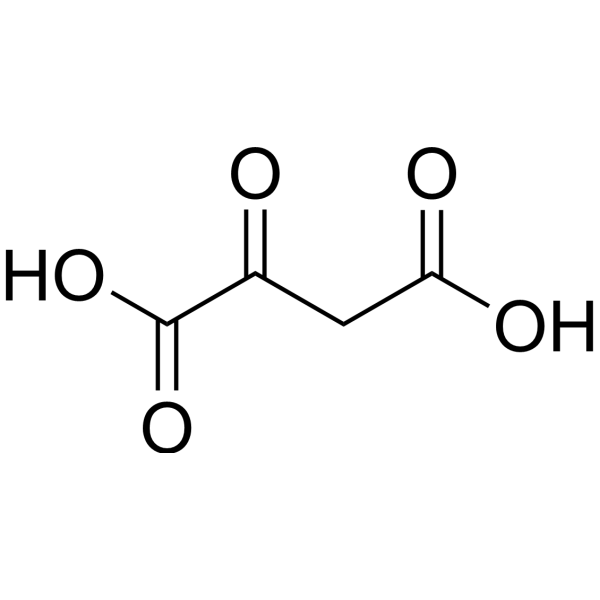
Physicochemical Properties
| Molecular Formula | C4H4O5 |
| Molecular Weight | 132.07 |
| Exact Mass | 132.005 |
| CAS # | 328-42-7 |
| PubChem CID | 970 |
| Appearance | Solid powder |
| Density | 1.6±0.1 g/cm3 |
| Boiling Point | 341.9±25.0 °C at 760 mmHg |
| Melting Point | 161 °C (dec.)(lit.) |
| Flash Point | 174.8±19.7 °C |
| Vapour Pressure | 0.0±1.6 mmHg at 25°C |
| Index of Refraction | 1.498 |
| LogP | -1.6 |
| Hydrogen Bond Donor Count | 2 |
| Hydrogen Bond Acceptor Count | 5 |
| Rotatable Bond Count | 3 |
| Heavy Atom Count | 9 |
| Complexity | 158 |
| Defined Atom Stereocenter Count | 0 |
| SMILES | C(C(=O)C(=O)O)C(=O)O |
| InChi Key | KHPXUQMNIQBQEV-UHFFFAOYSA-N |
| InChi Code | InChI=1S/C4H4O5/c5-2(4(8)9)1-3(6)7/h1H2,(H,6,7)(H,8,9) |
| Chemical Name | 2-oxobutanedioic acid |
| Synonyms | Oxaloacetic acid; 2-Oxosuccinic acid |
| HS Tariff Code | 2934.99.9001 |
| Storage |
Powder-20°C 3 years 4°C 2 years In solvent -80°C 6 months -20°C 1 month |
| Shipping Condition | Room temperature (This product is stable at ambient temperature for a few days during ordinary shipping and time spent in Customs) |
Biological Activity
| Targets | Human Endogenous Metabolite |
| ln Vivo | Oxaloacetic acid (10 mg/kg, once a day, for 3 consecutive days) can significantly reduce the acute lung injury induced by paraquat (50 mg/kg, once) and improve the survival rate of paraquat-poisoned mice[3] . |
| References |
[1]. F. L. Breusch. The fate of oxaloacetic acid in different organs. Biochem J. 1939 Nov; 33(11): 1757-1770. [2]. Oxaloacetic acid mediates ADP-dependent inhibition of mitochondrial complex II-driven respiration. J Biol Chem. 2018 Dec 21;293(51):19932-19941. [3]. Oxaloacetate acid ameliorates paraquat-induced acute lung injury by alleviating oxidative stress and mitochondrial dysfunction. Front Pharmacol. 2022 Oct 13;13:1029775. |
| Additional Infomation |
Oxaloacetic acid is an oxodicarboxylic acid that is succinic acid bearing a single oxo group. It has a role as a metabolite and a geroprotector. It is an oxo dicarboxylic acid and a C4-dicarboxylic acid. It is functionally related to a succinic acid. It is a conjugate acid of an oxaloacetate(2-). Oxalacetic acid is a metabolite found in or produced by Escherichia coli (strain K12, MG1655). Oxalacetic acid has been reported in Drosophila melanogaster, Medicago sativa, and other organisms with data available. Anhydrous Enol-oxaloacetate is the anhydrous form of enol-oxaloacetate, a small molecule blood glutamate scavenger, that can be used to lower glutamate plasma levels, and has potential neuroprotective activity. Upon administration, enol-oxaloacetate targets and binds to glutamate in the bloodstream. This lowers glutamate plasma levels and lowers the free glutamate available to be picked up by cells, such as tumor brain cells, thereby preventing glutamate metabolism and glutamate-mediated signaling. This prevents the proliferation of rapidly growing cells, such as brain tumor cells. And by lowering glutamate plasma levels, a molecular imbalance is formed and glutamate is excreted across the blood-brain barrier, resulting in lower free brain glutamate. This may help protect the brain from excitotoxicity in conditions where there is a surge of glutamate production, such as traumatic brain injury, thereby protecting neuronal cells. Glutamate, a non-essential amino acid and the major excitatory neurotransmitter in the central nervous system (CNS), provides energy and generates building blocks for the production of macromolecules, which are needed for cellular growth and survival. Oxalacetic acid is a metabolite found in or produced by Saccharomyces cerevisiae. A dicarboxylic acid ketone that is an important metabolic intermediate of the CITRIC ACID CYCLE. It can be converted to ASPARTIC ACID by ASPARTATE TRANSAMINASE. |
Solubility Data
| Solubility (In Vitro) | H2O : ≥ 100 mg/mL (757.17 mM) DMSO : ≥ 100 mg/mL (757.17 mM) |
| Solubility (In Vivo) | Solubility in Formulation 1: 100 mg/mL (757.17 mM) in PBS (add these co-solvents sequentially from left to right, and one by one), clear solution; sonication assisted. (Please use freshly prepared in vivo formulations for optimal results.) |
| Preparing Stock Solutions | 1 mg | 5 mg | 10 mg | |
| 1 mM | 7.5717 mL | 37.8587 mL | 75.7174 mL | |
| 5 mM | 1.5143 mL | 7.5717 mL | 15.1435 mL | |
| 10 mM | 0.7572 mL | 3.7859 mL | 7.5717 mL |