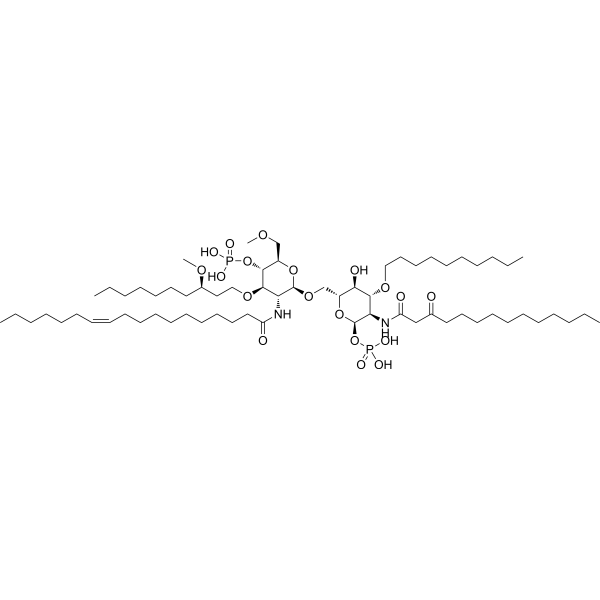
Physicochemical Properties
| Molecular Formula | C66H126N2O19P2 |
| Molecular Weight | 1313.66 |
| Exact Mass | 1400.77 |
| CAS # | 185955-34-4 |
| Related CAS # | 185955-34-4;185954-98-7 (tetrasodium); |
| PubChem CID | 6912404 |
| Appearance | Typically exists as solid at room temperature |
| Density | 1.14 |
| LogP | 16.145 |
| Hydrogen Bond Donor Count | 7 |
| Hydrogen Bond Acceptor Count | 19 |
| Rotatable Bond Count | 59 |
| Heavy Atom Count | 89 |
| Complexity | 1900 |
| Defined Atom Stereocenter Count | 11 |
| SMILES | CCCCCC/C=C/CCCCCCCCC/C(=N/[C@H]1[C@@H](OC[C@@H]2O[C@@H](OP([O-])(O)=O)[C@@H](/N=C(/CC(CCCCCCCCCCC)=O)\[O-])[C@@H](OCCCCCCCCCC)[C@H]2O)O[C@@H](COC)[C@@H](OP([O-])(O)=O)[C@H]1OCC[C@@H](CCCCCCC)OC)/[O-] |
| InChi Key | BPSMYQFMCXXNPC-MFCPCZTFSA-N |
| InChi Code | InChI=1S/C66H126N2O19P2/c1-7-11-15-19-22-25-26-27-28-29-30-32-34-38-42-46-57(70)67-60-64(82-49-47-54(80-6)45-41-36-18-14-10-4)62(86-88(73,74)75)56(51-79-5)85-65(60)83-52-55-61(72)63(81-48-43-39-35-24-21-17-13-9-3)59(66(84-55)87-89(76,77)78)68-58(71)50-53(69)44-40-37-33-31-23-20-16-12-8-2/h25-26,54-56,59-66,72H,7-24,27-52H2,1-6H3,(H,67,70)(H,68,71)(H2,73,74,75)(H2,76,77,78)/b26-25-/t54-,55-,56-,59-,60-,61-,62-,63-,64-,65-,66-/m1/s1 |
| Chemical Name | [(2R,3R,4R,5S,6R)-4-decoxy-5-hydroxy-6-[[(2R,3R,4R,5S,6R)-4-[(3R)-3-methoxydecoxy]-6-(methoxymethyl)-3-[[(Z)-octadec-11-enoyl]amino]-5-phosphonooxyoxan-2-yl]oxymethyl]-3-(3-oxotetradecanoylamino)oxan-2-yl] dihydrogen phosphate |
| HS Tariff Code | 2934.99.9001 |
| Storage |
Powder-20°C 3 years 4°C 2 years In solvent -80°C 6 months -20°C 1 month |
| Shipping Condition | Room temperature (This product is stable at ambient temperature for a few days during ordinary shipping and time spent in Customs) |
Biological Activity
| Targets | TLR4 |
| ln Vivo | At the end of the experiment, mice that received eritoran (233 μg/mouse; intraperitoneal injection; 10 days) were 70% still alive and protected against deadly EBOV infection [1]. |
| Animal Protocol |
Animal/Disease Models: C57BL/6J mice challenged with lethal EBOV[1] Doses: 233 μg/mouse Route of Administration: intraperitoneal (ip)injection; 10 days Experimental Results: diminished granulocytosis and results in a higher percentage of activated CD11b+ Ly6G/Ly6C+ neutrophils. Dramatically diminished the levels of IFN-γ-secreting CD8+ and CD4+ T cells and IL-17A-secreting CD4+ T cells. |
| ADME/Pharmacokinetics |
Biological Half-Life 50.4 to 62.7 hours |
| Toxicity/Toxicokinetics |
Protein Binding Approximately 55%, primarily to high-density lipoproteins. |
| References |
[1]. The Toll-Like Receptor 4 Antagonist Eritoran Protects Mice from Lethal Filovirus Challenge. mBio. 2017 Apr 25;8(2):e00226-17. [2]. Inhibition of corneal inflammation by the TLR4 antagonist Eritoran tetrasodium (E5564). Invest Ophthalmol Vis Sci. 2009 Mar;50(3):1247-54. |
| Additional Infomation |
Eritoran is a lipid A derivative used for the treatment of severe sepsis. It is a conjugate acid of an eritoran(4-). Eritoran is a structural analogue of the lipid A portion of lipopolysaccharide (LPS). It is being developed by Eisai Research Institute of Boston for the treatment of severe sepsis. Eritoran is a synthetic analogue of the lipid A portion of the endotoxin lipopolysaccharide (LPS) with potential immunomodulating activity. Eritoran binds to a receptor complex composed of toll-like receptor 4 (TLR4), CD14 and MD2 (MD-2, LY96) that is present on most cells of the immune system, inhibiting the activation of the receptor complex by LPS, which may result in the inhibition of pro-inflammatory cytokine secretion and a potentially fatal systemic inflammatory response syndrome (SIRS). LPS is found in the outer membrane of Gram-negative bacteria and binds to the TLR4/CD14/MD2 receptor complex of immune cells, including macrophages, resulting in the release of pro-inflammatory cytokines. See also: Eritoran Tetrasodium (annotation moved to). Drug Indication Investigated for use/treatment in sepsis and septicemia. Sepsis Mechanism of Action Eritoran is a toll-like receptor 4 inhibitor. Pharmacodynamics Eritoran has been shown to down-regulate the intracellular generation of pro-inflammatory cytokines IL-6 and TNF-alpha in human monocytes. |
Solubility Data
| Solubility (In Vitro) | May dissolve in DMSO (in most cases), if not, try other solvents such as H2O, Ethanol, or DMF with a minute amount of products to avoid loss of samples |
| Solubility (In Vivo) |
Note: Listed below are some common formulations that may be used to formulate products with low water solubility (e.g. < 1 mg/mL), you may test these formulations using a minute amount of products to avoid loss of samples. Injection Formulations (e.g. IP/IV/IM/SC) Injection Formulation 1: DMSO : Tween 80: Saline = 10 : 5 : 85 (i.e. 100 μL DMSO stock solution → 50 μL Tween 80 → 850 μL Saline) *Preparation of saline: Dissolve 0.9 g of sodium chloride in 100 mL ddH ₂ O to obtain a clear solution. Injection Formulation 2: DMSO : PEG300 :Tween 80 : Saline = 10 : 40 : 5 : 45 (i.e. 100 μL DMSO → 400 μLPEG300 → 50 μL Tween 80 → 450 μL Saline) Injection Formulation 3: DMSO : Corn oil = 10 : 90 (i.e. 100 μL DMSO → 900 μL Corn oil) Example: Take the Injection Formulation 3 (DMSO : Corn oil = 10 : 90) as an example, if 1 mL of 2.5 mg/mL working solution is to be prepared, you can take 100 μL 25 mg/mL DMSO stock solution and add to 900 μL corn oil, mix well to obtain a clear or suspension solution (2.5 mg/mL, ready for use in animals). Injection Formulation 4: DMSO : 20% SBE-β-CD in saline = 10 : 90 [i.e. 100 μL DMSO → 900 μL (20% SBE-β-CD in saline)] *Preparation of 20% SBE-β-CD in Saline (4°C,1 week): Dissolve 2 g SBE-β-CD in 10 mL saline to obtain a clear solution. Injection Formulation 5: 2-Hydroxypropyl-β-cyclodextrin : Saline = 50 : 50 (i.e. 500 μL 2-Hydroxypropyl-β-cyclodextrin → 500 μL Saline) Injection Formulation 6: DMSO : PEG300 : castor oil : Saline = 5 : 10 : 20 : 65 (i.e. 50 μL DMSO → 100 μLPEG300 → 200 μL castor oil → 650 μL Saline) Injection Formulation 7: Ethanol : Cremophor : Saline = 10: 10 : 80 (i.e. 100 μL Ethanol → 100 μL Cremophor → 800 μL Saline) Injection Formulation 8: Dissolve in Cremophor/Ethanol (50 : 50), then diluted by Saline Injection Formulation 9: EtOH : Corn oil = 10 : 90 (i.e. 100 μL EtOH → 900 μL Corn oil) Injection Formulation 10: EtOH : PEG300:Tween 80 : Saline = 10 : 40 : 5 : 45 (i.e. 100 μL EtOH → 400 μLPEG300 → 50 μL Tween 80 → 450 μL Saline) Oral Formulations Oral Formulation 1: Suspend in 0.5% CMC Na (carboxymethylcellulose sodium) Oral Formulation 2: Suspend in 0.5% Carboxymethyl cellulose Example: Take the Oral Formulation 1 (Suspend in 0.5% CMC Na) as an example, if 100 mL of 2.5 mg/mL working solution is to be prepared, you can first prepare 0.5% CMC Na solution by measuring 0.5 g CMC Na and dissolve it in 100 mL ddH2O to obtain a clear solution; then add 250 mg of the product to 100 mL 0.5% CMC Na solution, to make the suspension solution (2.5 mg/mL, ready for use in animals). Oral Formulation 3: Dissolved in PEG400 Oral Formulation 4: Suspend in 0.2% Carboxymethyl cellulose Oral Formulation 5: Dissolve in 0.25% Tween 80 and 0.5% Carboxymethyl cellulose Oral Formulation 6: Mixing with food powders Note: Please be aware that the above formulations are for reference only. InvivoChem strongly recommends customers to read literature methods/protocols carefully before determining which formulation you should use for in vivo studies, as different compounds have different solubility properties and have to be formulated differently. (Please use freshly prepared in vivo formulations for optimal results.) |
| Preparing Stock Solutions | 1 mg | 5 mg | 10 mg | |
| 1 mM | 0.7612 mL | 3.8062 mL | 7.6123 mL | |
| 5 mM | 0.1522 mL | 0.7612 mL | 1.5225 mL | |
| 10 mM | 0.0761 mL | 0.3806 mL | 0.7612 mL |