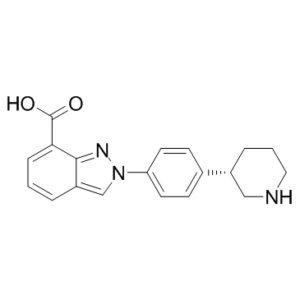
Niraparib metabolite M1 is a carboxylic acid metabolite of niraparib (MK4827; Zejula), which is a PARP1/2 inhibitor approved for cancer treatment.
Physicochemical Properties
| Molecular Formula | C₁₉H₁₉N₃O₂ | |
| Molecular Weight | 321.37 | |
| Exact Mass | 321.147 | |
| CAS # | 1476777-06-6 | |
| Related CAS # | Niraparib;1038915-60-4 | |
| PubChem CID | 118737587 | |
| Appearance | Light brown to brown solid powder | |
| Density | 1.3±0.1 g/cm3 | |
| Boiling Point | 442.0±45.0 °C at 760 mmHg | |
| Flash Point | 221.1±28.7 °C | |
| Vapour Pressure | 0.0±1.1 mmHg at 25°C | |
| Index of Refraction | 1.693 | |
| LogP | 4.01 | |
| Hydrogen Bond Donor Count | 2 | |
| Hydrogen Bond Acceptor Count | 4 | |
| Rotatable Bond Count | 3 | |
| Heavy Atom Count | 24 | |
| Complexity | 450 | |
| Defined Atom Stereocenter Count | 1 | |
| SMILES | C1C[C@H](CNC1)C2=CC=C(C=C2)N3C=C4C=CC=C(C4=N3)C(=O)O |
|
| InChi Key | HDQHGRLURKGIFL-CQSZACIVSA-N | |
| InChi Code | InChI=1S/C19H19N3O2/c23-19(24)17-5-1-3-15-12-22(21-18(15)17)16-8-6-13(7-9-16)14-4-2-10-20-11-14/h1,3,5-9,12,14,20H,2,4,10-11H2,(H,23,24)/t14-/m1/s1 | |
| Chemical Name | 2-[4-[(3S)-piperidin-3-yl]phenyl]indazole-7-carboxylic acid | |
| Synonyms |
|
|
| HS Tariff Code | 2934.99.9001 | |
| Storage |
Powder-20°C 3 years 4°C 2 years In solvent -80°C 6 months -20°C 1 month |
|
| Shipping Condition | Room temperature (This product is stable at ambient temperature for a few days during ordinary shipping and time spent in Customs) |
Biological Activity
| Targets | Niraparib metabolite | ||
| ln Vitro | Niraparib metabolite M1 has the validation in plasma and urine for the support of clinical studies such as the mass balance research and the absolute bioavailability study[1]. | ||
| ln Vivo |
|
||
| Animal Protocol |
|
||
| References |
[1]. Liquid chromatography-tandem mass spectrometry assay for the quantification of niraparib and its metabolite M1 in human plasma and urine. J Chromatogr B Analyt Technol Biomed Life Sci. 2016 Nov 19;1040:14-21. |
||
| Additional Infomation | Niraparib (MK-4827) is a novel poly(ADP-Ribose) polymerase (PARP) inhibitor currently investigated in phase III clinical trials to treat cancers. The development of a new drug includes the characterisation of absorption, metabolism and excretion (AME) of the compound. AME studies are a requirement of regulatory agencies and for this purpose bioanalytical assays are essential. This article describes the development and validation of a bioanalytical assay for niraparib and its carboxylic acid metabolite M1 in human plasma and urine using liquid chromatography-tandem mass spectrometry (LC-MS/MS). Sample pre-treatment involved protein precipitation for plasma and dilution of urine samples using acetonitrile-methanol (50:50, v/v). Final extracts were injected onto a SunFire C18 column and gradient elution using 20mM ammonium acetate (mobile phase A) and formic acid:acetonitrile:methanol (0.1:50:50, v/v/v) (mobile phase B) was applied. Detection was performed on an API5500 tandem mass spectrometer operating in the positive electrospray ionisation mode applying multiple reaction monitoring (MRM). The assay was successfully validated in accordance with the Food and Drug Administration and latest European Medicines Agency guidelines on bioanalytical method validation and can therefore be applied in pharmacological clinical studies. [1] |
Solubility Data
| Solubility (In Vitro) |
|
|||
| Solubility (In Vivo) |
Solubility in Formulation 1: ≥ 2.75 mg/mL (8.56 mM) (saturation unknown) in 10% DMSO + 40% PEG300 + 5% Tween80 + 45% Saline (add these co-solvents sequentially from left to right, and one by one), clear solution. For example, if 1 mL of working solution is to be prepared, you can add 100 μL of 27.5 mg/mL clear DMSO stock solution to 400 μL PEG300 and mix evenly; then add 50 μL Tween-80 to the above solution and mix evenly; then add 450 μL normal saline to adjust the volume to 1 mL. Preparation of saline: Dissolve 0.9 g of sodium chloride in 100 mL ddH₂ O to obtain a clear solution. Solubility in Formulation 2: ≥ 2.75 mg/mL (8.56 mM) (saturation unknown) in 10% DMSO + 90% (20% SBE-β-CD in Saline) (add these co-solvents sequentially from left to right, and one by one), clear solution. For example, if 1 mL of working solution is to be prepared, you can add 100 μL of 27.5 mg/mL clear DMSO stock solution to 900 μL of 20% SBE-β-CD physiological saline solution and mix evenly. Preparation of 20% SBE-β-CD in Saline (4°C,1 week): Dissolve 2 g SBE-β-CD in 10 mL saline to obtain a clear solution. Solubility in Formulation 3: ≥ 2.75 mg/mL (8.56 mM) (saturation unknown) in 10% DMSO + 90% Corn Oil (add these co-solvents sequentially from left to right, and one by one), clear solution. For example, if 1 mL of working solution is to be prepared, you can add 100 μL of 27.5 mg/mL clear DMSO stock solution to 900 μL of corn oil and mix evenly. (Please use freshly prepared in vivo formulations for optimal results.) |
| Preparing Stock Solutions | 1 mg | 5 mg | 10 mg | |
| 1 mM | 3.1117 mL | 15.5584 mL | 31.1168 mL | |
| 5 mM | 0.6223 mL | 3.1117 mL | 6.2234 mL | |
| 10 mM | 0.3112 mL | 1.5558 mL | 3.1117 mL |