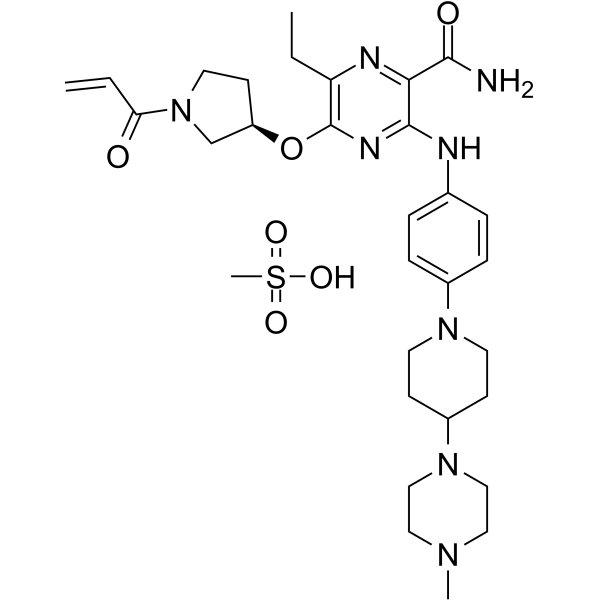
Naquotinib mesylate (ASP-8273; ASP8273), the mesylate salt of Naquotinib, is an irreversible/covalent and third-generation epidermal growth factor receptor (EGFR) inhibitor with potential anticancer activity. It inhibits EGFR with an IC50 of 70 nM.
Physicochemical Properties
| Molecular Formula | C31H46N8O6S |
| Molecular Weight | 658.811945438385 |
| Exact Mass | 658.326 |
| CAS # | 1448237-05-5 |
| Related CAS # | Naquotinib;1448232-80-1 |
| PubChem CID | 92135932 |
| Appearance | Light yellow to yellow solid powder |
| Hydrogen Bond Donor Count | 3 |
| Hydrogen Bond Acceptor Count | 12 |
| Rotatable Bond Count | 9 |
| Heavy Atom Count | 46 |
| Complexity | 976 |
| Defined Atom Stereocenter Count | 1 |
| SMILES | CCC1=C(N=C(C(=N1)C(=O)N)NC2=CC=C(C=C2)N3CCC(CC3)N4CCN(CC4)C)O[C@@H]5CCN(C5)C(=O)C=C.CS(=O)(=O)O |
| InChi Key | ALDUQYYVQWGTMR-GJFSDDNBSA-N |
| InChi Code | InChI=1S/C30H42N8O3.CH4O3S/c1-4-25-30(41-24-12-15-38(20-24)26(39)5-2)34-29(27(33-25)28(31)40)32-21-6-8-22(9-7-21)36-13-10-23(11-14-36)37-18-16-35(3)17-19-37;1-5(2,3)4/h5-9,23-24H,2,4,10-20H2,1,3H3,(H2,31,40)(H,32,34);1H3,(H,2,3,4)/t24-;/m1./s1 |
| Chemical Name | 6-ethyl-3-[4-[4-(4-methylpiperazin-1-yl)piperidin-1-yl]anilino]-5-[(3R)-1-prop-2-enoylpyrrolidin-3-yl]oxypyrazine-2-carboxamide;methanesulfonic acid |
| HS Tariff Code | 2934.99.9001 |
| Storage |
Powder-20°C 3 years 4°C 2 years In solvent -80°C 6 months -20°C 1 month Note: Please store this product in a sealed and protected environment, avoid exposure to moisture. |
| Shipping Condition | Room temperature (This product is stable at ambient temperature for a few days during ordinary shipping and time spent in Customs) |
Biological Activity
| ln Vitro | Naquotinib decreased the expression of PC-9(del ex19), HCC827(del ex19), NCI-H1975(del ex19/T790M), and PC-9ER(del ex19/T790M) in experiments utilizing endogenous EGFR-dependent cells. Growth, 8–33 nM is the IC50[1]. While the inhibitory impact of naquotinib was only observed at 1000nM in A431, it specifically decreased the phosphorylation of EGFR and its downstream signaling pathways, ERK and Akt, in HCC827 and NCI-H1975, commencing at 10nM. While other EGFR-TKIs were only partially successful, Naquotinib suppressed cell proliferation in NCI-H1650 (del ex19) with an IC50 value of 70nM [2]. |
| ln Vivo | Tumor regression was dose-dependently promoted in NCI-H1975 (L858R/T790M), HCC827 (del ex19), and PC-9 (del ex19) xenograft models by oral nargotinib treatment. The effectiveness of narcotinib remains unaffected by the dose schedule. After 14 days of nalcutinib treatment, tumor regression was fully achieved in the NCI-H1975 xenograft model. More than 85 days after nalcutinib medication was stopped, 50% of the mice continued to exhibit complete regression [2]. |
| References |
[1]. ASP8273, a novel mutant-selective irreversible EGFR inhibitor, inhibits growth of non-small cell lung cancer (NSCLC) cells with EGFR activating and T790M resistance mutations. [abstract]. In: Proceedings of the 105th Annual Meeting of t. [2]. ASP8273 selectively inhibits mutant EGFR signal pathway and induces tumor shrinkage in EGFR mutated tumor models. [abstract]. In: Proceedings of the 106th Annual Meeting of the American Association for Cancer Research; 2015 Apr 18-22; Ph. |
Solubility Data
| Solubility (In Vitro) | DMSO : ~12.5 mg/mL (~18.97 mM) |
| Solubility (In Vivo) |
Solubility in Formulation 1: ≥ 2 mg/mL (3.04 mM) (saturation unknown) in 10% DMSO + 40% PEG300 + 5% Tween80 + 45% Saline (add these co-solvents sequentially from left to right, and one by one), clear solution. For example, if 1 mL of working solution is to be prepared, you can add 100 μL of 20.0 mg/mL clear DMSO stock solution to 400 μL PEG300 and mix evenly; then add 50 μL Tween-80 to the above solution and mix evenly; then add 450 μL normal saline to adjust the volume to 1 mL. Preparation of saline: Dissolve 0.9 g of sodium chloride in 100 mL ddH₂ O to obtain a clear solution. Solubility in Formulation 2: ≥ 2 mg/mL (3.04 mM) (saturation unknown) in 10% DMSO + 90% (20% SBE-β-CD in Saline) (add these co-solvents sequentially from left to right, and one by one), clear solution. For example, if 1 mL of working solution is to be prepared, you can add 100 μL of 20.0 mg/mL clear DMSO stock solution to 900 μL of 20% SBE-β-CD physiological saline solution and mix evenly. Preparation of 20% SBE-β-CD in Saline (4°C,1 week): Dissolve 2 g SBE-β-CD in 10 mL saline to obtain a clear solution. (Please use freshly prepared in vivo formulations for optimal results.) |
| Preparing Stock Solutions | 1 mg | 5 mg | 10 mg | |
| 1 mM | 1.5179 mL | 7.5894 mL | 15.1789 mL | |
| 5 mM | 0.3036 mL | 1.5179 mL | 3.0358 mL | |
| 10 mM | 0.1518 mL | 0.7589 mL | 1.5179 mL |