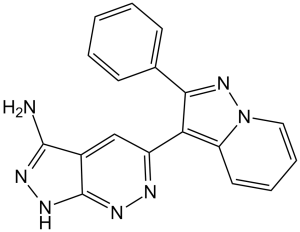
Physicochemical Properties
| Molecular Formula | C18H13N7 | |
| Molecular Weight | 327.34 | |
| Exact Mass | 327.123 | |
| Elemental Analysis | C, 66.04; H, 4.00; N, 29.95 | |
| CAS # | 865362-74-9 | |
| Related CAS # |
|
|
| PubChem CID | 11493598 | |
| Appearance | Light yellow to yellow solid powder | |
| Density | 1.6±0.1 g/cm3 | |
| Index of Refraction | 1.846 | |
| LogP | 0.29 | |
| Hydrogen Bond Donor Count | 2 | |
| Hydrogen Bond Acceptor Count | 5 | |
| Rotatable Bond Count | 2 | |
| Heavy Atom Count | 25 | |
| Complexity | 468 | |
| Defined Atom Stereocenter Count | 0 | |
| SMILES | N1C(C2=C3N(C=CC=C3)N=C2C2C=CC=CC=2)=CC2=C(NN=C2N)N=1 |
|
| InChi Key | XVECMUKVOMUNLE-UHFFFAOYSA-N | |
| InChi Code | InChI=1S/C18H13N7/c19-17-12-10-13(20-22-18(12)23-21-17)15-14-8-4-5-9-25(14)24-16(15)11-6-2-1-3-7-11/h1-10H,(H3,19,21,22,23) | |
| Chemical Name | 5-(2-phenylpyrazolo[1,5-a]pyridin-3-yl)-2H-pyrazolo[3,4-c]pyridazin-3-amine | |
| Synonyms |
|
|
| HS Tariff Code | 2934.99.9001 | |
| Storage |
Powder-20°C 3 years 4°C 2 years In solvent -80°C 6 months -20°C 1 month |
|
| Shipping Condition | Room temperature (This product is stable at ambient temperature for a few days during ordinary shipping and time spent in Customs) |
Biological Activity
| Targets | ERK2 (Ki = 0.14 μM); ERK1 (Ki = 0.31 μM); ERK2 (IC50 = 0.33 μM); ERK1 (IC50 = 0.51 μM) |
| ln Vitro | FR180204 has an IC50 of 3.1 μM and dose-dependently inhibits AP-1 transactivation in cells transfected with that protein.[1] FR 180204 prevents the growth of mesothelioma cells on their own.[3] |
| ln Vivo | FR180204 (100 mg/kg, i.p., b.i.d.) significantly lessens the severity of symptoms and body weight loss in mice with collagen-induced arthritis[2]. In a mouse model of dengue virus (DENV) infection, FR180204 reduces liver damage brought on by DENV, limits hepatocyte apoptosis, and enhances clinical indicators[4]. |
| Enzyme Assay | Nunc-Immuno MaxiSorp plates are coated with a 20 g/mL MBP solution in phosphate-buffered saline (PBS). Blocking buffer (T-PBS containing 3% BSA) is added to each well of the plates after washing them with PBS containing 0.05% Tween 20 (T-PBS). The plates are then left to sit at room temperature for 10 minutes. Chemicals, ATP, and recombinant ERK2 are diluted in assay dilution buffer (20 mM Mops, pH 7.2, 25 mM β-glycerol phosphate, 5 mM EGTA, 1 mM sodium orthovanadate, 1 mM dithiothreitol, and 50 μg/mL BSA) and added to each well after washing with T-PBS. For the control and basal determinations, vehicle groups (contain 0.1% DMSO) and kinase-withdrawal groups are used. Plates are twice T-PBS-washed after 1 hour of room temperature incubation. Each well receives 0.2 μg/mL of anti-phospho MBP antibody, and the plates are then left to sit at room temperature for an hour. Anti-mouse HRP-conjugated polyclonal antibodies are added to the plates after washing, and they are then left to sit for 30 minutes. |
| Cell Assay | The MTT method is used to measure cell viability. Using a micro-plate reader, MTT-reactive cells are measured at an absorbance of 570 nm. |
| Animal Protocol | Briefly, mice are randomized and categorized by body weight right before treatment. Bovine CII is dissolved in 0.1mol/L acetic acid at a concentration of 10 mg/mL before being emulsified in an equivalent volume of Freund's complete adjuvant H37Rv. Each mouse is immunized with 25 μL of the CII emulsion into the base of the tail, followed by a booster injection three weeks after the primary injection (day 0), with the exception of a naive group. In a volume of 5 mL/kg, FR180204 and methylprednisolone are ground and suspended in a solution of 0.1% methylcellulose. According to pharmacokinetic studies with a better area under the curve and Cmax values for intraperitoneal administration than s.c. or oral administration, medications are given by intraperitoneal injection twice daily from days 0 to 12. The initial dosage is given 30 minutes prior to the boost CII injection. By adding the visual severity grade of each limb, which is graded as follows, the clinical score of arthritis is determined: No arthritis; one swollen digit; two or more digits; swelling of the entire paw without ankylosis; and three, severe swelling with paw ankylosis. On day 12, one measures one's body weight. |
| References |
[1]. Identification of a selective ERK inhibitor and structural determination of the inhibitor-ERK2 complex. Biochem Biophys Res Commun. 2005 Oct 14;336(1):357-63. [2]. FR180204, a novel and selective inhibitor of extracellular signal-regulated kinase, ameliorates collagen-induced arthritis in mice. Naunyn Schmiedebergs Arch Pharmacol. 2007 Jan;374(4):311-6. [3]. Mesothelioma cell proliferation through autocrine activation of PDGF-ββ receptor. Cell Physiol Biochem. 2012;29(5-6):667-74. [4]. Role of ERK1/2 signaling in dengue virus-induced liver injury. Virus Res. 2014 Aug 8;188:15-26. |
| Additional Infomation | 5-(2-phenyl-3-pyrazolo[1,5-a]pyridinyl)-2H-pyrazolo[3,4-c]pyridazin-3-amine is a member of pyrazoles and a ring assembly. |
Solubility Data
| Solubility (In Vitro) |
|
|||
| Solubility (In Vivo) |
Solubility in Formulation 1: ≥ 2.5 mg/mL (7.64 mM) (saturation unknown) in 10% DMSO + 40% PEG300 + 5% Tween80 + 45% Saline (add these co-solvents sequentially from left to right, and one by one), clear solution. For example, if 1 mL of working solution is to be prepared, you can add 100 μL of 25.0 mg/mL clear DMSO stock solution to 400 μL PEG300 and mix evenly; then add 50 μL Tween-80 to the above solution and mix evenly; then add 450 μL normal saline to adjust the volume to 1 mL. Preparation of saline: Dissolve 0.9 g of sodium chloride in 100 mL ddH₂ O to obtain a clear solution. Solubility in Formulation 2: ≥ 2.5 mg/mL (7.64 mM) (saturation unknown) in 10% DMSO + 90% (20% SBE-β-CD in Saline) (add these co-solvents sequentially from left to right, and one by one), clear solution. For example, if 1 mL of working solution is to be prepared, you can add 100 μL of 25.0 mg/mL clear DMSO stock solution to 900 μL of 20% SBE-β-CD physiological saline solution and mix evenly. Preparation of 20% SBE-β-CD in Saline (4°C,1 week): Dissolve 2 g SBE-β-CD in 10 mL saline to obtain a clear solution. (Please use freshly prepared in vivo formulations for optimal results.) |
| Preparing Stock Solutions | 1 mg | 5 mg | 10 mg | |
| 1 mM | 3.0549 mL | 15.2746 mL | 30.5493 mL | |
| 5 mM | 0.6110 mL | 3.0549 mL | 6.1099 mL | |
| 10 mM | 0.3055 mL | 1.5275 mL | 3.0549 mL |