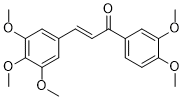
MD2-IN-1, a chalcone derivative, is a novel potent and specific inhibitor of Myeloid differentiation protein 2 (MD2) with potential anti-inflammatory activity. It inhibits MD2 with a KD of 189 μM for the recombinant human MD2 (rhMD2). Acute lung injury (ALI) is a life-threatening acute inflammatory disease with limited options available for therapy. Myeloid differentiation protein 2, a co-receptor of TLR4, is absolutely required for TLR4 sense LPS, and represents an attractive target for treating severe inflammatory diseases.MD2-IN-1 contains the moiety of (E)-4-phenylbut-3-en-2-one, which is considered to be the core structure of current MD2 inhibitors. The anti-inflammatory activities of MD2-IN-1 was evaluated in MPMs. MD2-IN-1 binds to the hydrophobic pocket of MD2 via hydrogen bonds with Arg(90) and Tyr(102) residues. MD2-IN-1 also blocked the LPS-induced activation of TLR4/MD2 -downstream pro-inflammatory MAPKs/NF-κB signaling pathways. In a rat model with ALI induced by intracheal LPS instillation, administration with MD2-IN-1 exhibited significant protective effect against ALI, accompanied by the inhibition of TLR4/MD2 complex formation in lung tissues. Taken together, the results of this study suggest the specific MD2 inhibitor from chalcone derivatives is a potential candidate for treating acute inflammatory diseases.
Physicochemical Properties
| Molecular Formula | C20H22O6 | |
| Molecular Weight | 358.39 | |
| Exact Mass | 358.141 | |
| CAS # | 111797-22-9 | |
| Related CAS # |
|
|
| PubChem CID | 5724738 | |
| Appearance | Light yellow to yellow solid powder | |
| LogP | 3.5 | |
| Hydrogen Bond Donor Count | 0 | |
| Hydrogen Bond Acceptor Count | 6 | |
| Rotatable Bond Count | 8 | |
| Heavy Atom Count | 26 | |
| Complexity | 451 | |
| Defined Atom Stereocenter Count | 0 | |
| SMILES | C1C(/C=C/C(=O)C2=CC(OC)=C(C=C2)OC)=CC(=C(OC)C=1OC)OC |
|
| InChi Key | ZKYRYELHPFTZTI-SOFGYWHQSA-N | |
| InChi Code | InChI=1S/C20H22O6/c1-22-16-9-7-14(12-17(16)23-2)15(21)8-6-13-10-18(24-3)20(26-5)19(11-13)25-4/h6-12H,1-5H3/b8-6+ | |
| Chemical Name |
|
|
| Synonyms |
|
|
| HS Tariff Code | 2934.99.9001 | |
| Storage |
Powder-20°C 3 years 4°C 2 years In solvent -80°C 6 months -20°C 1 month |
|
| Shipping Condition | Room temperature (This product is stable at ambient temperature for a few days during ordinary shipping and time spent in Customs) |
Biological Activity
| ln Vitro | TLR4's coreceptor is myeloid differentiation protein 2 (MD2). Of all the derivatives, compound 20 (MD2-IN-1) had the most potent inhibitory effect on the production of TNF-α and IL-6 produced by LPS. While pretreatment with MD2-IN-1 suppressed the increase in TLR4/MD2 complexes to vehicle levels, LPS alone significantly enhanced the quantity of TLR4/MD2 complexes relative to vehicle. SPR study revealed that xanthohumol bound to MD2 with a KD value of 460 μM, whereas MD2-IN-1 bound to rhMD2 protein in a dose-dependent manner with a KD value of 189 μM. The binding of FITC-LPS to MD2 in the cell surface membrane was dose-dependently decreased by pretreatment with several dosages of MD2-IN-1, with an average fluorescence intensity inhibition of 65% at 10 μM. Additionally, pretreatment with MD2-IN-1 dose-dependently prevents MPM-induced MAPK phosphorylation caused by LPS [1]. |
| ln Vivo | The LPS-induced rise in protein concentration in BALF was considerably attenuated by administering MD2-IN-1. A treatment of MD2-IN-1 reduced LPS-induced pulmonary edema, and the lung wet/dry weight ratio in the LPS treatment group was considerably greater than in the control group. Furthermore, areas of inflammatory infiltrates, bleeding, interstitial edema, thickening of the alveolar wall, and loss of lung tissue are all visible histological changes brought on by LPS. In the group receiving MD2-IN-1 treatment, these histological alterations improved [1]. |
| References |
[1]. Discovery of new MD2 inhibitor from chalcone derivatives with anti-inflammatory effects in LPS-induced acute lung injury. Sci Rep. 2016 Apr 27;6:25130. |
Solubility Data
| Solubility (In Vitro) |
|
|||
| Solubility (In Vivo) |
Solubility in Formulation 1: ≥ 3.25 mg/mL (9.07 mM) (saturation unknown) in 10% DMSO + 40% PEG300 + 5% Tween80 + 45% Saline (add these co-solvents sequentially from left to right, and one by one), clear solution. For example, if 1 mL of working solution is to be prepared, you can add 100 μL of 32.5 mg/mL clear DMSO stock solution to 400 μL of PEG300 and mix evenly; then add 50 μL of Tween-80 to the above solution and mix evenly; then add 450 μL of normal saline to adjust the volume to 1 mL. Preparation of saline: Dissolve 0.9 g of sodium chloride in 100 mL ddH₂ O to obtain a clear solution. Solubility in Formulation 2: 3.25 mg/mL (9.07 mM) in 10% DMSO + 90% (20% SBE-β-CD in Saline) (add these co-solvents sequentially from left to right, and one by one), suspension solution; with ultrasonication. For example, if 1 mL of working solution is to be prepared, you can add 100 μL of 32.5 mg/mL clear DMSO stock solution to 900 μL of 20% SBE-β-CD physiological saline solution and mix evenly. Preparation of 20% SBE-β-CD in Saline (4°C,1 week): Dissolve 2 g SBE-β-CD in 10 mL saline to obtain a clear solution. Solubility in Formulation 3: ≥ 3.25 mg/mL (9.07 mM) (saturation unknown) in 10% DMSO + 90% Corn Oil (add these co-solvents sequentially from left to right, and one by one), clear solution. For example, if 1 mL of working solution is to be prepared, you can add 100 μL of 32.5 mg/mL clear DMSO stock solution to 900 μL of corn oil and mix evenly. (Please use freshly prepared in vivo formulations for optimal results.) |
| Preparing Stock Solutions | 1 mg | 5 mg | 10 mg | |
| 1 mM | 2.7903 mL | 13.9513 mL | 27.9026 mL | |
| 5 mM | 0.5581 mL | 2.7903 mL | 5.5805 mL | |
| 10 mM | 0.2790 mL | 1.3951 mL | 2.7903 mL |