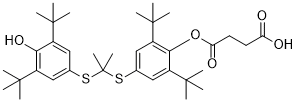
Succinobucol (formerly known as AGI-1067, AGZ-1067, Probucol monosuccinate, succinyl ester of probucol) is a a lipid-lowering compound and a phenolic antioxidant with anti-inflammatory and antiplatelet effects. Succinobucol inhibits TLR4 ligand (LPS)-induced activation of ASK1 and the downstream p38 and JNK MAP kinases, which could inhibit ASK1-JNK/p38-dependent gene expression of proinflamamtory molecules. Inhibition of both p38 and JNK by AGI-1067 occurred in a concentration-dependent manner with an IC50 value under 5 μM. AtheroGenics reports positive results from ANDES Phase 3 Clinical Trial (NCT00066898) of Succinobucol.
Physicochemical Properties
| Molecular Formula | C35H52O5S2 | |
| Molecular Weight | 616.92 | |
| Exact Mass | 616.326 | |
| CAS # | 216167-82-7 | |
| Related CAS # |
|
|
| PubChem CID | 216325 | |
| Appearance | White to off-white solid powder | |
| Density | 1.13g/cm3 | |
| Boiling Point | 659.5ºC at 760mmHg | |
| Flash Point | 352.7ºC | |
| Vapour Pressure | 2.71E-18mmHg at 25°C | |
| Index of Refraction | 1.571 | |
| LogP | 9.972 | |
| Hydrogen Bond Donor Count | 2 | |
| Hydrogen Bond Acceptor Count | 7 | |
| Rotatable Bond Count | 13 | |
| Heavy Atom Count | 42 | |
| Complexity | 870 | |
| Defined Atom Stereocenter Count | 0 | |
| InChi Key | RKSMVPNZHBRNNS-UHFFFAOYSA-N | |
| InChi Code | InChI=1S/C35H52O5S2/c1-31(2,3)23-17-21(18-24(29(23)39)32(4,5)6)41-35(13,14)42-22-19-25(33(7,8)9)30(26(20-22)34(10,11)12)40-28(38)16-15-27(36)37/h17-20,39H,15-16H2,1-14H3,(H,36,37) | |
| Chemical Name |
|
|
| Synonyms |
|
|
| HS Tariff Code | 2934.99.9001 | |
| Storage |
Powder-20°C 3 years 4°C 2 years In solvent -80°C 6 months -20°C 1 month |
|
| Shipping Condition | Room temperature (This product is stable at ambient temperature for a few days during ordinary shipping and time spent in Customs) |
Biological Activity
| ln Vitro | In rabbit whole blood, succinylbucol (10, 50, and 100 μM) reduces collagen-induced platelet aggregation in a dose-dependent manner. In reaction to ADP, succinobucol also significantly reduces whole blood aggregation. The relaxation to X/XO is greatly reduced by succinobucol (10, 100 μM)[1]. Succinobucol effectively inhibits 3-NP-induced loss of SH-SY5Y cell viability, production of reactive oxygen species, and lowering of ΔΨm. Succinobucol does not counteract the inhibition of mitochondrial complex II activity generated by 3-NP, suggesting that the secondary events brought on by the inhibition of mitochondrial complex II are mitigated. Succinobucol considerably raises (50 %) the levels of GSH in SH-SY5Y cells, which is accompanied by considerable increases in glutamate cysteine ligase messenger RNA (mRNA) expression and activity[2]. Succinobucol successfully demonstrates superior inhibitory effects on cell migration and invasion activities, VCAM-1 expression and cell-cell binding of RAW 264.7 to 4T1 cells. Succinobucol also showed inhibitory effect on VCAM-1 expression in 4T1 cells and cell-cell binding of RAW 264.7 to 4T1 cancer cells[3]. | ||
| ln Vivo | Rats' heart rates and mean arterial pressure (MAP) are not significantly affected by succinobucol (50, 100, and 150 mg/kg, iv). However, blood taken out 15 minutes after the last injection of succinobucol demonstrates significantly less aggregation in response to collagen at 5 µg/mL and 20 µg/mL[1]. In mice with lung metastasized breast cancer, injection of succinybucol (40 mg/kg) into the tail dramatically lowers the mean number of metastasized nodules[3]. | ||
| Animal Protocol |
|
||
| References |
[1]. An investigation of the antiplatelet effects of succinobucol (AGI-1067). Platelets. 2017 May;28(3):295-300. [2]. Succinobucol, a Lipid-Lowering Drug, Protects Against 3-Nitropropionic Acid-Induced Mitochondrial Dysfunction and Oxidative Stress in SH-SY5Y Cells via Upregulation of Glutathione Levels and Glutamate Cysteine Ligase Activity. Mol Neurobio. [3]. A pH-Responsive Host-guest Nanosystem Loading Succinobucol Suppresses Lung Metastasis of Breast Cancer. Theranostics. 2016 Jan 25;6(3):435-45. |
||
| Additional Infomation |
Succinobucol is a benzoate ester and a member of phenols. AGI-1067, is a novel small molecule with anti-oxidant and anti-inflammatory properties that was discovered by AtheroGenics and designed to treat atherosclerosis of the blood vessels of the heart, or coronary artery disease. Drug Indication Investigated for use/treatment in atherosclerosis, coronary artery disease, diabetes mellitus type 2, and in-stent restenosis. Mechanism of Action AGI-1067 works by inhibiting key oxidant signals within cells of blood vessel walls that generate inflammatory processes that are key to the pathogenesis of atherosclerosis. This includes inhibition of inflammatory cytokines, chemokines and vascular adhesion molecules that participate in the initiation, growth and eventual destabilization of the plaque. Its anti-oxidant properties also play a role in its ability to inhibit the formation of oxidized LDL, a critical component in the formation of atherosclerotic plaque. |
Solubility Data
| Solubility (In Vitro) |
|
|||
| Solubility (In Vivo) |
Solubility in Formulation 1: ≥ 2.5 mg/mL (4.05 mM) (saturation unknown) in 10% DMSO + 40% PEG300 + 5% Tween80 + 45% Saline (add these co-solvents sequentially from left to right, and one by one), clear solution. For example, if 1 mL of working solution is to be prepared, you can add 100 μL of 25.0 mg/mL clear DMSO stock solution to 400 μL PEG300 and mix evenly; then add 50 μL Tween-80 to the above solution and mix evenly; then add 450 μL normal saline to adjust the volume to 1 mL. Preparation of saline: Dissolve 0.9 g of sodium chloride in 100 mL ddH₂ O to obtain a clear solution. Solubility in Formulation 2: ≥ 2.5 mg/mL (4.05 mM) (saturation unknown) in 10% DMSO + 90% Corn Oil (add these co-solvents sequentially from left to right, and one by one), clear solution. For example, if 1 mL of working solution is to be prepared, you can add 100 μL of 25.0 mg/mL clear DMSO stock solution to 900 μL of corn oil and mix evenly. (Please use freshly prepared in vivo formulations for optimal results.) |
| Preparing Stock Solutions | 1 mg | 5 mg | 10 mg | |
| 1 mM | 1.6210 mL | 8.1048 mL | 16.2096 mL | |
| 5 mM | 0.3242 mL | 1.6210 mL | 3.2419 mL | |
| 10 mM | 0.1621 mL | 0.8105 mL | 1.6210 mL |