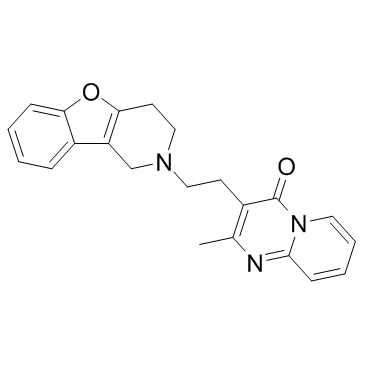
Lusaperidone (R107474; R-107474; R 107474) is a potent α2 adrenergic receptor antagonist with Kis of 0.13 and 0.15 nM for α2A and α2C, respectively.
Physicochemical Properties
| Molecular Formula | C₂₂H₂₁N₃O₂ |
| Molecular Weight | 359.42 |
| Exact Mass | 359.163 |
| Elemental Analysis | C, 73.52; H, 5.89; N, 11.69; O, 8.90 |
| CAS # | 214548-46-6 |
| PubChem CID | 3045401 |
| Appearance | White to light yellow solid powder |
| Density | 1.31g/cm3 |
| Boiling Point | 538.3ºC at 760 mmHg |
| Flash Point | 279.4ºC |
| Vapour Pressure | 1.17E-11mmHg at 25°C |
| Index of Refraction | 1.688 |
| LogP | 3.287 |
| Hydrogen Bond Donor Count | 0 |
| Hydrogen Bond Acceptor Count | 4 |
| Rotatable Bond Count | 3 |
| Heavy Atom Count | 27 |
| Complexity | 751 |
| Defined Atom Stereocenter Count | 0 |
| SMILES | O=C1C(CCN2CCC(OC3=CC=CC=C34)=C4C2)=C(C)N=C5N1C=CC=C5 |
| InChi Key | ZYXHQIPQIKTEDI-UHFFFAOYSA-N |
| InChi Code | InChI=1S/C22H21N3O2/c1-15-16(22(26)25-11-5-4-8-21(25)23-15)9-12-24-13-10-20-18(14-24)17-6-2-3-7-19(17)27-20/h2-8,11H,9-10,12-14H2,1H3 |
| Chemical Name | 3-[2-(3,4-dihydro-1H-[1]benzofuro[3,2-c]pyridin-2-yl)ethyl]-2-methylpyrido[1,2-a]pyrimidin-4-one |
| Synonyms | R107474; R-107474; R 107474 |
| HS Tariff Code | 2934.99.9001 |
| Storage |
Powder-20°C 3 years 4°C 2 years In solvent -80°C 6 months -20°C 1 month |
| Shipping Condition | Room temperature (This product is stable at ambient temperature for a few days during ordinary shipping and time spent in Customs) |
Biological Activity
| Targets | α2A adrenergic receptor ( Ki = 0.13 nM ); α2C adrenergic receptor ( Ki = 0.15 nM ) |
| ln Vitro | Lusaperidone exhibits nanomolar affinity for the hα2B adrenergic receptor and h5-HT7 receptors (Ki=1 and 5 nM, respectively), and subnanomolar affinity for the α2A and α2C adrenergic receptor (Ki=0.13 and 0.15 nM, respectively). Lusaperidone has a weak interaction (Ki values between 81 and 920 nM) with the following receptor types: dopamine-hD2L, -hD3 and -hD4, h5-HT1D, h5-HT1F, h5-HT2A, h5-HT2C, and h5-HT5A. In this study, lusomidine was tested up to 10 μM and found to interact with any of the other receptor or transporter binding sites only at micromolar concentrations or not at all. Lusaperidone is a full antagonist on both receptor subtypes and has been demonstrated to reverse the clonidine-induced inhibition of cyclic AMP production mediated by human α2A and α2C adrenoceptors expressed in cell lines (Kb is 2.8 and 4.4 nM, respectively)[1]. |
| ln Vivo | Lusaperidone has an ED50 of 0.014 mg/kg sc (0.009-0.019) for α2A and 0.026 mg/kg sc (0.022-0.030) for α2C adrenergic receptors. After being administered intravenously in vivo, R107474 is absorbed very quickly; in the majority of tissues, including the brain, its maximum concentration is reached five minutes after the tracer injection[1]. |
| Animal Protocol | Rats: Male Wistar rats (weighing 200–250 g) are anesthetized with diethyl ether, and radiolabeled lusaperidone (24–28 GBq/μmol) is injected into their tail vein. The rats were given injections of 30–40 MBq in 300 μL saline containing 10% (v/v) ethanol at the beginning of the experiment. Under the influence of diethyl ether anesthesia, the rats are killed by cervical dislocation at 5, 10, 20, and 30 minutes after injection. After a cardiac puncture, a blood sample is obtained, and a few chosen tissues are quickly dissected and weighed. Radioactivity is quantified [1]. |
| References |
[1]. Synthesis and biodistribution of [11C]R107474, a new radiolabeled alpha2-adrenoceptor antagonist. Bioorg Med Chem. 2006 Jul 1;14(13):4526-34. |
Solubility Data
| Solubility (In Vitro) | DMSO: ~3.45 mg/mL (~9.6 mM) |
| Solubility (In Vivo) |
Note: Listed below are some common formulations that may be used to formulate products with low water solubility (e.g. < 1 mg/mL), you may test these formulations using a minute amount of products to avoid loss of samples. Injection Formulations (e.g. IP/IV/IM/SC) Injection Formulation 1: DMSO : Tween 80: Saline = 10 : 5 : 85 (i.e. 100 μL DMSO stock solution → 50 μL Tween 80 → 850 μL Saline) *Preparation of saline: Dissolve 0.9 g of sodium chloride in 100 mL ddH ₂ O to obtain a clear solution. Injection Formulation 2: DMSO : PEG300 :Tween 80 : Saline = 10 : 40 : 5 : 45 (i.e. 100 μL DMSO → 400 μLPEG300 → 50 μL Tween 80 → 450 μL Saline) Injection Formulation 3: DMSO : Corn oil = 10 : 90 (i.e. 100 μL DMSO → 900 μL Corn oil) Example: Take the Injection Formulation 3 (DMSO : Corn oil = 10 : 90) as an example, if 1 mL of 2.5 mg/mL working solution is to be prepared, you can take 100 μL 25 mg/mL DMSO stock solution and add to 900 μL corn oil, mix well to obtain a clear or suspension solution (2.5 mg/mL, ready for use in animals). Injection Formulation 4: DMSO : 20% SBE-β-CD in saline = 10 : 90 [i.e. 100 μL DMSO → 900 μL (20% SBE-β-CD in saline)] *Preparation of 20% SBE-β-CD in Saline (4°C,1 week): Dissolve 2 g SBE-β-CD in 10 mL saline to obtain a clear solution. Injection Formulation 5: 2-Hydroxypropyl-β-cyclodextrin : Saline = 50 : 50 (i.e. 500 μL 2-Hydroxypropyl-β-cyclodextrin → 500 μL Saline) Injection Formulation 6: DMSO : PEG300 : castor oil : Saline = 5 : 10 : 20 : 65 (i.e. 50 μL DMSO → 100 μLPEG300 → 200 μL castor oil → 650 μL Saline) Injection Formulation 7: Ethanol : Cremophor : Saline = 10: 10 : 80 (i.e. 100 μL Ethanol → 100 μL Cremophor → 800 μL Saline) Injection Formulation 8: Dissolve in Cremophor/Ethanol (50 : 50), then diluted by Saline Injection Formulation 9: EtOH : Corn oil = 10 : 90 (i.e. 100 μL EtOH → 900 μL Corn oil) Injection Formulation 10: EtOH : PEG300:Tween 80 : Saline = 10 : 40 : 5 : 45 (i.e. 100 μL EtOH → 400 μLPEG300 → 50 μL Tween 80 → 450 μL Saline) Oral Formulations Oral Formulation 1: Suspend in 0.5% CMC Na (carboxymethylcellulose sodium) Oral Formulation 2: Suspend in 0.5% Carboxymethyl cellulose Example: Take the Oral Formulation 1 (Suspend in 0.5% CMC Na) as an example, if 100 mL of 2.5 mg/mL working solution is to be prepared, you can first prepare 0.5% CMC Na solution by measuring 0.5 g CMC Na and dissolve it in 100 mL ddH2O to obtain a clear solution; then add 250 mg of the product to 100 mL 0.5% CMC Na solution, to make the suspension solution (2.5 mg/mL, ready for use in animals). Oral Formulation 3: Dissolved in PEG400 Oral Formulation 4: Suspend in 0.2% Carboxymethyl cellulose Oral Formulation 5: Dissolve in 0.25% Tween 80 and 0.5% Carboxymethyl cellulose Oral Formulation 6: Mixing with food powders Note: Please be aware that the above formulations are for reference only. InvivoChem strongly recommends customers to read literature methods/protocols carefully before determining which formulation you should use for in vivo studies, as different compounds have different solubility properties and have to be formulated differently. (Please use freshly prepared in vivo formulations for optimal results.) |
| Preparing Stock Solutions | 1 mg | 5 mg | 10 mg | |
| 1 mM | 2.7823 mL | 13.9113 mL | 27.8226 mL | |
| 5 mM | 0.5565 mL | 2.7823 mL | 5.5645 mL | |
| 10 mM | 0.2782 mL | 1.3911 mL | 2.7823 mL |