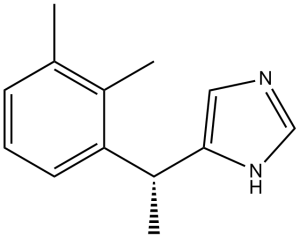
Dexmedetomidine (trade name Precedex), the dexter isomer of medetomidine, is a potent and highly selective alpha-2 adrenergic receptor agonist with sedative activities. Dexmedetomidine significantly sedates patients, thereby reducing the need for anesthesia.
Physicochemical Properties
| Molecular Formula | C13H16N2 | |
| Molecular Weight | 200.28 | |
| Exact Mass | 200.131 | |
| Elemental Analysis | C, 77.96; H, 8.05; N, 13.99 | |
| CAS # | 113775-47-6 | |
| Related CAS # | Medetomidine; 86347-14-0;Dexmedetomidine hydrochloride; 145108-58-3; Medetomidine hydrochloride; 86347-15-1 | |
| PubChem CID | 5311068 | |
| Appearance | White to off-white solid powder | |
| Density | 1.053g/cm3 | |
| Boiling Point | 381.9ºC at 760mmHg | |
| Melting Point | 146-149°C | |
| Flash Point | 191.3ºC | |
| Vapour Pressure | 1.08E-05mmHg at 25°C | |
| Index of Refraction | 1.569 | |
| LogP | 3.178 | |
| Hydrogen Bond Donor Count | 1 | |
| Hydrogen Bond Acceptor Count | 1 | |
| Rotatable Bond Count | 2 | |
| Heavy Atom Count | 15 | |
| Complexity | 205 | |
| Defined Atom Stereocenter Count | 1 | |
| SMILES | N1([H])C([H])=NC([H])=C1[C@@]([H])(C([H])([H])[H])C1=C([H])C([H])=C([H])C(C([H])([H])[H])=C1C([H])([H])[H] |
|
| InChi Key | CUHVIMMYOGQXCV-NSHDSACASA-N | |
| InChi Code | InChI=1S/C13H16N2/c1-9-5-4-6-12(10(9)2)11(3)13-7-14-8-15-13/h4-8,11H,1-3H3,(H,14,15)/t11-/m0/s1 | |
| Chemical Name | 5-[(1S)-1-(2,3-dimethylphenyl)ethyl]-1H-imidazole | |
| Synonyms |
|
|
| HS Tariff Code | 2934.99.9001 | |
| Storage |
Powder-20°C 3 years 4°C 2 years In solvent -80°C 6 months -20°C 1 month Note: This product requires protection from light (avoid light exposure) during transportation and storage. |
|
| Shipping Condition | Room temperature (This product is stable at ambient temperature for a few days during ordinary shipping and time spent in Customs) |
Biological Activity
| Targets | α2-adrenergic receptor ( Ki = 1.08 nM ) | |
| ln Vitro |
|
|
| ln Vivo | Medetomidine (10-100 μg/kg; i.v. at 5-min intervals) causes a dose-dependent dilation of the pupils in rats given pentobarbitone[1]. | |
| Animal Protocol |
Female Sprague-Dawley rats (270-350 g) 1, 5, 10, 50, 100 mg/kg I.v. at 5-min intervals |
|
| ADME/Pharmacokinetics |
Absorption, Distribution and Excretion A mass balance study demonstrated that after nine days an average of 95% of the radioactivity, following intravenous administration of radiolabeled dexmedetomidine, was recovered in the urine and 4% in the feces. Fractionation of the radioactivity excreted in urine demonstrated that products of N-glucuronidation accounted for approximately 34% of the cumulative urinary excretion. The majority of metabolites are excreted in the urine. 118 L 39 L/h [Healthy volunteers receiving IV infusion (0.2-0.7 mcg/kg/hr)] Metabolism / Metabolites Hepatic Dexmedetomidine has known human metabolites that include (2S,3S,4S,5R)-6-[5-[(1S)-1-(2,3-dimethylphenyl)ethyl]-1H-imidazol-3-ium-3-yl]-3,4,5-trihydroxyoxane-2-carboxylic acid and (2S,3S,4S,5R)-6-[5-[(1S)-1-(2,3-dimethylphenyl)ethyl]imidazol-1-yl]-3,4,5-trihydroxyoxane-2-carboxylic acid. Biological Half-Life 2 hours |
|
| Toxicity/Toxicokinetics |
Effects During Pregnancy and Lactation ◉ Summary of Use during Lactation Limited data indicate that very small amounts of dexmedetomidine are excreted into breastmilk for 4 to 6 hours after the end of an intravenous infusion. The drug is absent from breastmilk by 24 hours after the end of an infusion. The amounts in milk after sublingual use are expected to be less than after intravenous infusion. Because of the low dose in milk and its poor oral bioavailability, dexmedetomidine would not be expected to cause adverse effects in breastfed infants or neonates. Monitor the breastfed infant for irritability during sublingual use. ◉ Effects in Breastfed Infants Relevant published information was not found as of the revision date. ◉ Effects on Lactation and Breastmilk A double-blind study randomized 160 women receiving an elective cesarean section under spinal anesthesia to receive either sufentanil for patient-controlled intravenous analgesia (standard care) or standard care plus dexmedetomidine. Dexmedetomidine was given as 5 mcg/kg, followed by a continuous infusion of 0.5 mcg/kg per hour until the end of surgery. Patient in this latter group received dexmedetomidine plus sufentanil for patient-controlled intravenous analgesia postoperatively for 2 days. Patients who received dexmedetomidine had a shorter time to the first lactation (28 vs 34 hours), achieved exclusive breastfeeding sooner (8 vs 11 days) and had a greater amount of milk on the second day postpartum. In a retrospective study of women undergoing cesarean section deliveries, 3 regimens were compared: dexmedetomidine before anesthesia and during delivery (n = 115), normal saline before anesthesia and during delivery and dexmedetomidine after delivery (n = 109), and normal saline before anesthesia and during delivery (n = 168). Women who received dexmedetomidine before anesthesia and during delivery consumed less sufentanil and ondansetron during their hospitalization and had a slightly shorter time to the first production of milk than women in the other groups (25 minutes vs 27 to 28 minutes). Protein Binding 94% |
|
| References |
[1]. Characterization of the selectivity, specificity and potency of medetomidine as an alpha 2-adrenoceptor agonist. Eur J Pharmacol. 1988 May 20;150(1-2):9-14. [2]. Dexmedetomidine: a novel sedative-analgesic agent. Proc (Bayl Univ Med Cent). 2001 Jan;14(1):13-21. [3]. A comparison of oral dexmedetomidine and oral midazolam as premedicants in children. J Anaesthesiol Clin Pharmacol. Jan-Mar 2019;35(1):36-40. |
|
| Additional Infomation |
Dexmedetomidine is a medetomidine. It has a role as an alpha-adrenergic agonist, a non-narcotic analgesic, an analgesic and a sedative. It is an enantiomer of a levomedetomidine. An agonist of receptors, adrenergic alpha-2 that is used in veterinary medicine for its analgesic and sedative properties. It is the racemate of dexmedetomidine. Dexmedetomidine is a Central alpha-2 Adrenergic Agonist. The mechanism of action of dexmedetomidine is as an Adrenergic alpha2-Agonist. The physiologic effect of dexmedetomidine is by means of General Anesthesia. Dexmedetomidine is an imidazole derivate and active d-isomer of medetomidine with analgesic, anxiolytic and sedative properties. Dexmedetomidine selectively binds to presynaptic alpha-2 adrenoceptors located in the brain, thereby inhibiting the release of norepinephrine from synaptic vesicles. This leads to an inhibition of postsynaptic activation of adrenoceptors, which inhibit sympathetic activity, thereby leading to sedation and anxiolysis. The analgesic effect of this agent is mediated by binding to alpha-2 adrenoceptors in the spinal cord. An imidazole derivative that is an agonist of ADRENERGIC ALPHA-2 RECEPTORS. It is closely related to MEDETOMIDINE, which is the racemic form of this compound. Drug Indication Administered intravenously, dexmedetomidine is indicated for the sedation of initially intubated and mechanically ventilated patients during treatment in intensive care settings, and for the sedation of non-intubated patients prior to and/or during surgery and other procedures. It is also available as a buccally- or sublingually-administered dissolvable film for the acute treatment of agitation associated with schizophrenia or bipolar I or II disorder. For sedation of adult intensive care unit patients requiring a sedation level not deeper than arousal in response to verbal stimulation (corresponding to Richmond Agitation-Sedation Scale (RASS) 0 to -3). For sedation of adult ICU (Intensive Care Unit) patients requiring a sedation level not deeper than arousal in response to verbal stimulation (corresponding to Richmond Agitation-Sedation Scale (RASS) 0 to -3). For sedation of non-intubated adult patients prior to and/or during diagnostic or surgical procedures requiring sedation, i. e. procedural/awake sedation. Non-invasive, mildly to moderately painful, procedures and examinations which require restraint, sedation and analgesia in dogs and cats. Deep sedation and analgesia in dogs in concomitant use with butorphanol for medical and minor surgical procedures. Premedication in dogs and cats before induction and maintenance of general anaesthesia. Non-invasive, mildly to moderately painful, procedures and examinations which require restraint, sedation and analgesia in dogs and cats. Deep sedation and analgesia in dogs in concomitant use with butorphanol for medical and minor surgical procedures. Premedication in dogs and cats before induction and maintenance of general anaesthesia. Noninvasive, mildly to moderately painful, procedures and examinations which require restraint, sedation and analgesia in dogs and cats. Premedication in cats before induction and maintenance of general anaesthesia with ketamine. Deep sedation and analgesia in dogs in concomitant use with butorphanol for medical and minor surgical procedures. Premedication in dogs before induction and maintenance of general anaesthesia. Alleviation of acute anxiety and fear associated with noise in dogs. Mechanism of Action Dexmedetomidine is a specific and selective alpha-2 adrenoceptor agonist. By binding to the presynaptic alpha-2 adrenoceptors, it inhibits the release if norepinephrine, therefore, terminate the propagation of pain signals. Activation of the postsynaptic alpha-2 adrenoceptors inhibits the sympathetic activity decreases blood pressure and heart rate. Pharmacodynamics Dexmedetomidine activates 2-adrenoceptors, and causes the decrease of sympathetic tone, with attenuation of the neuroendocrine and hemodynamic responses to anesthesia and surgery; it reduces anesthetic and opioid requirements; and causes sedation and analgesia. |
Solubility Data
| Solubility (In Vitro) |
|
|||
| Solubility (In Vivo) |
Solubility in Formulation 1: ≥ 2.08 mg/mL (10.39 mM) (saturation unknown) in 10% DMSO + 40% PEG300 + 5% Tween80 + 45% Saline (add these co-solvents sequentially from left to right, and one by one), clear solution. For example, if 1 mL of working solution is to be prepared, you can add 100 μL of 20.8 mg/mL clear DMSO stock solution to 400 μL PEG300 and mix evenly; then add 50 μL Tween-80 to the above solution and mix evenly; then add 450 μL normal saline to adjust the volume to 1 mL. Preparation of saline: Dissolve 0.9 g of sodium chloride in 100 mL ddH₂ O to obtain a clear solution. Solubility in Formulation 2: ≥ 2.08 mg/mL (10.39 mM) (saturation unknown) in 10% DMSO + 90% (20% SBE-β-CD in Saline) (add these co-solvents sequentially from left to right, and one by one), clear solution. For example, if 1 mL of working solution is to be prepared, you can add 100 μL of 20.8 mg/mL clear DMSO stock solution to 900 μL of 20% SBE-β-CD physiological saline solution and mix evenly. Preparation of 20% SBE-β-CD in Saline (4°C,1 week): Dissolve 2 g SBE-β-CD in 10 mL saline to obtain a clear solution. Solubility in Formulation 3: ≥ 2.08 mg/mL (10.39 mM) (saturation unknown) in 10% DMSO + 90% Corn Oil (add these co-solvents sequentially from left to right, and one by one), clear solution. For example, if 1 mL of working solution is to be prepared, you can add 100 μL of 20.8 mg/mL clear DMSO stock solution to 900 μL of corn oil and mix evenly. (Please use freshly prepared in vivo formulations for optimal results.) |
| Preparing Stock Solutions | 1 mg | 5 mg | 10 mg | |
| 1 mM | 4.9930 mL | 24.9650 mL | 49.9301 mL | |
| 5 mM | 0.9986 mL | 4.9930 mL | 9.9860 mL | |
| 10 mM | 0.4993 mL | 2.4965 mL | 4.9930 mL |