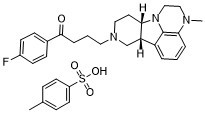
Physicochemical Properties
| Molecular Formula | C24H28FN3O-HCL |
| Exact Mass | 393.22 |
| Elemental Analysis | C, 65.82; H, 6.41; F, 3.36; N, 7.43; O, 11.31; S, 5.67 |
| Related CAS # | Lumateperone; 313368-91-1 |
| PubChem CID | 44241743 |
| Appearance | White to gray solid powder |
| InChi Key | LHAPOGAFBLSJJQ-GUTACTQSSA-N |
| InChi Code | InChI=1S/C24H28FN3O.C7H8O3S/c1-26-14-15-28-21-11-13-27(16-20(21)19-4-2-5-22(26)24(19)28)12-3-6-23(29)17-7-9-18(25)10-8-17;1-6-2-4-7(5-3-6)11(8,9)10/h2,4-5,7-10,20-21H,3,6,11-16H2,1H3;2-5H,1H3,(H,8,9,10)/t20-,21-;/m0./s1 |
| Chemical Name | 1-(4-fluorophenyl)-4-[(10R,15S)-4-methyl-1,4,12-triazatetracyclo[7.6.1.05,16.010,15]hexadeca-5,7,9(16)-trien-12-yl]butan-1-one;4-methylbenzenesulfonic acid |
| Synonyms | ITI722; ITI-722; ITI 722; Lumateperone toluenesulfonic acid; Lumateperone PTSA salt; ITI-007; ITI 007; ITI007; Lumateperone, Caplyta; UNII:JIE88N006O; ITI-007 tosylate |
| HS Tariff Code | 2934.99.9001 |
| Storage |
Powder-20°C 3 years 4°C 2 years In solvent -80°C 6 months -20°C 1 month Note: Please store this product in a sealed and protected environment, avoid exposure to moisture. |
| Shipping Condition | Room temperature (This product is stable at ambient temperature for a few days during ordinary shipping and time spent in Customs) |
Biological Activity
| Targets | 5-HT2A Receptor ( Ki = 0.54 nM ) |
| ln Vitro | Lumateperone tosylate (2-30 μM) exhibits anti-tumor activity and has the ability to dose-dependently inhibit cell proliferation[1]. |
| ln Vivo | Lumateperone (i.p., 1-10 mg/kg) tosylate stimulates the release of dopamine and glutamate in rat mPFC slices and promotes NMDA and AMPA-induced currents in a manner that is dependent on the dopamine D 1 receptor[2]. |
| Enzyme Assay |
Lumateperone is able to permeate multidrug resistance protein 1 (MDR1) and is very lipophilic at a pH of 7.4, which are characteristics that allow the antipsychotic to be absorbed in the small intestine and the blood brain barrier. Tmax occurs 3-4 hours after oral administration. Lumateperone is extensively metabolized. The carbonyl side chain is reduced by ketone reductase to produce the primary active metabolite. Cytochrome P450 3A4 enzymes metabolize lumateperone to 2 metabolites: the active N-desmethylated carbonyl metabolite (IC200161) or the N-desmethylated alcohol metabolite (IC200565). |
| Cell Assay |
Cell Line: RPMI-8226 cells Concentration: 2-30 μM Result: Inhibited cell growth with the IC50 value of 17.30 μM. |
| Animal Protocol |
Adult male Sprague-Dawley rats 1-10 mg/kg Intraperitoneal injection |
| References |
[1]. Identification of Trovafloxacin, Ozanimod, and Ozenoxacin as Potent c-Myc G-quadruplex Stabilizers to Suppress c-Myc Transcription and Myeloma Growth. Mol Inform. 2022 Mar 30:e2200011. [2]. Lumateperone-mediated effects on prefrontal glutamatergic receptor-mediated neurotransmission: A dopamine D1 receptor dependent mechanism. Eur Neuropsychopharmacol. 2022 Jul 22;62:22-35. |
| Additional Infomation |
Pharmacodynamics Lumateperone, also known as ITI-007, is an atypical antipsychotic that has proven to be effective in the treatment of schizophrenia. Lumateperone's receptor binding profile is unique, allowing it to target schizophrenia related symptoms while minimizing adverse effects. In contrast to other second generation antipsychotics such as [lurasidone] and [brexpiprazole], lumateperone behaves as a partial agonist and as an antagonist at pre and postynaptic dopamine (D2) receptors respectively. Patients with moderate or severe hepatic impairment (Child-Pugh class B or C) tend to have higher plasma concentrations of lumateperone than those with normal hepatic function. For this reason, patients with moderate or severe hepatic impairment should receive half the recommended daily dosage. Biological Half-Life Lumateperone's half life is reported to be between 13 to 18 hours. The reported half lives of the metabolites ICI200161 and ICI200131, are 20 and 21 hours respectively. Mechanism of Action There is much to learn about the pathophysiology of schizophrenia; however, dopamine abnormalities, specifically in the prefrontal and mesolimbic brain regions, are consistent in people with schizophrenia. In addition to dopamine, other neurotransmitters such as serotonin, glutamate, GABA and acetylcholine are thought to play a role. Lumateperone is unique among second generation antipsychotics based on its target profile and dopamine D2 receptor occupancy. Unlike other antipsychotics, lumateperone has partial agonist activity at presynaptic dopamine (D2) receptors, resulting in reduced presynaptic release of dopamine, and antagonistic activity at postsynaptic dopamine (D2) receptors. These characteristics allow lumateperone to efficiently reduce dopamine signaling. Lumateperone also targets dopamine (D1) receptors, and a useful secondary result of D1 activation is increased glutamatergic N-methyl-D-aspartate (NMDA) GluN2B receptor phosphorylation. This is significant since NMDA mediated glutamate signaling appears to be impaired in patients who have schizophrenia. Finally, lumateperone is capable of modulating serotonin by inhibiting serotonin transporters (SERT), and by behaving as a 5-HT2A receptor antagonist. Hepatotoxicity In preregistration controlled trials, ALT elevations arose in 2% of patients receiving lumateperone compared to less than 1% of placebo controls. The elevations, however, were usually mild, transient and typically resolved without dose modification or drug discontinuation. In preregistration trials, there were no instances of severe hepatic adverse events, discontinuations because of liver related events or episodes of clinically apparent liver injury with jaundice. Since its approval and more widescale use, there have been no published reports of liver injury with symptoms or jaundice attributed to lumateperone therapy, but clinical experience with its use has been limited. Likelihood score: E (unlikely cause of clinically apparent liver injury). |
Solubility Data
| Solubility (In Vitro) |
DMSO: ~100 mg/mL (~176.8 mM) H2O: < 0.1 mg/mL |
| Solubility (In Vivo) |
Solubility in Formulation 1: ≥ 2.5 mg/mL (4.42 mM) (saturation unknown) in 10% DMSO + 40% PEG300 + 5% Tween80 + 45% Saline (add these co-solvents sequentially from left to right, and one by one), clear solution. For example, if 1 mL of working solution is to be prepared, you can add 100 μL of 25.0 mg/mL clear DMSO stock solution to 400 μL PEG300 and mix evenly; then add 50 μL Tween-80 to the above solution and mix evenly; then add 450 μL normal saline to adjust the volume to 1 mL. Preparation of saline: Dissolve 0.9 g of sodium chloride in 100 mL ddH₂ O to obtain a clear solution. Solubility in Formulation 2: ≥ 2.5 mg/mL (4.42 mM) (saturation unknown) in 10% DMSO + 90% (20% SBE-β-CD in Saline) (add these co-solvents sequentially from left to right, and one by one), clear solution. For example, if 1 mL of working solution is to be prepared, you can add 100 μL of 25.0 mg/mL clear DMSO stock solution to 900 μL of 20% SBE-β-CD physiological saline solution and mix evenly. Preparation of 20% SBE-β-CD in Saline (4°C,1 week): Dissolve 2 g SBE-β-CD in 10 mL saline to obtain a clear solution. (Please use freshly prepared in vivo formulations for optimal results.) |