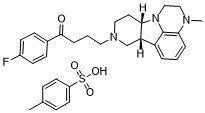
Lumateperone HCl salt (ITI-722, ITI-007; Caplyta), the hydrochloric acid salt of Lumateperone, is a dual 5HT2A receptor antagonist and dopamine receptor phosphoprotein modulator (DPPM), approved as an atypical antipsychotic in 2019 for the treatment of schizophrenia.
Physicochemical Properties
| Molecular Formula | C24H28FN3O-HCL |
| Exact Mass | |
| Related CAS # | Lumateperone; 313368-91-1 |
| Appearance | Solid powder |
| InChi Key | LHAPOGAFBLSJJQ-GUTACTQSSA-N |
| InChi Code | InChI=1S/C24H28FN3O.C7H8O3S/c1-26-14-15-28-21-11-13-27(16-20(21)19-4-2-5-22(26)24(19)28)12-3-6-23(29)17-7-9-18(25)10-8-171-6-2-4-7(5-3-6)11(8,9)10/h2,4-5,7-10,20-21H,3,6,11-16H2,1H32-5H,1H3,(H,8,9,10)/t20-,21-/m0./s1 |
| Chemical Name | 1-(4-fluorophenyl)-4-[(6bR,10aS)-3-methyl-2,3,6b,9,10,10a-hexahydro-1H-pyrido[3',4' |
| Synonyms | ITI-007 HCl; ITI007; Lumateperone; Caplyta; ITI-722; ITI722; ITI 722; ITI 007 |
| HS Tariff Code | 2934.99.9001 |
| Storage |
Powder-20°C 3 years 4°C 2 years In solvent -80°C 6 months -20°C 1 month Note: Please store this product in a sealed and protected environment, avoid exposure to moisture. |
| Shipping Condition | Room temperature (This product is stable at ambient temperature for a few days during ordinary shipping and time spent in Customs) |
Biological Activity
| Targets | Rat 5-HT2A ( Ki = 0.54 nM ) |
| ln Vitro | Lumateperone HCl(2-30 μM) exhibits anti-tumor activity and has the ability to dose-dependently inhibit cell proliferation[1]. |
| ln Vivo | Lumateperone (i.p., 1-10 mg/kg) tosylate increases the release of dopamine and glutamate in rat mPFC slices and promotes NMDA and AMPA-induced currents in a manner that is dependent on the dopamine D 1 receptor[2]. |
| Cell Assay |
Cell Line: RPMI-8226 cells Concentration: 2-30 μM Result: Inhibited cell growth with the IC50 value of 17.30 μM. |
| Animal Protocol |
Adult male Sprague-Dawley rats 1-10 mg/kg Intraperitoneal injection |
| References |
[1]. Identification of Trovafloxacin, Ozanimod, and Ozenoxacin as Potent c-Myc G-quadruplex Stabilizers to Suppress c-Myc Transcription and Myeloma Growth. Mol Inform. 2022 Mar 30:e2200011. [2]. Lumateperone-mediated effects on prefrontal glutamatergic receptor-mediated neurotransmission: A dopamine D1 receptor dependent mechanism. Eur Neuropsychopharmacol. 2022 Jul 22;62:22-35. [3]. Lumateperone. |
Solubility Data
| Solubility (In Vitro) |
DMSO: ~100 mg/mL (~176.8 mM) H2O: < 0.1 mg/mL |
| Solubility (In Vivo) |
Solubility in Formulation 1: ≥ 2.5 mg/mL (4.42 mM) (saturation unknown) in 10% DMSO + 40% PEG300 + 5% Tween80 + 45% Saline (add these co-solvents sequentially from left to right, and one by one), clear solution. For example, if 1 mL of working solution is to be prepared, you can add 100 μL of 25.0 mg/mL clear DMSO stock solution to 400 μL PEG300 and mix evenly; then add 50 μL Tween-80 to the above solution and mix evenly; then add 450 μL normal saline to adjust the volume to 1 mL. Preparation of saline: Dissolve 0.9 g of sodium chloride in 100 mL ddH₂ O to obtain a clear solution. Solubility in Formulation 2: ≥ 2.5 mg/mL (4.42 mM) (saturation unknown) in 10% DMSO + 90% (20% SBE-β-CD in Saline) (add these co-solvents sequentially from left to right, and one by one), clear solution. For example, if 1 mL of working solution is to be prepared, you can add 100 μL of 25.0 mg/mL clear DMSO stock solution to 900 μL of 20% SBE-β-CD physiological saline solution and mix evenly. Preparation of 20% SBE-β-CD in Saline (4°C,1 week): Dissolve 2 g SBE-β-CD in 10 mL saline to obtain a clear solution. (Please use freshly prepared in vivo formulations for optimal results.) |