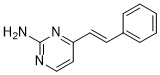
Physicochemical Properties
| Molecular Formula | C12H11N3 |
| Molecular Weight | 197.24 |
| Exact Mass | 197.095 |
| Elemental Analysis | C, 73.07; H, 5.62; N, 21.30 |
| CAS # | 125404-04-8 |
| Related CAS # | 125404-04-8 |
| PubChem CID | 46911068 |
| Appearance | White to off-white solid powder |
| LogP | 2.159 |
| Hydrogen Bond Donor Count | 1 |
| Hydrogen Bond Acceptor Count | 3 |
| Rotatable Bond Count | 2 |
| Heavy Atom Count | 15 |
| Complexity | 209 |
| Defined Atom Stereocenter Count | 0 |
| SMILES | NC1=NC=CC(/C=C/C2=CC=CC=C2)=N1 |
| InChi Key | LNUXNUNUGIHCPA-VOTSOKGWSA-N |
| InChi Code | InChI=1S/C12H11N3/c13-12-14-9-8-11(15-12)7-6-10-4-2-1-3-5-10/h1-9H,(H2,13,14,15)/b7-6+ |
| Chemical Name | 4-[(E)-2-phenylethenyl]pyrimidin-2-amine |
| Synonyms | Lu AF32615; Lu AF-32615; Lu AF 32615; Lu-AF32615; LuAF32615; TCN-238; TCN 238; TCN238 |
| HS Tariff Code | 2934.99.03.00 |
| Storage |
Powder-20°C 3 years 4°C 2 years In solvent -80°C 6 months -20°C 1 month |
| Shipping Condition | Room temperature (This product is stable at ambient temperature for a few days during ordinary shipping and time spent in Customs) |
Biological Activity
| Targets | mGlu4 Receptor ( EC50 = 1 μM ) |
| ln Vitro | TCN238 (Compound 11) has an EC50 of 1 μM in the rat mGlu4 PAM in vitro assay, which is similar to the human assay. The IC50 of 11 is greater than 30 μM for human mGlu5 and greater than 10 μM for rat mGlu5 in the assays used to screen TCN238. When TCN238 is used in a receptor screening panel with 68 targets, none of the receptors exhibit any activity at ≥50% at 10 μM. TCN238 is reported to have good permeability in CaCo-2 cells and no obvious efflux problem[1]. |
| ln Vivo | TCN238 has a concentration of 33.8 μM in the brain, making it a highly CNS penetrant drug. In rats, 90% bound plasma protein binding is used as a measurement. TCN238's metabolic stability is evaluated in rat and human microsomes, and the results show that it is 62% and 83% hepatic blood flow, respectively. When administered intravenously at a dose of 2 mg/kg, TCN238 has a moderate volume of distribution (2.7 L/kg) and a short mean residence time (0.6 h). In rats, the limited stability translated into a high in vivo clearance of 75 mL/min/kg. TCN238 can be taken orally and is found to be bioavailable; 30 minutes after a dose of 30 mg/kg, the plasma concentration is 11.6 μM[1]. TCN 238 has no effect on how well the learnt task is performed. But five days after TCN 238 treatment, the hippocampus's GRM4 expression level is consistently down-regulated. Furthermore, five days following treatment, the frontal cortex's expression level of GABRA1, which codes for the GABAA α-subunit, is downregulated[2]. |
| Animal Protocol | Rats: TCN 238 is injected subcutaneously four times in two days (morning and evening) at a dose of 2 mg/kg (0.5 mL). The test of retrieval of the task is conducted five days following the final injection of TCN 238 and thirty minutes following the first and third injections. The animals are placed in front of the start box, the door is opened, and the latent period of response is recorded during the retrieval test. [2]. |
| References |
[1]. An orally bioavailable positive allosteric modulator of the mGlu4 receptor with efficacy in an animal model of motor dysfunction. Bioorg Med Chem Lett. 2010 Aug 15;20(16):4901-5. [2]. Subacute activation of mGlu4 receptors causes the feedback inhibition of its gene expression in rat brain. Life Sci. 2016 May 15;153:50-4. |
Solubility Data
| Solubility (In Vitro) | DMSO: ≥ 150 mg/mL (~760.5 mM) |
| Solubility (In Vivo) |
Note: Listed below are some common formulations that may be used to formulate products with low water solubility (e.g. < 1 mg/mL), you may test these formulations using a minute amount of products to avoid loss of samples. Injection Formulations (e.g. IP/IV/IM/SC) Injection Formulation 1: DMSO : Tween 80: Saline = 10 : 5 : 85 (i.e. 100 μL DMSO stock solution → 50 μL Tween 80 → 850 μL Saline) *Preparation of saline: Dissolve 0.9 g of sodium chloride in 100 mL ddH ₂ O to obtain a clear solution. Injection Formulation 2: DMSO : PEG300 :Tween 80 : Saline = 10 : 40 : 5 : 45 (i.e. 100 μL DMSO → 400 μLPEG300 → 50 μL Tween 80 → 450 μL Saline) Injection Formulation 3: DMSO : Corn oil = 10 : 90 (i.e. 100 μL DMSO → 900 μL Corn oil) Example: Take the Injection Formulation 3 (DMSO : Corn oil = 10 : 90) as an example, if 1 mL of 2.5 mg/mL working solution is to be prepared, you can take 100 μL 25 mg/mL DMSO stock solution and add to 900 μL corn oil, mix well to obtain a clear or suspension solution (2.5 mg/mL, ready for use in animals). Injection Formulation 4: DMSO : 20% SBE-β-CD in saline = 10 : 90 [i.e. 100 μL DMSO → 900 μL (20% SBE-β-CD in saline)] *Preparation of 20% SBE-β-CD in Saline (4°C,1 week): Dissolve 2 g SBE-β-CD in 10 mL saline to obtain a clear solution. Injection Formulation 5: 2-Hydroxypropyl-β-cyclodextrin : Saline = 50 : 50 (i.e. 500 μL 2-Hydroxypropyl-β-cyclodextrin → 500 μL Saline) Injection Formulation 6: DMSO : PEG300 : castor oil : Saline = 5 : 10 : 20 : 65 (i.e. 50 μL DMSO → 100 μLPEG300 → 200 μL castor oil → 650 μL Saline) Injection Formulation 7: Ethanol : Cremophor : Saline = 10: 10 : 80 (i.e. 100 μL Ethanol → 100 μL Cremophor → 800 μL Saline) Injection Formulation 8: Dissolve in Cremophor/Ethanol (50 : 50), then diluted by Saline Injection Formulation 9: EtOH : Corn oil = 10 : 90 (i.e. 100 μL EtOH → 900 μL Corn oil) Injection Formulation 10: EtOH : PEG300:Tween 80 : Saline = 10 : 40 : 5 : 45 (i.e. 100 μL EtOH → 400 μLPEG300 → 50 μL Tween 80 → 450 μL Saline) Oral Formulations Oral Formulation 1: Suspend in 0.5% CMC Na (carboxymethylcellulose sodium) Oral Formulation 2: Suspend in 0.5% Carboxymethyl cellulose Example: Take the Oral Formulation 1 (Suspend in 0.5% CMC Na) as an example, if 100 mL of 2.5 mg/mL working solution is to be prepared, you can first prepare 0.5% CMC Na solution by measuring 0.5 g CMC Na and dissolve it in 100 mL ddH2O to obtain a clear solution; then add 250 mg of the product to 100 mL 0.5% CMC Na solution, to make the suspension solution (2.5 mg/mL, ready for use in animals). Oral Formulation 3: Dissolved in PEG400 Oral Formulation 4: Suspend in 0.2% Carboxymethyl cellulose Oral Formulation 5: Dissolve in 0.25% Tween 80 and 0.5% Carboxymethyl cellulose Oral Formulation 6: Mixing with food powders Note: Please be aware that the above formulations are for reference only. InvivoChem strongly recommends customers to read literature methods/protocols carefully before determining which formulation you should use for in vivo studies, as different compounds have different solubility properties and have to be formulated differently. (Please use freshly prepared in vivo formulations for optimal results.) |
| Preparing Stock Solutions | 1 mg | 5 mg | 10 mg | |
| 1 mM | 5.0700 mL | 25.3498 mL | 50.6997 mL | |
| 5 mM | 1.0140 mL | 5.0700 mL | 10.1399 mL | |
| 10 mM | 0.5070 mL | 2.5350 mL | 5.0700 mL |