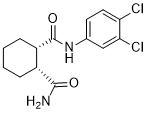
Lu AF21934 is a novel, potent, selective and brain-penetrant positive allosteric modulator of mGlu4 receptors with an IC50 of 500 nM for human mGlu4. In rats, Lu AF21934 lessens harmaline-induced hyperactivity but not tremor. Lu AF21934's effects are 5-HT1A receptor-dependent. The development of novel antipsychotic medications that are effective against positive, negative, and cognitive symptoms may be facilitated by activation of the mGlu4 receptor.
Physicochemical Properties
| Molecular Formula | C14H16CL2N2O2 |
| Molecular Weight | 315.1950 |
| Exact Mass | 314.058 |
| Elemental Analysis | C, 53.35; H, 5.12; Cl, 22.49; N, 8.89; O, 10.15 |
| CAS # | 1445605-23-1 |
| PubChem CID | 66553157 |
| Appearance | White to off-white solid powder |
| Density | 1.4±0.1 g/cm3 |
| Boiling Point | 577.6±50.0 °C at 760 mmHg |
| Flash Point | 303.1±30.1 °C |
| Vapour Pressure | 0.0±1.6 mmHg at 25°C |
| Index of Refraction | 1.615 |
| LogP | 2.62 |
| Hydrogen Bond Donor Count | 2 |
| Hydrogen Bond Acceptor Count | 2 |
| Rotatable Bond Count | 3 |
| Heavy Atom Count | 20 |
| Complexity | 378 |
| Defined Atom Stereocenter Count | 2 |
| SMILES | ClC1=C(C([H])=C([H])C(=C1[H])N([H])C([C@@]1([H])C([H])([H])C([H])([H])C([H])([H])C([H])([H])[C@@]1([H])C(N([H])[H])=O)=O)Cl |
| InChi Key | AVKZWCJNDWOBAM-ZJUUUORDSA-N |
| InChi Code | InChI=1S/C14H16Cl2N2O2/c15-11-6-5-8(7-12(11)16)18-14(20)10-4-2-1-3-9(10)13(17)19/h5-7,9-10H,1-4H2,(H2,17,19)(H,18,20)/t9-,10+/m1/s1 |
| Chemical Name | (1R,2S)-2-N-(3,4-dichlorophenyl)cyclohexane-1,2-dicarboxamide |
| Synonyms | Lu-AF21934; Lu-AF-21934; Lu-AF 21934; Lu AF21934; Lu AF-21934; Lu AF 21934; LuAF21934; LuAF-21934; LuAF 21934 |
| HS Tariff Code | 2934.99.9001 |
| Storage |
Powder-20°C 3 years 4°C 2 years In solvent -80°C 6 months -20°C 1 month |
| Shipping Condition | Room temperature (This product is stable at ambient temperature for a few days during ordinary shipping and time spent in Customs) |
Biological Activity
| Targets | mGlu4 Receptor ( EC50 = 7500 nM ) |
| ln Vivo | Lu AF21934 treatment shows a dose-dependent anxiolytic-like effect in the stress-induced hyperthermia, four-plate, and marble-burying tests. Flumazenil (10 mg/kg), a benzodiazepine receptor antagonist, inhibits Lu AF21934's (5 mg/kg) anti-hyperthermic effect in the SIH test. This effect is not serotonin dependent. In the tail suspension test, Lu AF21934 does not have antidepressant-like effects on mice; however, it does reduce the basal locomotor activity of mice that have not become accustomed to activity cages[1]. While Lu AF21934 (0.5–5 mg/kg sc) does not affect tremor, harmaline-induced hyperactivity is reversed at doses of 0.5 and 2.5 mg/kg. At a dose of 2.5 mg/kg, Lu AF21934 amplifies the first 30 minutes of the measurement's inhibitory effect of harmaline on AP1 and exploratory activity, and it offsets the harmaline-induced rise in basic activity over the next 30 to 90 minutes[2]. Hyperactivity brought on by MK-801 or amphetamine is dose-dependently inhibited by Lu AF21934 (0.1–5 mg/kg). It also makes head twitches more aggressive and raises the frequency of DOI-induced spontaneous excitatory postsynaptic currents in brain slices[3]. |
| Animal Protocol |
Rats: The 20% (2-hydropropyl)-b-cyclodextrin-dispersed Lu AF21934 is applied subcutaneously (s.c.) 60 minutes prior to the test. Acute administration of Lu AF21934 (2, 5, 10 and 15 mg/kg, s.c.) and diazepam (5 mg/kg, i.p.) occurs one hour prior to the Vogel's conflict test. In all experiments, groups of eight to ten animals are used to measure the effects of each drug[1]. Mice: Sixty minutes prior to the test, Lu AF21934 is applied subcutaneously (s.c.) after being diluted in 20% (2-hydropropyl)-b-cyclodextrin. The mice are inserted carefully into the box and given fifteen seconds to explore. Once the mouse has moved from one plate to another, the experimenter electrifies the entire floor, causing the mouse to visibly flee. No more shocks are given for the next three seconds if the animal keeps running[1]. |
| References |
[1]. Anxiolytic- but not antidepressant-like activity of Lu AF21934, a novel, selective positive allosteric modulator of the mGlu? receptor. Neuropharmacology. 2013 Mar;66:225-35. [2]. Lu AF21934, a positive allosteric modulator of mGlu4 receptors, reduces the harmaline-induced hyperactivity but not tremor in rats. Neuropharmacology. 2014 Aug;83:28-35. [3]. The antipsychotic-like effects of positive allosteric modulators of metabotropic glutamate mGlu4 receptors in rodents. Br J Pharmacol. 2013 Aug;169(8):1824-39. |
Solubility Data
| Solubility (In Vitro) | DMSO: ≥ 80 mg/mL (~253.8 mM) |
| Solubility (In Vivo) |
Solubility in Formulation 1: ≥ 2.5 mg/mL (7.93 mM) (saturation unknown) in 10% DMSO + 40% PEG300 + 5% Tween80 + 45% Saline (add these co-solvents sequentially from left to right, and one by one), clear solution. For example, if 1 mL of working solution is to be prepared, you can add 100 μL of 25.0 mg/mL clear DMSO stock solution to 400 μL PEG300 and mix evenly; then add 50 μL Tween-80 to the above solution and mix evenly; then add 450 μL normal saline to adjust the volume to 1 mL. Preparation of saline: Dissolve 0.9 g of sodium chloride in 100 mL ddH₂ O to obtain a clear solution. Solubility in Formulation 2: ≥ 2.5 mg/mL (7.93 mM) (saturation unknown) in 10% DMSO + 90% (20% SBE-β-CD in Saline) (add these co-solvents sequentially from left to right, and one by one), clear solution. For example, if 1 mL of working solution is to be prepared, you can add 100 μL of 25.0 mg/mL clear DMSO stock solution to 900 μL of 20% SBE-β-CD physiological saline solution and mix evenly. Preparation of 20% SBE-β-CD in Saline (4°C,1 week): Dissolve 2 g SBE-β-CD in 10 mL saline to obtain a clear solution. Solubility in Formulation 3: ≥ 2.5 mg/mL (7.93 mM) (saturation unknown) in 10% DMSO + 90% Corn Oil (add these co-solvents sequentially from left to right, and one by one), clear solution. For example, if 1 mL of working solution is to be prepared, you can add 100 μL of 25.0 mg/mL clear DMSO stock solution to 900 μL of corn oil and mix evenly. (Please use freshly prepared in vivo formulations for optimal results.) |
| Preparing Stock Solutions | 1 mg | 5 mg | 10 mg | |
| 1 mM | 3.1726 mL | 15.8629 mL | 31.7259 mL | |
| 5 mM | 0.6345 mL | 3.1726 mL | 6.3452 mL | |
| 10 mM | 0.3173 mL | 1.5863 mL | 3.1726 mL |