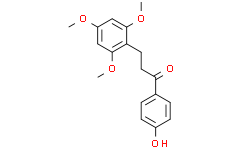
Loureirin B is a naturally occurring flavonoid isolated from Dracaena cochinchinensis, has anti-diabetic properties and functions as a plasminogen activator inhibitor-1 (PAI-1) inhibitor with an IC50 of 26.10 μM. Aso prevents KATP, ERK, and JNK phosphorylation.
Physicochemical Properties
| Molecular Formula | C18H20O5 |
| Molecular Weight | 316.35 |
| Exact Mass | 316.131 |
| Elemental Analysis | C, 68.34; H, 6.37; O, 25.29 |
| CAS # | 119425-90-0 |
| Related CAS # | 119425-90-0 |
| PubChem CID | 189670 |
| Appearance | White to off-white solid powder |
| Density | 1.2±0.1 g/cm3 |
| Boiling Point | 509.9±50.0 °C at 760 mmHg |
| Flash Point | 184.0±23.6 °C |
| Vapour Pressure | 0.0±1.4 mmHg at 25°C |
| Index of Refraction | 1.564 |
| LogP | 2.98 |
| Hydrogen Bond Donor Count | 1 |
| Hydrogen Bond Acceptor Count | 5 |
| Rotatable Bond Count | 7 |
| Heavy Atom Count | 23 |
| Complexity | 350 |
| Defined Atom Stereocenter Count | 0 |
| SMILES | O(C([H])([H])[H])C1C([H])=C(C([H])=C(C=1C([H])([H])C([H])([H])C(C1C([H])=C([H])C(=C([H])C=1[H])O[H])=O)OC([H])([H])[H])OC([H])([H])[H] |
| InChi Key | ZPFRAPVRYLGYEC-UHFFFAOYSA-N |
| InChi Code | InChI=1S/C18H20O5/c1-21-14-10-17(22-2)15(18(11-14)23-3)8-9-16(20)12-4-6-13(19)7-5-12/h4-7,10-11,19H,8-9H2,1-3H3 |
| Chemical Name | 1-(4-hydroxyphenyl)-3-(2,4,6-trimethoxyphenyl)propan-1-one |
| Synonyms | L B; LR-B; Loureirin B |
| HS Tariff Code | 2934.99.03.00 |
| Storage |
Powder-20°C 3 years 4°C 2 years In solvent -80°C 6 months -20°C 1 month |
| Shipping Condition | Room temperature (This product is stable at ambient temperature for a few days during ordinary shipping and time spent in Customs) |
Biological Activity
| Targets | PAI-1 (IC50 = 26.1 μM); KATP; ERK; JNK |
| ln Vitro | Loureirin B enhances the relative mRNA level of Pdx-1 and MafA. Insulin secretion from Ins-1 cells is boosted by loureirin B (1, 0.1, and 0.01 µM). Cells are almost completely unaffected by loureirin B (0.01 µM). The expression of MafA, Pdx-1, and ATP are all enhanced by Loureirin B. While increasing the [Ca2+]i level in Ins-1 cells, loureirin B inhibits the KATP current[1]. The TGF-β1-mediated upregulation of p-JNK as well as the expression of Col1 and FN are all inhibited by loureirin B. p-ERK is upregulated by TGF-β1, and loureirin B inhibits this process. The downregulation of p-ERK and p-JNK is another way that loureirin B prevents the contraction of TGF-β1 stimulated fibroblasts. The upregulation of p-p38 brought on by TGF-β1 is not suppressed by loureirin B, though [2]. Type I collagen, type III collagen, and -smooth muscle actin have dose-dependent downregulations by loureirin B at the mRNA and protein levels in HS fibroblasts. Although it has no effect on cell apoptosis, loureirin B also reduces fibroblast proliferative activity and redistributes the cell cycle[3]. |
| ln Vivo | In a rabbit ear scar model, loureirin B significantly improves collagen fiber arrangement and deposition, lowers ColI, ColIII, and -SMA protein levels, and suppresses myofibroblast differentiation and scar proliferative activity. The TGF-β1-induced upregulation of ColI, ColIII, and -SMA levels, myofibroblast differentiation, and activation of Smad2 and Smad3 in NS fibroblasts are all successfully inhibited by loureirin B[3]. |
| Cell Assay | On 96-well plates, Ins-1 cells are seeded and cultured for 48 hours until they are 80–90% confluent. The cells are then starved for 12 hours in a 2% FBS/DMEM solution. While the positive control group receives fresh medium containing glimepiride, the control group is cultured in medium devoid of loureirin B. Cell Counting Kit-8 (CCK-8) is used to determine the cell viability following treatments with loureirin B and glimepiride for 4 and 8 hours, respectively. |
| Animal Protocol | In brief, 10 adult male New Zealand white rabbits (weighing between 2.0 and 2.5 kg each) are acclimated and housed in a 12-hour light/dark cycle with free access to water and SPF base diet. A dermal punch biopsy (10×4 mm) is made on the ventral surface of each ear of the rabbit to outline a full-thickness wound after the animal has been given 1% pentobarbital (1.5 mg/kg b.w.) anesthesia. On each of the eight rabbits' ears, four punches are made. To ensure that the epidermis, dermis, and perichondrium are completely removed from each wound, a dissecting microscope is employed. DMSO solution (0.125% in PBS, 0.25 mL/kg b.w.) is subcutaneously injected into the left ear of each group of injured rabbits 48 hours after surgery, and loureirin B solution (25 g/mL in PBS, 0.25 mL/kg b.w.) is subcutaneously injected into the right ear once every other day for a total of six times. Two rabbits are used in the pilot study, four are sacrificed at 14 days following the injury (n = 4), and the remaining four are sacrificed at 28 days following the injury (n = 4). The same ear contains four scar tissues, two of which are processed for Western blot and the other two for Masson staining. |
| References |
[1]. Loureirin B promotes insulin secretion through inhibition of KATP channel and influx of intracellular calcium. J Cell Biochem. 2017 Aug 17. [2]. Loureirin B Inhibits Hypertrophic Scar Formation via Inhibition of the TGF-β1-ERK/JNK Pathway. Cell Physiol Biochem. 2015;37(2):666-76. [3]. Loureirin B inhibits fibroblast proliferation and extracellular matrix deposition in hypertrophic scar via TGF-β/Smad pathway. Exp Dermatol. 2015 May;24(5):355-60. [4]. Bioactivity-Guided Fractionation of the Traditional Chinese Medicine Resina Draconis Reveals Loureirin B as a PAI-1 Inhibitor. Evidence-Based Complementary and Alternative Medicine |
| Additional Infomation |
Loureirin B is a member of dihydrochalcones. Loureirin B has been reported in Garcinia dulcis with data available. |
Solubility Data
| Solubility (In Vitro) | DMSO: ≥ 150 mg/mL (~474.2 mM) |
| Solubility (In Vivo) |
Solubility in Formulation 1: ≥ 2.5 mg/mL (7.90 mM) (saturation unknown) in 10% DMSO + 40% PEG300 + 5% Tween80 + 45% Saline (add these co-solvents sequentially from left to right, and one by one), clear solution. For example, if 1 mL of working solution is to be prepared, you can add 100 μL of 25.0 mg/mL clear DMSO stock solution to 400 μL PEG300 and mix evenly; then add 50 μL Tween-80 to the above solution and mix evenly; then add 450 μL normal saline to adjust the volume to 1 mL. Preparation of saline: Dissolve 0.9 g of sodium chloride in 100 mL ddH₂ O to obtain a clear solution. Solubility in Formulation 2: ≥ 2.5 mg/mL (7.90 mM) (saturation unknown) in 10% DMSO + 90% (20% SBE-β-CD in Saline) (add these co-solvents sequentially from left to right, and one by one), clear solution. For example, if 1 mL of working solution is to be prepared, you can add 100 μL of 25.0 mg/mL clear DMSO stock solution to 900 μL of 20% SBE-β-CD physiological saline solution and mix evenly. Preparation of 20% SBE-β-CD in Saline (4°C,1 week): Dissolve 2 g SBE-β-CD in 10 mL saline to obtain a clear solution. Solubility in Formulation 3: ≥ 2.5 mg/mL (7.90 mM) (saturation unknown) in 10% DMSO + 90% Corn Oil (add these co-solvents sequentially from left to right, and one by one), clear solution. For example, if 1 mL of working solution is to be prepared, you can add 100 μL of 25.0 mg/mL clear DMSO stock solution to 900 μL of corn oil and mix evenly. (Please use freshly prepared in vivo formulations for optimal results.) |
| Preparing Stock Solutions | 1 mg | 5 mg | 10 mg | |
| 1 mM | 3.1611 mL | 15.8053 mL | 31.6106 mL | |
| 5 mM | 0.6322 mL | 3.1611 mL | 6.3221 mL | |
| 10 mM | 0.3161 mL | 1.5805 mL | 3.1611 mL |