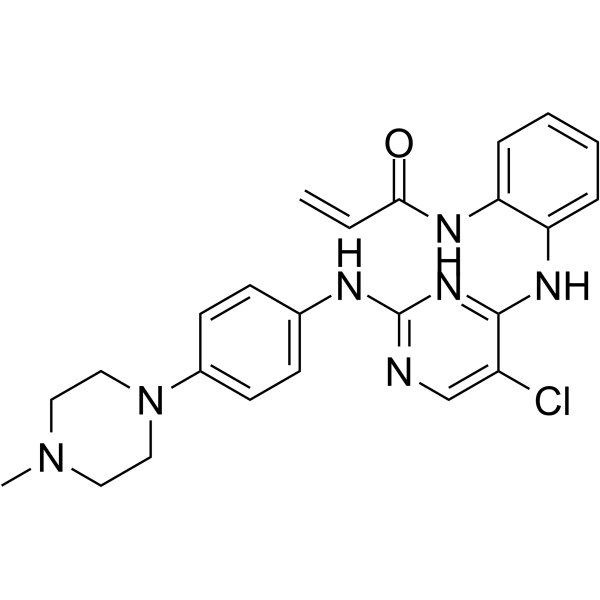
Physicochemical Properties
| Molecular Formula | C24H26CLN7O |
| Molecular Weight | 463.96 |
| Exact Mass | 463.188 |
| CAS # | 2088179-99-9 |
| PubChem CID | 131801160 |
| Appearance | White to off-white solid powder |
| Density | 1.3±0.1 g/cm3 |
| Index of Refraction | 1.691 |
| LogP | 2.88 |
| Hydrogen Bond Donor Count | 3 |
| Hydrogen Bond Acceptor Count | 7 |
| Rotatable Bond Count | 7 |
| Heavy Atom Count | 33 |
| Complexity | 636 |
| Defined Atom Stereocenter Count | 0 |
| InChi Key | SCMLGVPMSXTUNC-UHFFFAOYSA-N |
| InChi Code | InChI=1S/C24H26ClN7O/c1-3-22(33)28-20-6-4-5-7-21(20)29-23-19(25)16-26-24(30-23)27-17-8-10-18(11-9-17)32-14-12-31(2)13-15-32/h3-11,16H,1,12-15H2,2H3,(H,28,33)(H2,26,27,29,30) |
| Chemical Name | N-[2-[[5-chloro-2-[4-(4-methylpiperazin-1-yl)anilino]pyrimidin-4-yl]amino]phenyl]prop-2-enamide |
| HS Tariff Code | 2934.99.9001 |
| Storage |
Powder-20°C 3 years 4°C 2 years In solvent -80°C 6 months -20°C 1 month |
| Shipping Condition | Room temperature (This product is stable at ambient temperature for a few days during ordinary shipping and time spent in Customs) |
Biological Activity
| Targets | IC50: 0.8 nM (GAK), 0.8 nM (YES1), 2 nM (SRC), 4.4 nM (AAK1), 5.4 nM (LIMK1), 7.1 nM (BMP2K), 9.3 nM (MAP2K2), 10.4 nM (MAP2K1), 28.7 nM (MAP3K1), 48.3 nM (MAPK1), 107 nM (MAPK3)[1] |
| ln Vitro | In a concentration-dependent manner, SM1-71 (0.001-100 μM; 72 h) potently suppresses the growth of H23 and Calu-6 non-small cell lung cancer cell lines[1]. In eight out of eleven cancer cell lines, SM1-71 (72 h) generates strong cytotoxicity with nanomolar values for GR50 and negative GRmax values[2]. |
| Cell Assay |
Cell Viability Assay[1] Cell Types: H23-KRASG12C and Calu-6-KRASQ61K cells Tested Concentrations: 0.001, 0.01, 0.1, 1, 10, 100 μM Incubation Duration: 72 hrs (hours) Experimental Results: Inhibited proliferation of H23-KRASG12C and Calu-6-KRASQ61K cells with IC50s of 0.4 and 0.3 μM, respectively. |
| References |
[1]. Leveraging Compound Promiscuity to Identify Targetable Cysteines within the Kinome. Cell Chem Biol. 2019 Jun 20; 26(6): 818-829.e9. [2]. A multitargeted probe-based strategy to identify signaling vulnerabilities in cancers. J Biol Chem. 2019 May 24;294(21):8664-8673. [3]. Structure-guided development of covalent TAK1 inhibitors. Bioorg Med Chem. 2017 Feb 1; 25(3): 838-846. |
Solubility Data
| Solubility (In Vitro) | DMSO : 125 mg/mL (269.42 mM) |
| Solubility (In Vivo) |
Solubility in Formulation 1: ≥ 2.08 mg/mL (4.48 mM) (saturation unknown) in 10% DMSO + 40% PEG300 + 5% Tween80 + 45% Saline (add these co-solvents sequentially from left to right, and one by one), clear solution. For example, if 1 mL of working solution is to be prepared, you can add 100 μL of 20.8 mg/mL clear DMSO stock solution to 400 μL PEG300 and mix evenly; then add 50 μL Tween-80 to the above solution and mix evenly; then add 450 μL normal saline to adjust the volume to 1 mL. Preparation of saline: Dissolve 0.9 g of sodium chloride in 100 mL ddH₂ O to obtain a clear solution. Solubility in Formulation 2: ≥ 2.08 mg/mL (4.48 mM) (saturation unknown) in 10% DMSO + 90% Corn Oil (add these co-solvents sequentially from left to right, and one by one), clear solution. For example, if 1 mL of working solution is to be prepared, you can add 100 μL of 20.8 mg/mL clear DMSO stock solution to 900 μL of corn oil and mix evenly. (Please use freshly prepared in vivo formulations for optimal results.) |
| Preparing Stock Solutions | 1 mg | 5 mg | 10 mg | |
| 1 mM | 2.1554 mL | 10.7768 mL | 21.5536 mL | |
| 5 mM | 0.4311 mL | 2.1554 mL | 4.3107 mL | |
| 10 mM | 0.2155 mL | 1.0777 mL | 2.1554 mL |