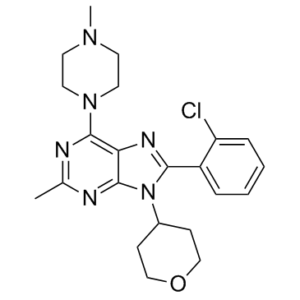
LY2828360 (LY-2828360) is a potent, slowly signaling, G protein-biased CB2 cannabinoid agonist that lacked both toxicity and efficacy in a clinical trial for osteoarthritis. LY2828360 was a G protein-biased CB2 agonist that worked slowly but effectively in vitro. It prevented the build-up of cAMP and triggered the signaling of extracellular signal-regulated kinase 1/2, but it did not attract arrestin, initiate inositol phosphate signaling, or internalize CB2 receptors. LY2828360 (3 mg/kg daily i.p. × 12 days) suppressed chemotherapy-induced neuropathic pain caused by paclitaxel in wild-type (WT) mice without causing tolerance. In CB2 knockout (KO) mice, LY2828360 had no antiallodynic effect. While WT mice with a history of LY2828360 treatment (3 mg/kg per day i.p. × 12 days) did not develop tolerance to morphine (10 mg/kg per day i.p. × 12 days), CB2KO mice did. The LY2828360-induced antiallodynic efficacy was not present in morphine-tolerant CB2KO mice, but it persisted in WT mice that had previously been made tolerant to morphine (10 mg/kg per day i.p. × 12 days). In WT mice, but not in CB2KO mice, coadministration of LY2828360 (0.1 mg/kg per day i.p. × 12 days) and morphine (10 mg/kg per day × 12 days) inhibited morphine tolerance. Compared to CB2KO mice, WT mice that received LY2828360 in addition to morphine showed a trend (P = 0.055) toward fewer naloxone-precipitated jumps. To sum up, LY2828360 is a G protein-biased, slowly signaling CB2 agonist that may prolong effective opioid analgesia while lowering opioid dependence. It also attenuates chemotherapy-induced neuropathic pain without causing tolerance. In neuropathic pain states that are resistant to opioid analgesics, LY2828360 may prove to be a highly effective first-line treatment for pain brought on by chemotherapy.
Physicochemical Properties
| Molecular Formula | C22H27CLN6O | |
| Molecular Weight | 426.95 | |
| Exact Mass | 426.193 | |
| Elemental Analysis | C, 61.89; H, 6.37; Cl, 8.30; N, 19.68; O, 3.75 | |
| CAS # | 1231220-79-3 | |
| Related CAS # |
|
|
| PubChem CID | 46833780 | |
| Appearance | White to off-white solid powder | |
| Density | 1.4±0.1 g/cm3 | |
| Boiling Point | 541.8±60.0 °C at 760 mmHg | |
| Flash Point | 281.5±32.9 °C | |
| Vapour Pressure | 0.0±1.4 mmHg at 25°C | |
| Index of Refraction | 1.701 | |
| LogP | 1.6 | |
| Hydrogen Bond Donor Count | 0 | |
| Hydrogen Bond Acceptor Count | 6 | |
| Rotatable Bond Count | 3 | |
| Heavy Atom Count | 30 | |
| Complexity | 570 | |
| Defined Atom Stereocenter Count | 0 | |
| SMILES | ClC1C=CC=CC=1C1=NC2C(=NC(C)=NC=2N1C1CCOCC1)N1CCN(C)CC1 |
|
| InChi Key | UCMNDPDJRSEZPL-UHFFFAOYSA-N | |
| InChi Code | InChI=1S/C22H27ClN6O/c1-15-24-21(28-11-9-27(2)10-12-28)19-22(25-15)29(16-7-13-30-14-8-16)20(26-19)17-5-3-4-6-18(17)23/h3-6,16H,7-14H2,1-2H3 | |
| Chemical Name | 8-(2-chlorophenyl)-2-methyl-6-(4-methylpiperazin-1-yl)-9-(oxan-4-yl)purine | |
| Synonyms |
|
|
| HS Tariff Code | 2934.99.9001 | |
| Storage |
Powder-20°C 3 years 4°C 2 years In solvent -80°C 6 months -20°C 1 month |
|
| Shipping Condition | Room temperature (This product is stable at ambient temperature for a few days during ordinary shipping and time spent in Customs) |
Biological Activity
| Targets | CB2 |
| ln Vitro | Acute systemic LY2828360 administration suppresses mechanical and cold allodynia induced by paclitaxel in a dose-dependent manner in WT mice. Paclitaxel-evoked mechanical and cold hypersensitivities are time-dependently suppressed by LY2828360, and suppression of allodynia is sustained for at least 4.5 hours post-injection in comparison to drug pre-injection levels. The mechanical allodynia caused by paclitaxel has returned to the hypersensitive levels seen prior to the drug injection at 24 hours after the injection. By 72 hours after starting LY2828360 treatment, there was no longer any residual suppression of cold allodynia. In WT mice, LY2828360 has been shown to prevent tolerance to the antiallodynic effects of morphine over time, but not in CB2KO mice. Chronic LY2828360 treatment suppresses paclitaxel-induced mechanical and cold allodynia in WT mice but not in CB2KO mice previously render tolerant to morphine[1]. |
| ln Vivo | In WT mice, acute systemic administration of LY2828360 inhibited paclitaxel-induced mechanical and cold allodynia in a dose-dependent manner. LY2828360 produced a time-dependent inhibition of paclitaxel-induced mechanical and cold hypersensitivity, and the inhibition of allodynia was maintained for at least 4.5 hours post-injection relative to pre-drug injection levels. By 24 hours after injection, paclitaxel-induced mechanical allodynia had returned to pre-drug injection hypersensitivity levels. Residual suppression of cold allodynia was absent 72 hours after LY2828360 treatment. Chronic administration of LY2828360 previously blocked tolerance to the anti-allodynic effects of morphine in WT mice but not in CB2KO mice. Long-term LY2828360 treatment inhibited paclitaxel-induced mechanical and cold allodynia in WT mice but not in CB2KO mice that had previously developed tolerance to morphine [1]. |
| References |
[1]. Slowly Signaling G Protein-Biased CB2 Cannabinoid Receptor Agonist LY2828360 Suppresses Neuropathic Pain with Sustained Efficacy and Attenuates Morphine Tolerance and Dependence. Mol Pharmacol. 2018 Feb;93(2):49-62. |
| Additional Infomation | LY2828360 is under investigation in clinical trial NCT01319929 (A Study of LY2828360 in Patients With Osteoarthritic Knee Pain). |
Solubility Data
| Solubility (In Vitro) |
|
|||
| Solubility (In Vivo) |
Solubility in Formulation 1: ≥ 2.08 mg/mL (4.87 mM) (saturation unknown) in 10% DMSO + 40% PEG300 + 5% Tween80 + 45% Saline (add these co-solvents sequentially from left to right, and one by one), clear solution. For example, if 1 mL of working solution is to be prepared, you can add 100 μL of 20.8 mg/mL clear DMSO stock solution to 400 μL PEG300 and mix evenly; then add 50 μL Tween-80 to the above solution and mix evenly; then add 450 μL normal saline to adjust the volume to 1 mL. Preparation of saline: Dissolve 0.9 g of sodium chloride in 100 mL ddH₂ O to obtain a clear solution. Solubility in Formulation 2: ≥ 2.08 mg/mL (4.87 mM) (saturation unknown) in 10% DMSO + 90% (20% SBE-β-CD in Saline) (add these co-solvents sequentially from left to right, and one by one), clear solution. For example, if 1 mL of working solution is to be prepared, you can add 100 μL of 20.8 mg/mL clear DMSO stock solution to 900 μL of 20% SBE-β-CD physiological saline solution and mix evenly. Preparation of 20% SBE-β-CD in Saline (4°C,1 week): Dissolve 2 g SBE-β-CD in 10 mL saline to obtain a clear solution. Solubility in Formulation 3: ≥ 2.08 mg/mL (4.87 mM) (saturation unknown) in 10% DMSO + 90% Corn Oil (add these co-solvents sequentially from left to right, and one by one), clear solution. For example, if 1 mL of working solution is to be prepared, you can add 100 μL of 20.8 mg/mL clear DMSO stock solution to 900 μL of corn oil and mix evenly. (Please use freshly prepared in vivo formulations for optimal results.) |
| Preparing Stock Solutions | 1 mg | 5 mg | 10 mg | |
| 1 mM | 2.3422 mL | 11.7110 mL | 23.4219 mL | |
| 5 mM | 0.4684 mL | 2.3422 mL | 4.6844 mL | |
| 10 mM | 0.2342 mL | 1.1711 mL | 2.3422 mL |