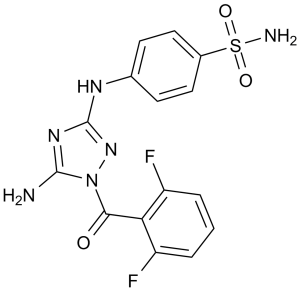
JNJ-7706621 (JNJ7706621) is novel and potent pan-CDK (cyclin-dependent kinases) inhibitor and also an Aurora-A and Aurora-B inhibitor with potential antitumor activity. It inhibits CDK1/2 with IC50 of 9 nM/4 nM and exhibits >6-fold selectivity for CDK1/2 over CDK3/4/6 in cell-free assays. It also potently inhibits Aurora A/B and has little/no activity on Plk1 and Wee1. It shows potent in vitro antiproliferative activity and high in vivo antitumor efficacy.
Physicochemical Properties
| Molecular Formula | C15H12F2N6O3S | |
| Molecular Weight | 394.36 | |
| Exact Mass | 394.065 | |
| CAS # | 443797-96-4 | |
| Related CAS # |
|
|
| PubChem CID | 5330790 | |
| Appearance | White to off-white solid powder | |
| Density | 1.7±0.1 g/cm3 | |
| Boiling Point | 676.6±65.0 °C at 760 mmHg | |
| Melting Point | 149-155ºC | |
| Flash Point | 363.0±34.3 °C | |
| Vapour Pressure | 0.0±2.1 mmHg at 25°C | |
| Index of Refraction | 1.724 | |
| LogP | 0.18 | |
| Hydrogen Bond Donor Count | 3 | |
| Hydrogen Bond Acceptor Count | 10 | |
| Rotatable Bond Count | 4 | |
| Heavy Atom Count | 27 | |
| Complexity | 630 | |
| Defined Atom Stereocenter Count | 0 | |
| InChi Key | KDKUVYLMPJIGKA-UHFFFAOYSA-N | |
| InChi Code | InChI=1S/C15H12F2N6O3S/c16-10-2-1-3-11(17)12(10)13(24)23-14(18)21-15(22-23)20-8-4-6-9(7-5-8)27(19,25)26/h1-7H,(H2,19,25,26)(H3,18,20,21,22) | |
| Chemical Name | 4-((5-amino-1-(2,6-difluorobenzoyl)-1H-1,2,4-triazol-3-yl)amino)benzenesulfonamide | |
| HS Tariff Code | 2934.99.9001 | |
| Storage |
Powder-20°C 3 years 4°C 2 years In solvent -80°C 6 months -20°C 1 month |
|
| Shipping Condition | Room temperature (This product is stable at ambient temperature for a few days during ordinary shipping and time spent in Customs) |
Biological Activity
| ln Vitro | The anti-proliferative activity of JNJ-7706621 has been seen against a range of human tumor cells, including HeLa, HCT116, and A375, with IC50 values of 284, 254, and 447 nM, respectively [1]. During early mitosis, JNJ-7706621 inhibits TOG, Nek2, and TACC3, among other centrosomal proteins, but it does not stop Aurora A from localizing to spindle poles. By inhibiting spindle checkpoint signaling, JNJ-7706621 treatment of nocodazole-synchronized cells can prevent mitotic arrest and prevent chromosomal alignment and segregation failure [2]. When tested against Plk1 or Wee1 serine/threonine kinases at the highest concentrations, JNJ-7706621 was inactive but inhibited Aurora-A and Aurora-B. With IC50 values ranging from 112 to 514 nM, JNJ-7706621 exhibited strong growth inhibition against all human cancer cell types in vitro [3]. HeLa cell viability is inhibited by JNJ-7706621 suspension, with IC50 values of 2.1 and 0.9 μg/mL at 24 and 48 hours, respectively. The JNJ-7706621-loaded nanoparticles had an IC50 of 35 and 2.7 μg/mL, respectively, while the micelles had an IC50 of 6.3 and 1.6 μg/mL, respectively [4]. | ||
| ln Vivo | In human tumor xenograft models, JNJ-7706621 (100 and 125 mg/kg) works well when administered intermittently [3]. In an A375 (human melanoma) tumor xenograft model, JNJ-7706621 (100 mg/kg, i.p.) showed 95% tumor growth inhibition [1]. More successfully than the control group, JNJ-7706621 suspension postponed tumor growth, and JNJ-7706621 loaded micelles inhibited tumor growth [4]. | ||
| Animal Protocol |
|
||
| References |
[1]. Synthesis and evaluation of N-acyl sulfonamides as potential prodrugs of cyclin-dependent kinase inhibitor JNJ-7706621. Bioorg Med Chem Lett. 2006 Jul 15;16(14):3639-41. Epub 2006 May 6. [2]. Growth suppression and mitotic defect induced by JNJ-7706621, an inhibitor of cyclin-dependent kinases and aurora kinases. Curr Cancer Drug Targets. 2012 Jul;12(6):625-39. [3]. The in vitro and in vivo effects of JNJ-7706621: a dual inhibitor of cyclin-dependent kinases and aurora kinases. Cancer Res. 2005 Oct 1;65(19):9038-46. [4]. Active and passive tumor targeting of a novel poorly soluble cyclin dependent kinase inhibitor, JNJ-7706621. Int J Pharm. 2010 Jun 15;392(1-2):20-8. |
||
| Additional Infomation | 4-[[5-amino-1-[(2,6-difluorophenyl)-oxomethyl]-1,2,4-triazol-3-yl]amino]benzenesulfonamide is a sulfonamide. |
Solubility Data
| Solubility (In Vitro) |
|
|||
| Solubility (In Vivo) |
Solubility in Formulation 1: ≥ 2.08 mg/mL (5.27 mM) (saturation unknown) in 10% DMSO + 40% PEG300 + 5% Tween80 + 45% Saline (add these co-solvents sequentially from left to right, and one by one), clear solution. For example, if 1 mL of working solution is to be prepared, you can add 100 μL of 20.8 mg/mL clear DMSO stock solution to 400 μL PEG300 and mix evenly; then add 50 μL Tween-80 to the above solution and mix evenly; then add 450 μL normal saline to adjust the volume to 1 mL. Preparation of saline: Dissolve 0.9 g of sodium chloride in 100 mL ddH₂ O to obtain a clear solution. Solubility in Formulation 2: ≥ 2.08 mg/mL (5.27 mM) (saturation unknown) in 10% DMSO + 90% Corn Oil (add these co-solvents sequentially from left to right, and one by one), clear solution. For example, if 1 mL of working solution is to be prepared, you can add 100 μL of 20.8 mg/mL clear DMSO stock solution to 900 μL of corn oil and mix evenly. Solubility in Formulation 3: 0.5% methylcellulose+0.2% Tween 80:14mg/mL (Please use freshly prepared in vivo formulations for optimal results.) |
| Preparing Stock Solutions | 1 mg | 5 mg | 10 mg | |
| 1 mM | 2.5358 mL | 12.6788 mL | 25.3575 mL | |
| 5 mM | 0.5072 mL | 2.5358 mL | 5.0715 mL | |
| 10 mM | 0.2536 mL | 1.2679 mL | 2.5358 mL |