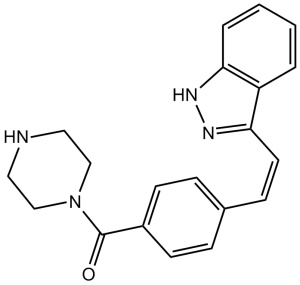
KW-2449 (KW2449) is a novel, potent, multiple-kinase (e.g. FLT3/Bcr-Abl/FGFR/Aurora) inhibitor with potential antitumor activity. It mostly inhibits Flt3 with an IC50 of 6.6 nM, and shows modest potency against FGFR1, Bcr-Abl and Aurora A. KW-2449 shows potent in vitro antiproliferative activity and high in vivo antitumor efficacy.
Physicochemical Properties
| Molecular Formula | C20H20N4O | |
| Molecular Weight | 332.4 | |
| Exact Mass | 332.163 | |
| CAS # | 1000669-72-6 | |
| Related CAS # |
|
|
| PubChem CID | 11427553 | |
| Appearance | White to light yellow solid powder | |
| Density | 1.3±0.1 g/cm3 | |
| Boiling Point | 604.1±55.0 °C at 760 mmHg | |
| Flash Point | 319.1±31.5 °C | |
| Vapour Pressure | 0.0±1.7 mmHg at 25°C | |
| Index of Refraction | 1.723 | |
| LogP | 2.07 | |
| Hydrogen Bond Donor Count | 2 | |
| Hydrogen Bond Acceptor Count | 3 | |
| Rotatable Bond Count | 3 | |
| Heavy Atom Count | 25 | |
| Complexity | 480 | |
| Defined Atom Stereocenter Count | 0 | |
| SMILES | C1CN(CCN1)C(=O)C2=CC=C(C=C2)/C=C/C3=NNC4=CC=CC=C43 |
|
| InChi Key | YYLKKYCXAOBSRM-JXMROGBWSA-N | |
| InChi Code | InChI=1S/C20H20N4O/c25-20(24-13-11-21-12-14-24)16-8-5-15(6-9-16)7-10-19-17-3-1-2-4-18(17)22-23-19/h1-10,21H,11-14H2,(H,22,23)/b10-7+ | |
| Chemical Name | (E)-(4-(2-(1H-indazol-3-yl)vinyl)phenyl)(piperazin-1-yl)methanone | |
| Synonyms | KW-2449; KW 2449; KW2449. | |
| HS Tariff Code | 2934.99.9001 | |
| Storage |
Powder-20°C 3 years 4°C 2 years In solvent -80°C 6 months -20°C 1 month |
|
| Shipping Condition | Room temperature (This product is stable at ambient temperature for a few days during ordinary shipping and time spent in Customs) |
Biological Activity
| ln Vitro | When FLT3/ITD, FLT3/D835Y, and wt-FLT3/FL are expressed in 32D cells, MOLM-13, and MV4;11, KW-2449 exhibits growth inhibitory activity. Its GI50 values are 0.024, 0.046, 0.014, 0.024, and 0.011 μM, in that order. In MOLM-13 cells, KW-2449 dose-dependently suppresses the phosphorylation of FLT3 (P-FLT3) and its downstream component, phosphorylated STAT5 (P-STAT5). The apoptotic cell population rises as a result of KW-2449's ability to raise the proportion of cells in the G1 phase and decrease the number of cells in the S phase of the cell cycle [1]. | ||
| ln Vivo | In a FLT3-mutated xenograft model, oral treatment of KW-2449 results in minimal suppression of the bone marrow while exhibiting dose-dependent and considerable tumor growth inhibition. It causes apoptosis, G2/M arrest, and a decrease in phosphorylated histone H3 in human leukemia of the FLT3 wild-type. By simultaneously down-regulating BCR/ABL and Aurora kinases, KW-2449 aids in the release of resistance in leukemia that is resistant to imatinib. Furthermore, initial samples from patients with AML and those who are resistant to imatinib demonstrate the antiproliferative effect of KW-2449. Human plasma protein, such as α1-acid glycoprotein, had no effect on KW-2449's inhibitory activity[1]. | ||
| Animal Protocol |
|
||
| References |
[1]. KW-2449, a novel multikinase inhibitor, suppresses the growth of leukemia cells with FLT3 mutations or T315I-mutated BCR/ABL translocation. Blood. 2009 Aug 20;114(8):1607-17. |
||
| Additional Infomation |
[4-[2-(1H-indazol-3-yl)ethenyl]phenyl]-(1-piperazinyl)methanone is a member of indazoles. FLT3/ABL/Aurora Kinase Inhibitor KW-2449 is an orally available inhibitor of FMS-related tyrosine kinase 3 (FLT3, STK1, or FLK2), the tyrosine kinase ABL, and aurora kinases, with potential antineoplastic activity. Upon administration, FLT3/ABL/Aurora kinase inhibitor KW-2449 specifically binds to and inhibits both wild-type and mutated forms of FLT3, ABL and aurora kinases, which both interferes with the activation of signal transduction pathways mediated by these kinases and reduces the proliferation of susceptible cancer cells. FLT3 and ABL kinases are upregulated in certain tumor cells and play important roles in tumor cell proliferation and metastasis. Aurora kinases, serine-threonine kinases overexpressed by a wide variety of cancer cell types, play essential roles in mitotic checkpoint control. |
Solubility Data
| Solubility (In Vitro) |
|
|||
| Solubility (In Vivo) |
Solubility in Formulation 1: ≥ 2.5 mg/mL (7.52 mM) (saturation unknown) in 10% DMSO + 40% PEG300 + 5% Tween80 + 45% Saline (add these co-solvents sequentially from left to right, and one by one), clear solution. For example, if 1 mL of working solution is to be prepared, you can add 100 μL of 25.0 mg/mL clear DMSO stock solution to 400 μL PEG300 and mix evenly; then add 50 μL Tween-80 to the above solution and mix evenly; then add 450 μL normal saline to adjust the volume to 1 mL. Preparation of saline: Dissolve 0.9 g of sodium chloride in 100 mL ddH₂ O to obtain a clear solution. Solubility in Formulation 2: ≥ 2.5 mg/mL (7.52 mM) (saturation unknown) in 10% DMSO + 90% (20% SBE-β-CD in Saline) (add these co-solvents sequentially from left to right, and one by one), clear solution. For example, if 1 mL of working solution is to be prepared, you can add 100 μL of 25.0 mg/mL clear DMSO stock solution to 900 μL of 20% SBE-β-CD physiological saline solution and mix evenly. Preparation of 20% SBE-β-CD in Saline (4°C,1 week): Dissolve 2 g SBE-β-CD in 10 mL saline to obtain a clear solution. Solubility in Formulation 3: ≥ 2.5 mg/mL (7.52 mM) (saturation unknown) in 10% DMSO + 90% Corn Oil (add these co-solvents sequentially from left to right, and one by one), clear solution. For example, if 1 mL of working solution is to be prepared, you can add 100 μL of 25.0 mg/mL clear DMSO stock solution to 900 μL of corn oil and mix evenly. Solubility in Formulation 4: 0.5% methylcellulose: 29mg/mL (Please use freshly prepared in vivo formulations for optimal results.) |
| Preparing Stock Solutions | 1 mg | 5 mg | 10 mg | |
| 1 mM | 3.0084 mL | 15.0421 mL | 30.0842 mL | |
| 5 mM | 0.6017 mL | 3.0084 mL | 6.0168 mL | |
| 10 mM | 0.3008 mL | 1.5042 mL | 3.0084 mL |