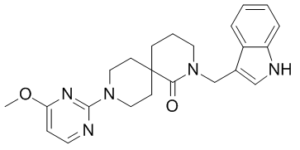
IPSU is a novel, potent, selective, orally bioavailable and brain penetrant orexin receptor (OX2R) antagonist with potential to be used for insomnia. It inhibits OX2R with a pKi of 7.85. IPSU binds quickly and reaches equilibrium in assays for binding and/or functionality very quickly. In general, IPSU has a slow rate of equilibrium convergence and a tendency to be relatively unselective in non-equilibrium situations. Every ligand exhibits a selectivity profile when equilibrium is reached, which differs from the non-equilibrium state. The 'dual' antagonists tested have slow kinetics, which implies that the duration of in vitro receptor occupancy might be longer than anticipated. This raises concerns about the accuracy of pharmacokinetic studies measuring these antagonists' brain or plasma levels as indicators of receptor occupancy in vivo.
Physicochemical Properties
| Molecular Formula | C23H27N5O2 | |
| Molecular Weight | 405.50 | |
| Exact Mass | 405.216 | |
| Elemental Analysis | C, 68.13; H, 6.71; N, 17.27; O, 7.89 | |
| CAS # | 1373765-19-5 | |
| Related CAS # |
|
|
| PubChem CID | 56970858 | |
| Appearance | White to off-white solid powder | |
| Density | 1.3±0.1 g/cm3 | |
| Boiling Point | 702.0±70.0 °C at 760 mmHg | |
| Flash Point | 378.4±35.7 °C | |
| Vapour Pressure | 0.0±2.2 mmHg at 25°C | |
| Index of Refraction | 1.674 | |
| LogP | 3.92 | |
| Hydrogen Bond Donor Count | 1 | |
| Hydrogen Bond Acceptor Count | 5 | |
| Rotatable Bond Count | 4 | |
| Heavy Atom Count | 30 | |
| Complexity | 608 | |
| Defined Atom Stereocenter Count | 0 | |
| SMILES | O=C1C2(C([H])([H])C([H])([H])N(C3=NC([H])=C([H])C(=N3)OC([H])([H])[H])C([H])([H])C2([H])[H])C([H])([H])C([H])([H])C([H])([H])N1C([H])([H])C1=C([H])N([H])C2=C([H])C([H])=C([H])C([H])=C12 |
|
| InChi Key | PCMHOSYCWRRHTG-UHFFFAOYSA-N | |
| InChi Code | InChI=1S/C23H27N5O2/c1-30-20-7-11-24-22(26-20)27-13-9-23(10-14-27)8-4-12-28(21(23)29)16-17-15-25-19-6-3-2-5-18(17)19/h2-3,5-7,11,15,25H,4,8-10,12-14,16H2,1H3 | |
| Chemical Name | 2-(1H-indol-3-ylmethyl)-9-(4-methoxypyrimidin-2-yl)-2,9-diazaspiro[5.5]undecan-1-one | |
| Synonyms | IPSU | |
| HS Tariff Code | 2934.99.9001 | |
| Storage |
Powder-20°C 3 years 4°C 2 years In solvent -80°C 6 months -20°C 1 month |
|
| Shipping Condition | Room temperature (This product is stable at ambient temperature for a few days during ordinary shipping and time spent in Customs) |
Biological Activity
| Targets | OX2R ( pKi = 7.85 ); OX1R ( pKi = 6.29 ) | |
| ln Vitro |
|
|
| ln Vivo |
|
|
| Enzyme Assay | One concentration of radioligand and six concentrations of competitors (unlabeled ligands such as BBAC, almorexant, SB-649868, suvorexant, filorexant, or IPSU) are used in competition experiments. Membranes (150 μL/well) are filled to capacity with 4.6 nM [3H]-BBAC and different concentrations of unlabeled ligand (0.1 nM–10 μM) in 50 μL/well of assay buffer, for a total volume of 250 μL/well. At room temperature, the amount of [3H]-BBAC bound to receptors is measured at various time intervals (from 15 min to 4 h), and the process is concluded by liquid scintillation counting and fast vacuum filtration[2]. | |
| Animal Protocol | Mice: C57Bl/6 mice that are allowed to roam freely and have permanent electrode implantations are accustomed to the experiment boxes and have unlimited access to food and drink. Just before lights out and recording begins, the test compounds (IPSU) or vehicle are given one at a time as a suspension in 0.5% methylcellulose. Infrared sensors installed in the box's roof record movement. To categorize 10 s epochs into wake, NREM sleep, and REM sleep, EEG/EMG signals and motility data are utilized. By applying and recording the vehicle the day before compound (IPSU) dosing, each animal acted as its own control[1]. | |
| References |
[1]. Identification of a novel series of orexin receptor antagonists with a distinct effect on sleeparchitecture for the treatment of insomnia. J Med Chem. 2013 Oct 10;56(19):7590-607. [2]. Kinetic properties of "dual" orexin receptor antagonists at OX1R and OX2R orexin receptors. Front Neurosci. 2013 Dec 3;7:230. [3]. Distinct effects of IPSU and suvorexant on mouse sleep architecture. |
Solubility Data
| Solubility (In Vitro) |
|
|||
| Solubility (In Vivo) |
Note: Listed below are some common formulations that may be used to formulate products with low water solubility (e.g. < 1 mg/mL), you may test these formulations using a minute amount of products to avoid loss of samples. Injection Formulations (e.g. IP/IV/IM/SC) Injection Formulation 1: DMSO : Tween 80: Saline = 10 : 5 : 85 (i.e. 100 μL DMSO stock solution → 50 μL Tween 80 → 850 μL Saline) *Preparation of saline: Dissolve 0.9 g of sodium chloride in 100 mL ddH ₂ O to obtain a clear solution. Injection Formulation 2: DMSO : PEG300 :Tween 80 : Saline = 10 : 40 : 5 : 45 (i.e. 100 μL DMSO → 400 μLPEG300 → 50 μL Tween 80 → 450 μL Saline) Injection Formulation 3: DMSO : Corn oil = 10 : 90 (i.e. 100 μL DMSO → 900 μL Corn oil) Example: Take the Injection Formulation 3 (DMSO : Corn oil = 10 : 90) as an example, if 1 mL of 2.5 mg/mL working solution is to be prepared, you can take 100 μL 25 mg/mL DMSO stock solution and add to 900 μL corn oil, mix well to obtain a clear or suspension solution (2.5 mg/mL, ready for use in animals). Injection Formulation 4: DMSO : 20% SBE-β-CD in saline = 10 : 90 [i.e. 100 μL DMSO → 900 μL (20% SBE-β-CD in saline)] *Preparation of 20% SBE-β-CD in Saline (4°C,1 week): Dissolve 2 g SBE-β-CD in 10 mL saline to obtain a clear solution. Injection Formulation 5: 2-Hydroxypropyl-β-cyclodextrin : Saline = 50 : 50 (i.e. 500 μL 2-Hydroxypropyl-β-cyclodextrin → 500 μL Saline) Injection Formulation 6: DMSO : PEG300 : castor oil : Saline = 5 : 10 : 20 : 65 (i.e. 50 μL DMSO → 100 μLPEG300 → 200 μL castor oil → 650 μL Saline) Injection Formulation 7: Ethanol : Cremophor : Saline = 10: 10 : 80 (i.e. 100 μL Ethanol → 100 μL Cremophor → 800 μL Saline) Injection Formulation 8: Dissolve in Cremophor/Ethanol (50 : 50), then diluted by Saline Injection Formulation 9: EtOH : Corn oil = 10 : 90 (i.e. 100 μL EtOH → 900 μL Corn oil) Injection Formulation 10: EtOH : PEG300:Tween 80 : Saline = 10 : 40 : 5 : 45 (i.e. 100 μL EtOH → 400 μLPEG300 → 50 μL Tween 80 → 450 μL Saline) Oral Formulations Oral Formulation 1: Suspend in 0.5% CMC Na (carboxymethylcellulose sodium) Oral Formulation 2: Suspend in 0.5% Carboxymethyl cellulose Example: Take the Oral Formulation 1 (Suspend in 0.5% CMC Na) as an example, if 100 mL of 2.5 mg/mL working solution is to be prepared, you can first prepare 0.5% CMC Na solution by measuring 0.5 g CMC Na and dissolve it in 100 mL ddH2O to obtain a clear solution; then add 250 mg of the product to 100 mL 0.5% CMC Na solution, to make the suspension solution (2.5 mg/mL, ready for use in animals). Oral Formulation 3: Dissolved in PEG400 Oral Formulation 4: Suspend in 0.2% Carboxymethyl cellulose Oral Formulation 5: Dissolve in 0.25% Tween 80 and 0.5% Carboxymethyl cellulose Oral Formulation 6: Mixing with food powders Note: Please be aware that the above formulations are for reference only. InvivoChem strongly recommends customers to read literature methods/protocols carefully before determining which formulation you should use for in vivo studies, as different compounds have different solubility properties and have to be formulated differently. (Please use freshly prepared in vivo formulations for optimal results.) |
| Preparing Stock Solutions | 1 mg | 5 mg | 10 mg | |
| 1 mM | 2.4661 mL | 12.3305 mL | 24.6609 mL | |
| 5 mM | 0.4932 mL | 2.4661 mL | 4.9322 mL | |
| 10 mM | 0.2466 mL | 1.2330 mL | 2.4661 mL |