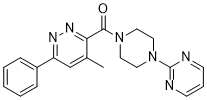
GIBH-130 is a neuroinflammation inhibitor. GIBH-130 exhibited comparable in vivo efficacy of cognitive impairment relief to donepezil and memantine respectively in both β amyloid-induced and APP/PS1 double transgenic Alzheimer's murine models at a substantially lower dose (0.25 mg/kg). Therefore, GIBH-130 constitutes a unique chemical probe for pathogenesis research and drug development of AD, and it also suggests microglia-based phenotypic screenings that target neuroinflammation as an effective and feasible strategy to identify novel anti-AD agents.
Physicochemical Properties
| Molecular Formula | C20H20N6O |
| Molecular Weight | 360.412403106689 |
| Exact Mass | 360.169 |
| CAS # | 1252608-59-5 |
| Related CAS # | 1252608-59-5 |
| PubChem CID | 50938773 |
| Appearance | Off-white to pink solid powder |
| LogP | 1.9 |
| Hydrogen Bond Donor Count | 0 |
| Hydrogen Bond Acceptor Count | 6 |
| Rotatable Bond Count | 3 |
| Heavy Atom Count | 27 |
| Complexity | 483 |
| Defined Atom Stereocenter Count | 0 |
| SMILES | C(C1=NN=C(C2=CC=CC=C2)C=C1C)(N1CCN(C2=NC=CC=N2)CC1)=O |
| InChi Key | ZTJHTEHADIHZJS-UHFFFAOYSA-N |
| InChi Code | InChI=1S/C20H20N6O/c1-15-14-17(16-6-3-2-4-7-16)23-24-18(15)19(27)25-10-12-26(13-11-25)20-21-8-5-9-22-20/h2-9,14H,10-13H2,1H3 |
| Chemical Name | (4-methyl-6-phenylpyridazin-3-yl)-(4-pyrimidin-2-ylpiperazin-1-yl)methanone |
| Synonyms | GIBH-130 GIBH 130 GIBH130. |
| HS Tariff Code | 2934.99.9001 |
| Storage |
Powder-20°C 3 years 4°C 2 years In solvent -80°C 6 months -20°C 1 month |
| Shipping Condition | Room temperature (This product is stable at ambient temperature for a few days during ordinary shipping and time spent in Customs) |
Biological Activity
| ln Vitro | GIBH-130 is a brand-new anti-inflammatory medication that was found using a phenotypic screen based on microglia. The screen revealed GIBH-130 (IC50 3.4 nM) as one of the most effective inhibitors with a reasonable half-life. The production of these lipopolysaccharide (LPS)-stimulated components was greatly reduced in microglia pretreated with GIBH-130; the extent of the reduction was dependent on the concentration of GIBH-130. GIBH-130's inhibitory concentrations against NO and TNF-α were 46.24 and 40.82 μM, respectively. Notably, activated microglia's release of IL-1β was markedly suppressed by GIBH-130 pretreatment (IC50=3.4 nM). 20 μM minocycline and 20 nM GIBH-130 both had similar inhibitory effects on the release of IL-1β. One of the primary cytokines in the development of AD neuroinflammation is IL-1β. Thus, it seems sense to discuss how GIBH-130 is more selective for IL-1β (IC50 value 3.4 nM) than for NO and TNF-α (IC50 values 46.24 and 40.82 μM, respectively) [1]. |
| ln Vivo | In mouse models of Alzheimer's disease caused by amyloid-β toxicity and APP/PS1 double-transgenic mice, GIBH-130 showed similar in vivo cognitive performance to donepezil and memantine, but at substantially lower doses (0.25 mg/kg), respectively. effects of removing obstacles. GIBH-130's pharmacokinetic characteristics were assessed in Sprague-Dawley rats. GIBH-130 is a prospective CNS-targeting drug candidate having an oral bioavailability of 74.91% and a half-life of 4.32 hours in rats. Furthermore, GIBH-130 exhibits good ability to penetrate the blood-brain barrier (AUCBrain/Plasma=0.21) [1]. |
| References |
[1]. Microglia-Based Phenotypic Screening Identifies a Novel Inhibitor of Neuroinflammation Effective in Alzheimer's Disease Models. ACS Chem Neurosci. 2016 Nov 16;7(11):1499-1507. |
Solubility Data
| Solubility (In Vitro) |
DMSO : ~50 mg/mL (~138.73 mM) H2O : < 0.1 mg/mL |
| Solubility (In Vivo) |
Solubility in Formulation 1: ≥ 2.5 mg/mL (6.94 mM) (saturation unknown) in 10% DMSO + 40% PEG300 + 5% Tween80 + 45% Saline (add these co-solvents sequentially from left to right, and one by one), clear solution. For example, if 1 mL of working solution is to be prepared, you can add 100 μL of 25.0 mg/mL clear DMSO stock solution to 400 μL PEG300 and mix evenly; then add 50 μL Tween-80 to the above solution and mix evenly; then add 450 μL normal saline to adjust the volume to 1 mL. Preparation of saline: Dissolve 0.9 g of sodium chloride in 100 mL ddH₂ O to obtain a clear solution. Solubility in Formulation 2: ≥ 2.5 mg/mL (6.94 mM) (saturation unknown) in 10% DMSO + 90% (20% SBE-β-CD in Saline) (add these co-solvents sequentially from left to right, and one by one), clear solution. For example, if 1 mL of working solution is to be prepared, you can add 100 μL of 25.0 mg/mL clear DMSO stock solution to 900 μL of 20% SBE-β-CD physiological saline solution and mix evenly. Preparation of 20% SBE-β-CD in Saline (4°C,1 week): Dissolve 2 g SBE-β-CD in 10 mL saline to obtain a clear solution. Solubility in Formulation 3: ≥ 2.5 mg/mL (6.94 mM) (saturation unknown) in 10% DMSO + 90% Corn Oil (add these co-solvents sequentially from left to right, and one by one), clear solution. For example, if 1 mL of working solution is to be prepared, you can add 100 μL of 25.0 mg/mL clear DMSO stock solution to 900 μL of corn oil and mix evenly. (Please use freshly prepared in vivo formulations for optimal results.) |
| Preparing Stock Solutions | 1 mg | 5 mg | 10 mg | |
| 1 mM | 2.7746 mL | 13.8731 mL | 27.7462 mL | |
| 5 mM | 0.5549 mL | 2.7746 mL | 5.5492 mL | |
| 10 mM | 0.2775 mL | 1.3873 mL | 2.7746 mL |