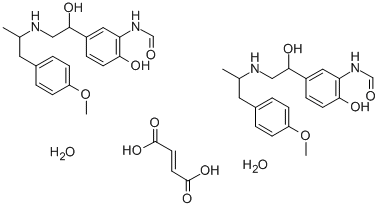
Formoterol fumarate dihydrate (also known as Foradil) is a long-acting β2 agonist (LABA) used in the treatment of asthma and COPD (chronic obstructive pulmonary disease). It is marketed in three forms: a dry-powder inhaler, a metered-dose inhaler and an inhalation solution, under various trade names including Atock, Atimos/Atimos Modulite, Foradil/Foradile, Oxeze/Oxis, and Perforomist. Mometasone/formoterol and Budesonide/formoterol combination formulations are also available for purchase. Unlike salbutamol (albuterol), which acts for 4 to 6 hours, formoterol acts for up to 12 hours. This is a longer duration of action than other short-acting β2 agonists. In addition to prophylactic corticosteroid therapy, LABAs like formoterol are used as "symptom controllers." When treating acute asthma, LABAs are not advised; instead, a "reliever" short-acting β2 agonist (such as salbutamol) is still needed.
Physicochemical Properties
| Molecular Formula | 2(C19H24N2O4).C4H4O4.2(H2O) |
| Molecular Weight | 496.51 |
| Exact Mass | 840.379 |
| CAS # | 183814-30-4 |
| Related CAS # | Formoterol fumarate; 43229-80-7 |
| PubChem CID | 60196271 |
| Appearance | White to off-white solid powder |
| Boiling Point | 603.2ºC at 760 mmHg |
| Melting Point | 116-120ºC |
| Flash Point | 318.6ºC |
| Vapour Pressure | 2.12E-15mmHg at 25°C |
| LogP | 6.229 |
| Hydrogen Bond Donor Count | 12 |
| Hydrogen Bond Acceptor Count | 16 |
| Rotatable Bond Count | 18 |
| Heavy Atom Count | 60 |
| Complexity | 507 |
| Defined Atom Stereocenter Count | 4 |
| SMILES | C[C@H](NC[C@@H](O)C1=CC(NC=O)=C(O)C=C1)CC2=CC=C(OC)C=C2.C[C@H](NC[C@@H](O)C1=CC(NC=O)=C(O)C=C1)CC2=CC=C(OC)C=C2.O=C(O)/C=C/C(O)=O.O.O |
| InChi Key | RATSWNOMCHFQGJ-XODSYJLDSA-N |
| InChi Code | InChI=1S/2C19H24N2O4.C4H4O4.2H2O/c2*1-13(9-14-3-6-16(25-2)7-4-14)20-11-19(24)15-5-8-18(23)17(10-15)21-12-22;5-3(6)1-2-4(7)8;;/h2*3-8,10,12-13,19-20,23-24H,9,11H2,1-2H3,(H,21,22);1-2H,(H,5,6)(H,7,8);2*1H2/b;;2-1+;; |
| Chemical Name | (E)-but-2-enedioic acid;N-[2-hydroxy-5-[1-hydroxy-2-[1-(4-methoxyphenyl)propan-2-ylamino]ethyl]phenyl]formamide;dihydrate |
| Synonyms | (-)-Formoterol; Arformoterol; (R,R)-Formoterol; Formoterol; arformoterol; (R,R)-Formoterol; BD 40A; eformoterol; Foradil; formoterol fumarate; Trade names: Atock; Atimos/Atimos Modulite; Foradil/Foradile; Oxeze/Oxis; Perforomist |
| HS Tariff Code | 2934.99.9001 |
| Storage |
Powder-20°C 3 years 4°C 2 years In solvent -80°C 6 months -20°C 1 month |
| Shipping Condition | Room temperature (This product is stable at ambient temperature for a few days during ordinary shipping and time spent in Customs) |
Biological Activity
| ln Vitro |
|
||
| ln Vivo |
|
||
| Enzyme Assay | Formoterol((also known as arformoterol) exhibits great potential as a β2-agonist that may provide desired metabolic effects with its unique and highly β2-selective adrenergic agonist properties. | ||
| Animal Protocol |
|
||
| References |
[1]. Am J Respir Cell Mol Biol. 2011 Jul; 45(1): 88–94. Published online 2010 Sep 20. [2]. BMC Pediatr . 2012 Mar 7:12:21. |
||
| Additional Infomation |
Formoterol Fumarate is the fumarate salt form of formoterol, a long-acting and selective sympathomimetic beta-receptor agonist with bronchodilator activity. Formoterol fumarate binds beta 2 adrenergic receptors in bronchial smooth muscle and stimulates intracellular adenyl cyclase, thereby increasing the production of cyclic adenosine monophosphate (cAMP). Increased cAMP levels cause relaxation of bronchial smooth muscle, improve mucociliary clearance and reduce mediator substance release in inflammatory cells, especially from mast cells. (NCI05) An ADRENERGIC BETA-2 RECEPTOR AGONIST with a prolonged duration of action. It is used to manage ASTHMA and in the treatment of CHRONIC OBSTRUCTIVE PULMONARY DISEASE. See also: Formoterol Fumarate (annotation moved to). |
Solubility Data
| Solubility (In Vitro) |
|
|||
| Solubility (In Vivo) |
Note: Listed below are some common formulations that may be used to formulate products with low water solubility (e.g. < 1 mg/mL), you may test these formulations using a minute amount of products to avoid loss of samples. Injection Formulations (e.g. IP/IV/IM/SC) Injection Formulation 1: DMSO : Tween 80: Saline = 10 : 5 : 85 (i.e. 100 μL DMSO stock solution → 50 μL Tween 80 → 850 μL Saline) *Preparation of saline: Dissolve 0.9 g of sodium chloride in 100 mL ddH ₂ O to obtain a clear solution. Injection Formulation 2: DMSO : PEG300 :Tween 80 : Saline = 10 : 40 : 5 : 45 (i.e. 100 μL DMSO → 400 μLPEG300 → 50 μL Tween 80 → 450 μL Saline) Injection Formulation 3: DMSO : Corn oil = 10 : 90 (i.e. 100 μL DMSO → 900 μL Corn oil) Example: Take the Injection Formulation 3 (DMSO : Corn oil = 10 : 90) as an example, if 1 mL of 2.5 mg/mL working solution is to be prepared, you can take 100 μL 25 mg/mL DMSO stock solution and add to 900 μL corn oil, mix well to obtain a clear or suspension solution (2.5 mg/mL, ready for use in animals). Injection Formulation 4: DMSO : 20% SBE-β-CD in saline = 10 : 90 [i.e. 100 μL DMSO → 900 μL (20% SBE-β-CD in saline)] *Preparation of 20% SBE-β-CD in Saline (4°C,1 week): Dissolve 2 g SBE-β-CD in 10 mL saline to obtain a clear solution. Injection Formulation 5: 2-Hydroxypropyl-β-cyclodextrin : Saline = 50 : 50 (i.e. 500 μL 2-Hydroxypropyl-β-cyclodextrin → 500 μL Saline) Injection Formulation 6: DMSO : PEG300 : castor oil : Saline = 5 : 10 : 20 : 65 (i.e. 50 μL DMSO → 100 μLPEG300 → 200 μL castor oil → 650 μL Saline) Injection Formulation 7: Ethanol : Cremophor : Saline = 10: 10 : 80 (i.e. 100 μL Ethanol → 100 μL Cremophor → 800 μL Saline) Injection Formulation 8: Dissolve in Cremophor/Ethanol (50 : 50), then diluted by Saline Injection Formulation 9: EtOH : Corn oil = 10 : 90 (i.e. 100 μL EtOH → 900 μL Corn oil) Injection Formulation 10: EtOH : PEG300:Tween 80 : Saline = 10 : 40 : 5 : 45 (i.e. 100 μL EtOH → 400 μLPEG300 → 50 μL Tween 80 → 450 μL Saline) Oral Formulations Oral Formulation 1: Suspend in 0.5% CMC Na (carboxymethylcellulose sodium) Oral Formulation 2: Suspend in 0.5% Carboxymethyl cellulose Example: Take the Oral Formulation 1 (Suspend in 0.5% CMC Na) as an example, if 100 mL of 2.5 mg/mL working solution is to be prepared, you can first prepare 0.5% CMC Na solution by measuring 0.5 g CMC Na and dissolve it in 100 mL ddH2O to obtain a clear solution; then add 250 mg of the product to 100 mL 0.5% CMC Na solution, to make the suspension solution (2.5 mg/mL, ready for use in animals). Oral Formulation 3: Dissolved in PEG400 Oral Formulation 4: Suspend in 0.2% Carboxymethyl cellulose Oral Formulation 5: Dissolve in 0.25% Tween 80 and 0.5% Carboxymethyl cellulose Oral Formulation 6: Mixing with food powders Note: Please be aware that the above formulations are for reference only. InvivoChem strongly recommends customers to read literature methods/protocols carefully before determining which formulation you should use for in vivo studies, as different compounds have different solubility properties and have to be formulated differently. (Please use freshly prepared in vivo formulations for optimal results.) |
| Preparing Stock Solutions | 1 mg | 5 mg | 10 mg | |
| 1 mM | 2.0141 mL | 10.0703 mL | 20.1406 mL | |
| 5 mM | 0.4028 mL | 2.0141 mL | 4.0281 mL | |
| 10 mM | 0.2014 mL | 1.0070 mL | 2.0141 mL |