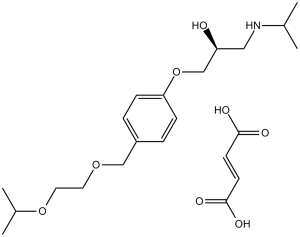
Physicochemical Properties
| Molecular Formula | C22H35NO8 |
| Molecular Weight | 441.515207529068 |
| Exact Mass | 441.236 |
| CAS # | 105878-43-1 |
| Related CAS # | Bisoprolol hemifumarate;104344-23-2;Bisoprolol-d5 hemifumarate;Bisoprolol;66722-44-9 |
| PubChem CID | 6917733 |
| Appearance | Typically exists as solid at room temperature |
| Hydrogen Bond Donor Count | 4 |
| Hydrogen Bond Acceptor Count | 9 |
| Rotatable Bond Count | 14 |
| Heavy Atom Count | 31 |
| Complexity | 397 |
| Defined Atom Stereocenter Count | 0 |
| SMILES | CC(C)NCC(COC1=CC=C(C=C1)COCCOC(C)C)O.C(=C/C(=O)O)\C(=O)O |
| InChi Key | RZPZLFIUFMNCLY-WLHGVMLRSA-N |
| InChi Code | InChI=1S/C18H31NO4.C4H4O4/c1-14(2)19-11-17(20)13-23-18-7-5-16(6-8-18)12-21-9-10-22-15(3)4;5-3(6)1-2-4(7)8/h5-8,14-15,17,19-20H,9-13H2,1-4H3;1-2H,(H,5,6)(H,7,8)/b;2-1+ |
| Chemical Name | (E)-but-2-enedioic acid;1-(propan-2-ylamino)-3-[4-(2-propan-2-yloxyethoxymethyl)phenoxy]propan-2-ol |
| HS Tariff Code | 2934.99.9001 |
| Storage |
Powder-20°C 3 years 4°C 2 years In solvent -80°C 6 months -20°C 1 month |
| Shipping Condition | Room temperature (This product is stable at ambient temperature for a few days during ordinary shipping and time spent in Customs) |
Biological Activity
| ln Vitro | Ischemia/reperfusion (I/R) injury is prevented in cardiomyocytes (H9c2) by bisoprolol fumarate (2 μM, 1 hour) [2]. In H9c2 cells, bisoprolol fumarate (2 μM, 1 h) can lessen ROS production and apoptosis brought on by H/R [2]. In H9c2 cells, bisoprolol fumarate (2 μM, 1 hour) raises AKT and GSK3β phosphorylation [2]. By increasing β-arrestin 2, CCR7, and PI3K phosphorylation, bisoprolol fumarate (100 μM, 24 hours) reverses the effects of epinephrine-inhibited migration in cholesterol-loaded DCs (dendritic cells) [3]. Determination of cell viability [2] |
| ln Vivo | Bisoprolol fumarate lowers heart rate and raises left ventricular ejection fraction (LVEF) when taken orally for one week at a dose of 5 mg/kg [2]. Administering bisoprolol fumarate orally (daily, 8 mg/kg) for four weeks has been shown to protect rats from cadmium-induced cardiotoxicity [4]. In a rat model of volume overload, bisoprolol fumarate (oral gavage, 1 mg/kg daily for 6 weeks) reverses small-conductance calcium-activated potassium channel (SK) remodeling [5]. |
| Cell Assay |
Cell viability determination [2] Cell Types: H9c2 Cell Tested Concentrations: 0.2, 2, 20 μM Incubation Duration: 1 h Experimental Results: H/R (hypoxia/reoxygenation) cardiomyocyte survival rate increased to 73.20%, 90.38%, 81.25% respectively. Cell migration assay [3] Cell Types: DC Tested Concentrations: 100 μM Incubation Duration: 6, 12, 24 hrs (hours) Experimental Results: The number of migrating cells increased by 46.00% (6 hrs (hours)), 64.25% (12 hrs (hours)), and 55.74% (24 H). |
| Animal Protocol |
Animal/Disease Models: ischemia/reperfusion (I/R) injury in rats [2] Doses: 0.5, 5, 10 mg/kg Route of Administration: Oral administration for 1 week, after 0.5 hrs (hrs (hours)) of ischemia/4 hrs (hrs (hours)) of re-injury before perfusion. Experimental Results: Infarct size diminished from 44% in the I/R group to 31% in the treatment group. Animal/Disease Models: Cadmium-induced rats [4] Doses: 2, 8 mg/kg Route of Administration: po (oral gavage), one time/day for four weeks. Experimental Results: Mean arterial pressure (MAP) diminished to 8 mg/kg. Serum biomarkers (ALT, AST) and NF-kB p65 expression as well as TNF-α levels (cardiac tissue samples) were diminished at 8 mg/kg. |
| References |
[1]. The selectivity of beta-adrenoceptor antagonists at the human beta1, beta2 and beta3 adrenoceptors. Br J Pharmacol. 2005 Feb;144(3):317-22. [2]. Bisoprolol, a β 1 antagonist, protects myocardial cells from ischemia-reperfusion injury via PI3K/AKT/GSK3β pathway. Fundam Clin Pharmacol. 2020 Dec;34(6):708-720. [3]. Bisoprolol reverses epinephrine-mediated inhibition of cell emigration through increases in the expression of β-arrestin 2 and CCR7 and PI3K phosphorylation, in dendritic cells loaded with cholesterol. Thromb Res. 2013 Mar;131(3):230-7. [4]. Protective Effects of Bisoprolol Against Cadmium-induced Myocardial Toxicity Through Inhibition of Oxidative Stress and NF-κΒ Signalling in Rats. J Vet Res. 2021 Oct 20;65(4):505-511. [5]. Bisoprolol reversed small conductance calcium-activated potassium channel (SK) remodeling in a volume-overload rat model. Mol Cell Biochem. 2013 Dec;384(1-2):95-103. |
| Additional Infomation |
Bisoprolol Fumarate is the fumarate salt of a synthetic phenoxy-2-propanol-derived cardioselective beta-1 adrenergic receptor antagonist with antihypertensive and potential cardioprotective activities. Devoid of intrinsic sympathomimetic activity, bisoprolol selectively and competitively binds to and blocks beta-1 adrenergic receptors in the heart, decreasing cardiac contractility and rate, reducing cardiac output, and lowering blood pressure. In addition, this agent may exhibit antihypertensive activity through the inhibition of renin secretion by juxtaglomerular epithelioid (JGE) cells in the kidney, thus inhibiting activation of the renin-angiotensin system (RAS). Bisoprolol has been shown to be cardioprotective in animal models. A cardioselective beta-1 adrenergic blocker. It is effective in the management of HYPERTENSION and ANGINA PECTORIS. See also: Bisoprolol (annotation moved to); Bisoprolol Fumarate (annotation moved to). |
Solubility Data
| Solubility (In Vitro) | May dissolve in DMSO (in most cases), if not, try other solvents such as H2O, Ethanol, or DMF with a minute amount of products to avoid loss of samples |
| Solubility (In Vivo) |
Note: Listed below are some common formulations that may be used to formulate products with low water solubility (e.g. < 1 mg/mL), you may test these formulations using a minute amount of products to avoid loss of samples. Injection Formulations (e.g. IP/IV/IM/SC) Injection Formulation 1: DMSO : Tween 80: Saline = 10 : 5 : 85 (i.e. 100 μL DMSO stock solution → 50 μL Tween 80 → 850 μL Saline) *Preparation of saline: Dissolve 0.9 g of sodium chloride in 100 mL ddH ₂ O to obtain a clear solution. Injection Formulation 2: DMSO : PEG300 :Tween 80 : Saline = 10 : 40 : 5 : 45 (i.e. 100 μL DMSO → 400 μLPEG300 → 50 μL Tween 80 → 450 μL Saline) Injection Formulation 3: DMSO : Corn oil = 10 : 90 (i.e. 100 μL DMSO → 900 μL Corn oil) Example: Take the Injection Formulation 3 (DMSO : Corn oil = 10 : 90) as an example, if 1 mL of 2.5 mg/mL working solution is to be prepared, you can take 100 μL 25 mg/mL DMSO stock solution and add to 900 μL corn oil, mix well to obtain a clear or suspension solution (2.5 mg/mL, ready for use in animals). Injection Formulation 4: DMSO : 20% SBE-β-CD in saline = 10 : 90 [i.e. 100 μL DMSO → 900 μL (20% SBE-β-CD in saline)] *Preparation of 20% SBE-β-CD in Saline (4°C,1 week): Dissolve 2 g SBE-β-CD in 10 mL saline to obtain a clear solution. Injection Formulation 5: 2-Hydroxypropyl-β-cyclodextrin : Saline = 50 : 50 (i.e. 500 μL 2-Hydroxypropyl-β-cyclodextrin → 500 μL Saline) Injection Formulation 6: DMSO : PEG300 : castor oil : Saline = 5 : 10 : 20 : 65 (i.e. 50 μL DMSO → 100 μLPEG300 → 200 μL castor oil → 650 μL Saline) Injection Formulation 7: Ethanol : Cremophor : Saline = 10: 10 : 80 (i.e. 100 μL Ethanol → 100 μL Cremophor → 800 μL Saline) Injection Formulation 8: Dissolve in Cremophor/Ethanol (50 : 50), then diluted by Saline Injection Formulation 9: EtOH : Corn oil = 10 : 90 (i.e. 100 μL EtOH → 900 μL Corn oil) Injection Formulation 10: EtOH : PEG300:Tween 80 : Saline = 10 : 40 : 5 : 45 (i.e. 100 μL EtOH → 400 μLPEG300 → 50 μL Tween 80 → 450 μL Saline) Oral Formulations Oral Formulation 1: Suspend in 0.5% CMC Na (carboxymethylcellulose sodium) Oral Formulation 2: Suspend in 0.5% Carboxymethyl cellulose Example: Take the Oral Formulation 1 (Suspend in 0.5% CMC Na) as an example, if 100 mL of 2.5 mg/mL working solution is to be prepared, you can first prepare 0.5% CMC Na solution by measuring 0.5 g CMC Na and dissolve it in 100 mL ddH2O to obtain a clear solution; then add 250 mg of the product to 100 mL 0.5% CMC Na solution, to make the suspension solution (2.5 mg/mL, ready for use in animals). Oral Formulation 3: Dissolved in PEG400 Oral Formulation 4: Suspend in 0.2% Carboxymethyl cellulose Oral Formulation 5: Dissolve in 0.25% Tween 80 and 0.5% Carboxymethyl cellulose Oral Formulation 6: Mixing with food powders Note: Please be aware that the above formulations are for reference only. InvivoChem strongly recommends customers to read literature methods/protocols carefully before determining which formulation you should use for in vivo studies, as different compounds have different solubility properties and have to be formulated differently. (Please use freshly prepared in vivo formulations for optimal results.) |
| Preparing Stock Solutions | 1 mg | 5 mg | 10 mg | |
| 1 mM | 2.2649 mL | 11.3245 mL | 22.6490 mL | |
| 5 mM | 0.4530 mL | 2.2649 mL | 4.5298 mL | |
| 10 mM | 0.2265 mL | 1.1325 mL | 2.2649 mL |