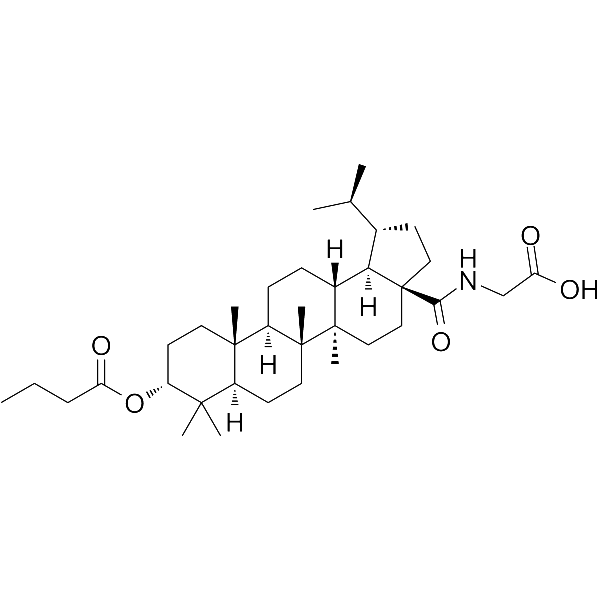
Physicochemical Properties
| Molecular Weight | 585.86 |
| Exact Mass | 585.439 |
| CAS # | 2295804-68-9 |
| PubChem CID | 168277605 |
| Appearance | White to off-white solid powder |
| LogP | 9 |
| Hydrogen Bond Donor Count | 2 |
| Hydrogen Bond Acceptor Count | 5 |
| Rotatable Bond Count | 8 |
| Heavy Atom Count | 42 |
| Complexity | 1080 |
| Defined Atom Stereocenter Count | 10 |
| SMILES | C(=O)(CNC([C@@]12CC[C@]3(C)[C@@]([H])([C@]1([C@H](C(C)C)CC2)[H])CC[C@@]1([C@@]2([C@@]([H])(CC[C@]13C)C(C)([C@H](OC(=O)CCC)CC2)C)C)[H])=O)O |
| InChi Key | CLKCLHBPLVDIOB-VCXUAKCGSA-N |
| InChi Code | InChI=1S/C36H59NO5/c1-9-10-29(40)42-27-15-16-33(6)25(32(27,4)5)14-17-35(8)26(33)12-11-24-30-23(22(2)3)13-18-36(30,20-19-34(24,35)7)31(41)37-21-28(38)39/h22-27,30H,9-21H2,1-8H3,(H,37,41)(H,38,39)/t23-,24+,25-,26+,27+,30+,33-,34+,35+,36-/m0/s1 |
| Chemical Name | 2-[[(1S,3aS,5aR,5bR,7aR,9R,11aR,11bR,13aR,13bR)-9-butanoyloxy-5a,5b,8,8,11a-pentamethyl-1-propan-2-yl-1,2,3,4,5,6,7,7a,9,10,11,11b,12,13,13a,13b-hexadecahydrocyclopenta[a]chrysene-3a-carbonyl]amino]acetic acid |
| HS Tariff Code | 2934.99.9001 |
| Storage |
Powder-20°C 3 years 4°C 2 years In solvent -80°C 6 months -20°C 1 month |
| Shipping Condition | Room temperature (This product is stable at ambient temperature for a few days during ordinary shipping and time spent in Customs) |
Biological Activity
| Targets | FXR 2.1 μM (IC50) |
| ln Vitro | In HEK293T cells, FXR antagonist 1 (0-100 µM; 24 h) exhibits FXR antagonistic activities[1]. |
| ln Vivo | In GAN-diet-induced NASH mice, FXR antagonist 1 (10 mg/kg; po; once daily for 12 weeks) decreases obesity, enhances glucose sensitivity, and slows the advancement of NASH[1]. In GAN-diet-induced mice, FXR antagonist 1 (10 mg/kg; po; once daily for 12 weeks) suppresses intestinal FXR signaling but indirectly increases hepatic FXR signaling[1]. In rats put on an HFMCD diet, FXR antagonist 1 (3, 10, 30 mg/kg; po; once daily for 4 weeks) reduces NASH pathologies in a dose-dependent manner[1]. |
| Cell Assay |
Cell Viability Assay[1] Cell Types: HEK293T cells (co-transfected with pCMV-Script-hFXR and pGL4.11-hSHP -Luciferase) Tested Concentrations: 0-100 µM Incubation Duration: 24 h Experimental Results: demonstrated FXR antagonistic activities with an IC50 value of 2.1 μM. |
| Animal Protocol |
Animal/Disease Models: Adult male C57BL/6 mice (GAN (Gubra-amylin NASH)-diet induced NASH model)[1]. Doses: 10 mg/kg Route of Administration: Oral administration; single daily for 12 weeks. Experimental Results: Reversed metabolic dysfunction in GAN-induced NASH mice. decreased GAN-diet-induced hepatic steatosis, injury, inflammation, and fibrosis. Inhibited the hepatic mRNA expression involved in lipid metabolism, inflammatory inflammation signaling, and fibrogenesis in GAN-diet-induced mice. Dramatically antagonized intestinal FXR signaling and bile acid reabsorption. Animal/Disease Models: Adult male C57BL/6 mice (HFMCD-diet induced NASH model)[1]. Doses: 3, 10, 30 mg/kg Route of Administration: Oral administration; single daily for 4 weeks. Experimental Results: Dramatically diminished serum ALT and AST levels at 30 mg/kg, and markedly lowered the hepatic TG concentration in both 10 and 30 mg/kg. Lowered hepatic hydroxyproline level. |
| References |
[1]. Discovery of Betulinic Acid Derivatives as Potent Intestinal Farnesoid X Receptor Antagonists to Ameliorate Nonalcoholic Steatohepatitis. J Med Chem. 2022 Sep 15. |
Solubility Data
| Solubility (In Vivo) |
Note: Listed below are some common formulations that may be used to formulate products with low water solubility (e.g. < 1 mg/mL), you may test these formulations using a minute amount of products to avoid loss of samples. Injection Formulations (e.g. IP/IV/IM/SC) Injection Formulation 1: DMSO : Tween 80: Saline = 10 : 5 : 85 (i.e. 100 μL DMSO stock solution → 50 μL Tween 80 → 850 μL Saline) *Preparation of saline: Dissolve 0.9 g of sodium chloride in 100 mL ddH ₂ O to obtain a clear solution. Injection Formulation 2: DMSO : PEG300 :Tween 80 : Saline = 10 : 40 : 5 : 45 (i.e. 100 μL DMSO → 400 μLPEG300 → 50 μL Tween 80 → 450 μL Saline) Injection Formulation 3: DMSO : Corn oil = 10 : 90 (i.e. 100 μL DMSO → 900 μL Corn oil) Example: Take the Injection Formulation 3 (DMSO : Corn oil = 10 : 90) as an example, if 1 mL of 2.5 mg/mL working solution is to be prepared, you can take 100 μL 25 mg/mL DMSO stock solution and add to 900 μL corn oil, mix well to obtain a clear or suspension solution (2.5 mg/mL, ready for use in animals). Injection Formulation 4: DMSO : 20% SBE-β-CD in saline = 10 : 90 [i.e. 100 μL DMSO → 900 μL (20% SBE-β-CD in saline)] *Preparation of 20% SBE-β-CD in Saline (4°C,1 week): Dissolve 2 g SBE-β-CD in 10 mL saline to obtain a clear solution. Injection Formulation 5: 2-Hydroxypropyl-β-cyclodextrin : Saline = 50 : 50 (i.e. 500 μL 2-Hydroxypropyl-β-cyclodextrin → 500 μL Saline) Injection Formulation 6: DMSO : PEG300 : castor oil : Saline = 5 : 10 : 20 : 65 (i.e. 50 μL DMSO → 100 μLPEG300 → 200 μL castor oil → 650 μL Saline) Injection Formulation 7: Ethanol : Cremophor : Saline = 10: 10 : 80 (i.e. 100 μL Ethanol → 100 μL Cremophor → 800 μL Saline) Injection Formulation 8: Dissolve in Cremophor/Ethanol (50 : 50), then diluted by Saline Injection Formulation 9: EtOH : Corn oil = 10 : 90 (i.e. 100 μL EtOH → 900 μL Corn oil) Injection Formulation 10: EtOH : PEG300:Tween 80 : Saline = 10 : 40 : 5 : 45 (i.e. 100 μL EtOH → 400 μLPEG300 → 50 μL Tween 80 → 450 μL Saline) Oral Formulations Oral Formulation 1: Suspend in 0.5% CMC Na (carboxymethylcellulose sodium) Oral Formulation 2: Suspend in 0.5% Carboxymethyl cellulose Example: Take the Oral Formulation 1 (Suspend in 0.5% CMC Na) as an example, if 100 mL of 2.5 mg/mL working solution is to be prepared, you can first prepare 0.5% CMC Na solution by measuring 0.5 g CMC Na and dissolve it in 100 mL ddH2O to obtain a clear solution; then add 250 mg of the product to 100 mL 0.5% CMC Na solution, to make the suspension solution (2.5 mg/mL, ready for use in animals). Oral Formulation 3: Dissolved in PEG400 Oral Formulation 4: Suspend in 0.2% Carboxymethyl cellulose Oral Formulation 5: Dissolve in 0.25% Tween 80 and 0.5% Carboxymethyl cellulose Oral Formulation 6: Mixing with food powders Note: Please be aware that the above formulations are for reference only. InvivoChem strongly recommends customers to read literature methods/protocols carefully before determining which formulation you should use for in vivo studies, as different compounds have different solubility properties and have to be formulated differently. (Please use freshly prepared in vivo formulations for optimal results.) |
| Preparing Stock Solutions | 1 mg | 5 mg | 10 mg | |
| 1 mM | 1.7069 mL | 8.5345 mL | 17.0689 mL | |
| 5 mM | 0.3414 mL | 1.7069 mL | 3.4138 mL | |
| 10 mM | 0.1707 mL | 0.8534 mL | 1.7069 mL |